Trump's Fresh Fed Attack Revives 'Sell America' Market Fears
Former US President Donald Trump's renewed criticism of the Federal Reserve has sparked fresh worries in financial markets. Strategists and market experts now warn that the growing tension between the government and the central bank could deepen a market selloff over time.
Market Sentiment Turns Cautious
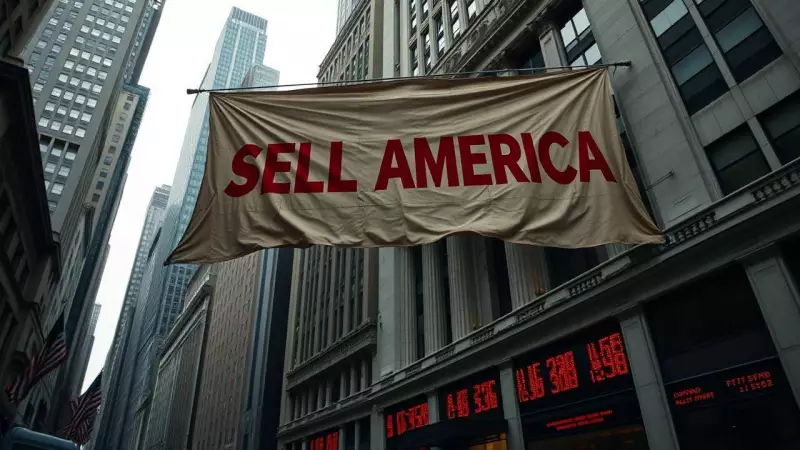
Investor sentiment turned cautious on Monday as the 'Sell America' narrative gained traction. This followed intensified criticism of the Federal Reserve by the Trump administration. The renewed focus has revived concerns about the central bank's independence in setting interest rates.
The dollar, Treasury bonds, and US equity futures all edged lower. Although these moves remained modest, they clearly unsettled investors. The broader implications for financial markets became a central concern.

What's Behind the Tension?
Federal Reserve Chair Jerome Powell revealed on Sunday evening that the central bank received grand jury subpoenas from the Justice Department. These subpoenas link to his testimony before Congress regarding renovation work at the Fed's headquarters.
This episode marks another flashpoint in a series of confrontations. Previous conflicts included attempts to remove Governor Lisa Cook and repeated demands for sharp interest rate cuts.
Trump has consistently urged the Federal Reserve to reduce interest rates more aggressively. He believes this would stimulate growth and lower government borrowing costs. In contrast, Fed policymakers have maintained a cautious stance, citing inflation risks as their primary concern.
Speaking to NBC News on Sunday, Trump claimed he was unaware of any Justice Department investigation involving the Federal Reserve.
Analyst Perspectives on the Investigation
Hebe Chen, senior market analyst at Vantage Global Prime Pty., offered her assessment. She said the investigation involving Powell currently appears to be "more smoke than fire." However, she cautioned that its durability remains uncertain.
"The longer-term and more deeply embedded consequences could be far more significant," Chen added, highlighting potential future implications.
Why Markets Remain Wary
At the heart of investor unease lies a fundamental question. To what extent can, or should, a US president exert influence over monetary policy? This area has largely remained shielded from political intervention for decades.
The situation has revived questions about whether global investors should scale back exposure to US assets and the dollar. These concerns echo worries that swept markets last April after President Donald Trump announced blanket tariffs.
Gary Tan, portfolio manager at Allspring Global Investments, explained the market perspective. "Any development that raises questions about the Fed's independence adds uncertainty around US monetary policy," he said. His firm manages more than $600 billion in assets according to a Bloomberg report.
"This is likely to reinforce existing trends of diversification away from the dollar," Tan continued. "It will also increase interest in traditional hedges such as gold."
Market Strategists Issue Warnings
According to Bloomberg, Ian Lyngen of BMO Capital Markets wrote a revealing note. He stated that characterizing these events as putting Fed independence discussions into uncharted waters would be an understatement. His team remains skewed toward higher yields in the near-term.
Market strategists cautioned that the recent decline could intensify if political and policy frictions worsen. Several major financial institutions highlighted specific risks.
JPMorgan Asset Management noted the possibility of a sharper steepening in the US Treasury yield curve. This scenario would see longer-dated yields rise faster than short-term rates, driven by expectations of deeper interest-rate cuts.
Lombard Odier warned that both the dollar and Treasuries could face sustained pressure. Meanwhile, Invesco Asset Management observed that assets outside the US appear relatively more attractive. This includes European and Asian equities.

Bhanu Baweja, chief strategist at UBS Investment Bank, offered a sobering perspective. "This is a bad time to be worrying about Fed independence for the market," he said. Baweja added that US inflation is expected to pick up in the months ahead.
"The one common theme for this year seems to be not just a weaker dollar, but equity volume going higher," he told Bloomberg.
The 'Sell America' Theme Returns
Gerald Gan, chief investment officer at Singapore-based Reed Capital Partners, identified a concerning trend. He said the latest developments risk reviving the "Sell America" theme.
Gan suggested the situation reflects an administration intent on rebuilding public support ahead of midterm elections. He believes this push might come at the cost of weakening institutional credibility.
US financial assets have faced similar pressure before. Last year, markets experienced significant jolts after President Donald Trump unexpectedly unveiled sweeping global tariffs. That move triggered sharp volatility across multiple asset classes.
David Chao, global market strategist at Invesco Asset Management, connected current events to broader trends. The subpoena involving the Federal Reserve adds to concerns that US assets are losing appeal, he explained. Invesco manages over $2 trillion in assets.
Chao argued that the US is not only retreating behind what he described as "Fortress America" policies. The country is also adopting a more aggressive stance that unsettles investors globally.
Calls for Restraint Amid Uncertainty
Some analysts urged restraint despite the growing concerns. They noted several factors that could limit market downside and even create buying opportunities.
The dollar maintains its entrenched status as the world's primary reserve currency. The Treasury market offers exceptional depth and liquidity. Additionally, artificial intelligence-driven momentum continues to support equities.
Marvin Loh, senior macro strategist at State Street in Boston, offered a measured perspective. "Independence is always a concern," he acknowledged. "But we will monitor developments and respond once the economic implications become clearer."
Even with these stabilizing factors, pressure linked to the 'Sell America' narrative appears unlikely to fade quickly. Market participants continue watching developments closely as political tensions persist.