

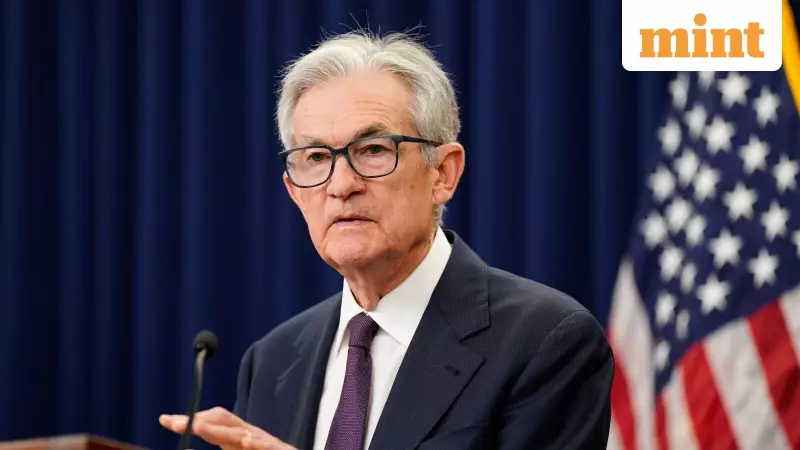
US Federal Reserve Maintains Status Quo on Policy Rates as Expected
In a move that was widely anticipated by financial markets globally, the United States Federal Open Market Committee (FOMC) decided on January 28 to keep policy rates unchanged. This decision follows three consecutive rate cuts implemented during the policy meetings held in September, October, and December of the previous year. The Committee has opted to maintain the target range for the federal funds rate at 3.5% to 3.75%, which represents the lowest level observed since 2022.
Economic Assessment Behind the Fed's Decision
The Federal Reserve's choice to hold rates steady comes after reducing the federal funds rate by a cumulative 0.75 percentage points throughout 2025. This pause is grounded in the Committee's evaluation of current economic conditions, which it describes as "expanding at a solid pace." Federal Reserve Chair Jerome Powell elaborated on this assessment, stating, "Available indicators suggest that economic activity has been expanding at a solid pace. Consumer spending has been resilient, and business fixed investment has continued to expand. In contrast, activity in the housing sector has remained weak."
However, the FOMC also highlighted certain areas of concern within the economy. The Committee noted that "job gains have remained low, and the unemployment rate has shown some signs of stabilisation. Inflation remains somewhat elevated." These mixed signals contribute to the cautious approach adopted by the central bank in its latest policy meeting.

Limited Impact on Indian Stock Market Anticipated
Financial experts and market analysts in India have largely downplayed the immediate implications of the Fed's decision on domestic equity markets. According to VK Vijayakumar, Chief Investment Strategist at Geojit Investments Limited, "The market had already discounted this status quo on policy rates. The policy decision is unlikely to affect the Indian stock market. A 25 basis points rate cut would have given a mild boost to the market." This sentiment reflects the prevailing expectation among market participants, which had already factored in the likelihood of unchanged rates.
Manoranjan Sharma, Chief Economist at Infomerics Ratings, provided further insight into the potential macroeconomic effects. He noted, "A hold reinforces 'higher-for-longer' stance, keeping US yields high and the dollar firm. Flows to emerging markets stay selective, limiting upside for India. The rupee may see mild pressure, with RBI intervening only to smooth volatility. Equities are likely neutral to mildly negative, with rate-sensitive sectors pausing. Bond yields have limited downside; long-duration bonds may underperform." This analysis suggests that while the decision may strengthen the US dollar and slightly pressure the Indian rupee, the overall impact on equities is expected to be minimal.
Domestic Factors Take Precedence Over Fed Policy
G Chokkalingam, founder and head of research at Equinomics Research Private Limited, emphasized that the Fed's policy decision holds little significance for the Indian market at present. He stated, "The Fed's policy decision doesn't matter for India at all. The market is more focused on other issues, such as corporate earnings, the retail liquidity crunch, the FII selling, and the India-US trade deal." According to Chokkalingam, even a hypothetical 25 basis points rate cut by the Fed would not have constituted a major event for domestic market dynamics.
The attention of Indian investors and policymakers appears to be shifting towards potential bilateral trade agreements, particularly following the finalization of the India-EU free trade agreement. Chokkalingam pointed out, "The US Fed issue is suppressed now. The priority is more for the US trade move rather than the Fed move, as it may stabilise the rupee exchange rate, because when the rupee is weak, the Fed rate cut will not induce more debt inflow from the US to India. The rupee's weakness can be arrested if the tariff issue gets resolved between India and the US." An India-US trade deal is anticipated to bolster the rupee's strength and potentially attract foreign institutional investments back into Indian markets.

In summary, while the US Federal Reserve's decision to maintain interest rates aligns with global expectations, its direct impact on Indian financial markets is projected to be negligible. Market participants are advised to monitor domestic economic indicators, corporate performance, and developments in international trade negotiations, as these factors are likely to exert greater influence on market trajectories in the near term.





