

US Stocks Edge Lower as Asian Rally Momentum Fades on Wall Street
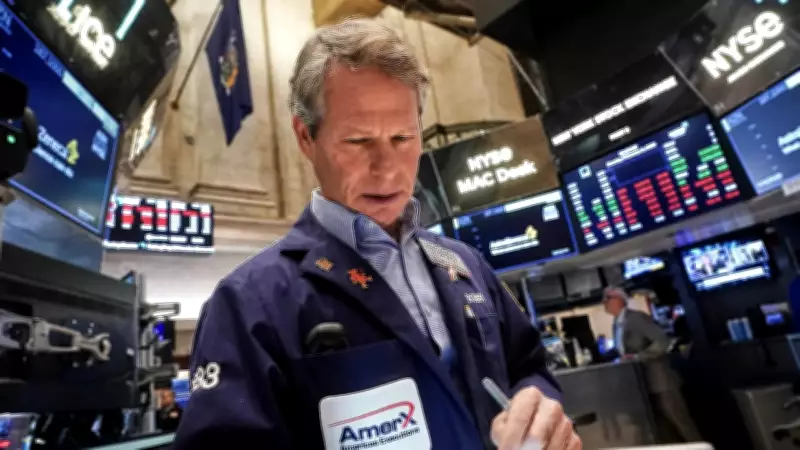
US stock markets opened the week on a softer note on Monday, with major indices retreating as the powerful momentum from a robust global rally that originated in Asian trading sessions dissipated by the time activity reached Wall Street. The early decline marked a pause following Friday's significant surge, which had been the best trading session since May.
Market Performance and Key Movements
The benchmark S&P 500 index slipped 0.2 percent in early trading. The Dow Jones Industrial Average fell 62 points, equivalent to 0.1 percent, as of 9:35 a.m. Eastern time. Meanwhile, the technology-heavy Nasdaq Composite experienced a more pronounced decline of 0.4 percent. This subdued start contrasted sharply with the explosive performance witnessed earlier in Asian markets.
In Asia, Japan's Nikkei 225 index jumped an impressive 3.9 percent to reach a record high. This surge followed the ruling party's landslide victory in parliamentary elections, with investors anticipating that the political outcome would strengthen Prime Minister Sanae Takaichi's capacity to implement substantial economic and market reforms. Other Asian markets followed suit, with South Korea's Kospi surging 4.1 percent, Hong Kong rising 1.8 percent, and Shanghai gaining 1.4 percent.

Underlying Concerns and Investor Sentiment
Despite the recent rally, persistent concerns continue to hover over Wall Street. The S&P 500 remains trading near its all-time high established last month, raising questions about stretched valuations. Furthermore, investors are increasingly scrutinizing whether the massive spending by Big Tech companies and other corporations on artificial intelligence initiatives will generate sufficient profits to justify the enormous scale of these investments.
Market participants are also closely monitoring key economic indicators scheduled for release later in the week. The monthly jobs data on Wednesday and consumer inflation figures on Friday are expected to significantly shape expectations regarding the Federal Reserve's interest rate outlook. The central bank has currently paused its rate-cutting cycle, but a weakening labor market could accelerate easing measures, while persistently high inflation might delay further rate reductions.
Notable Stock Movements and Corporate Developments
Several individual stocks experienced significant movements based on corporate announcements:
- Kroger gained 6.1 percent after appointing a former Walmart executive as its new chief executive officer.
- Workday fell 5.9 percent following the announcement that CEO Carl Eschenbach would step down, with co-founder Aneel Bhusri set to return to the leadership role.
- Transocean slipped 1 percent after revealing plans to acquire Valaris in an all-stock deal valued at $5.8 billion. In contrast, Valaris shares surged 22.3 percent on the news.
Commodity and Cryptocurrency Markets
Volatility across other asset classes showed signs of easing after recent sharp fluctuations. Bitcoin slipped below $69,000 after briefly crossing the $71,000 threshold over the weekend. This represents a recovery from last week's drop to near $60,000, though it remains more than halfway below its record high reached in October.
In precious metals, gold rose 1.2 percent to move back above $5,000 per ounce, continuing its pattern of sharp price swings after roughly doubling over the past year. Silver also advanced 3 percent, extending its volatile trading pattern that has characterized recent sessions.
Bond Markets and Global Context
In bond markets, US Treasury yields remained largely steady ahead of the crucial economic data releases. The yield on the 10-year Treasury held steady at 4.22 percent, reflecting cautious investor positioning. European markets presented a mixed picture, trading with modest movements that contrasted with the stronger performances seen in Asian counterparts.

The global financial landscape thus presented a tale of two hemispheres on Monday: explosive gains in Asia driven by political developments and reform expectations, contrasted with a more measured and cautious approach on Wall Street as investors weighed valuation concerns, technological investment returns, and upcoming economic indicators that could influence monetary policy decisions in the coming months.





