

US Stocks Tumble as Iran Deadline Looms, Sparking Investor Anxiety
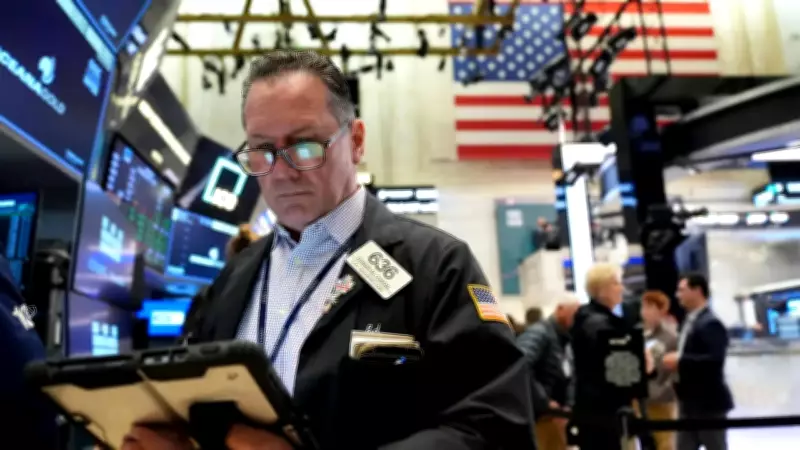
US equities experienced a significant downturn on Tuesday, with investors adopting a cautious stance in anticipation of President Donald Trump's deadline for Iran to reopen the Strait of Hormuz. The escalating tensions in the Middle East fueled concerns that the conflict could intensify, putting markets on edge and triggering a broad sell-off across major indexes.
Markets Monitor War Rhetoric Ahead of Critical Deadline
The decline unfolded as market participants closely tracked developments in the Iran conflict, with Trump's Tuesday deadline for Tehran to reopen the vital Strait of Hormuz heightening uncertainty. A US official confirmed that Washington had targeted military sites on Iran's Kharg Island, a crucial hub for Iranian oil exports. In response, Iran warned it would no longer refrain from attacking infrastructure in Gulf states and indicated the Bab el-Mandeb waterway could also be shut if the crisis worsens. Trump escalated the situation on social media, stating, "a whole civilization will die tonight" if Iran fails to comply.
David Waddell, chief investment strategist at Waddell & Associates, noted, "The markets are taking it in stride because they've learned not to over-index Trump's threats, recognizing it's probably more negotiation than reality." However, Chris Zaccarelli, chief investment officer for Northlight Asset Management, added, "What you're seeing with the market reaction is an acknowledgement that an end is not necessarily as close as people had hoped. The conflict is more likely to continue with these attacks or increasing rhetoric from both sides ... that puts traders back in an uneasy position and expecting a more worse outcome in terms of continuation."

Technology Sector Drags, Energy Rises Amid Sectoral Divergence
Technology shares were the primary drag on Wall Street, with the S&P 500 information technology index falling 1.7 per cent. Apple dropped 3.8 per cent, becoming the heaviest weight on all three major indexes. In contrast, some chip stocks provided support: Broadcom rose 3 per cent after signing a long-term agreement with Alphabet's Google to develop AI chips and other components, while Intel gained 2.2 per cent upon announcing its participation in Elon Musk's Terafab AI chip complex project alongside SpaceX, Tesla, and xAI.
Energy stocks moved in the opposite direction, with the S&P 500 energy index climbing 1.8 per cent as oil prices surged sharply. Benchmark US crude jumped 3.9 per cent to $116.83 a barrel, and Brent crude rose 0.7 per cent to $110.55, levels well above the approximately $70 seen before the war began in late February. The Iran conflict has complicated the Federal Reserve's interest rate outlook, as elevated oil prices risk reigniting inflation despite a resilient US labour market.
Health Insurers Cushion Losses After Medicare Advantage Payment Hike
Losses on the Dow were partially offset by gains in health insurers following a US government move to increase payments for Medicare Advantage plans. UnitedHealth surged 7.7 per cent, Humana climbed 4.5 per cent, and CVS Health gained 3.7 per cent after the announcement on Monday that payments to private insurers offering these plans for older adults would be raised more than the near-flat change initially proposed. The Centers for Medicare and Medicaid Services indicated Medicare Advantage payments are likely to see a net average increase of 2.48 per cent in 2027, a figure UBS analysts described as stronger than many investors had anticipated.
Volatility Expected to Persist as Investors Await Clarity
Tuesday's decline followed a positive Monday session, where Wall Street's main indexes closed higher, marking a fourth consecutive day of gains for the S&P 500 and Nasdaq as investors positioned for the upcoming earnings season. However, optimism faded as the deadline approached, reintroducing uncertainty. Paul Christopher, head of global investment strategy at Wells Fargo Investment Institute, stated, "Investors are likely to remain on edge and markets unable to establish trends, probably until there is a clear outcome later this evening: a deal, the US/Israeli strikes intensify, or Iran's retaliation becomes escalatory instead of proportional."

Market breadth reflected the nervous sentiment, with declining stocks outnumbering gainers by a 2.42-to-1 ratio on the NYSE and 3.08-to-1 on the Nasdaq. The S&P 500 recorded no new 52-week highs and four new lows, while the Nasdaq logged 26 new highs and 63 new lows. Investors are also monitoring fresh inflation readings and comments from Federal Reserve officials Austan Goolsbee, Philip Jefferson, and Mary Daly later in the day for insights into the policy path.
At 10:08 am ET, the Dow Jones Industrial Average was down 408.87 points, or 0.88 per cent, at 46,261.01, the S&P 500 had fallen 66.46 points, or 0.99 per cent, to 6,546.61, and the Nasdaq Composite was lower by 326.15 points, or 1.45 per cent, at 21,677.16.





