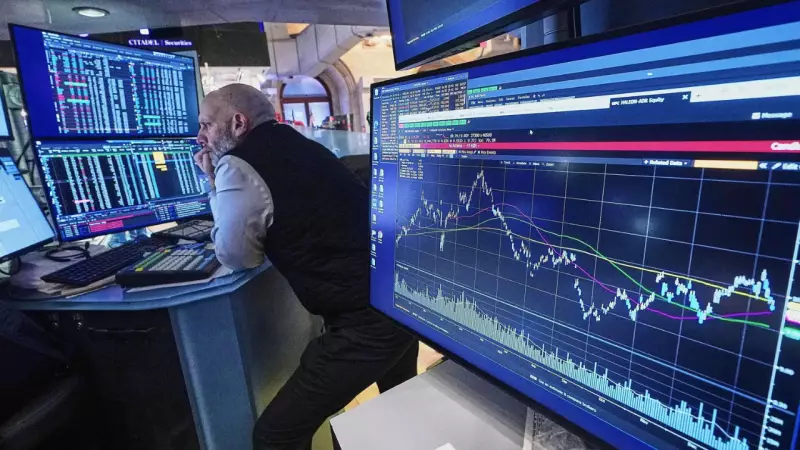
US stocks started Friday's trading session on a positive note. Wall Street remained near its record highs as the first week of the quarterly earnings season came to a close. Selective bank results and a recovery in oil prices helped lift market sentiment.
Early Trading Shows Gains Across Major Indices
In early trade, the S&P 500 index rose by 0.3 percent. The Dow Jones Industrial Average added 116 points, which translates to a gain of 0.2 percent. Meanwhile, the Nasdaq composite advanced by 0.4 percent, according to AP reports.
Bank Earnings Drive Market Movements
Market focus stayed firmly on earnings updates from regional banks. This followed a mixed set of results from larger financial institutions earlier in the week. PNC Financial Services saw its stock jump after it beat Wall Street's fourth-quarter expectations. In contrast, Regions Financial slipped after missing forecasts.

Among individual stocks, PNC surged 3.2 percent. The bank reported stronger-than-expected quarterly results, aided by higher interest income and fee growth. M&T Bank rose 1 percent after also topping analyst estimates. However, transport firm J.B. Hunt fell nearly 4 percent. This decline came despite the company beating profit expectations, as it was weighed down by a drop in fourth-quarter revenue.
Commodities and Bond Market Activity
Crude oil prices gained about 1 percent. This recovery came after a sharp decline in the previous session. Treasury yields edged higher in the bond market, reflecting ongoing adjustments.
Ahead of the opening bell, US futures had signaled modest gains. S&P 500 futures were up 0.2 percent. Nasdaq futures rose 0.5 percent, while Dow futures remained largely flat.
Investor Focus Shifts to Tech and AI
As earnings season gathers pace, investor attention is expected to shift toward technology and artificial intelligence-linked companies. Ipek Ozkardeskaya of Swissquote highlighted this trend.
"As we dive into the heart of earnings season in the coming weeks, tech results will be scrutinized in far greater detail," Ozkardeskaya said. She added, "Concerns around circular AI deals, leverage and delayed returns on investment remain front of mind for investors. These worries are compounded by rising electricity and metals costs, higher memory-chip prices, and the risk of supply disruptions."
Global Market Performance
In overseas markets, European indices showed a mixed picture. Germany's DAX was down 0.3 percent. France's CAC 40 fell by 0.8 percent, while Britain's FTSE 100 remained flat.
Asian markets mostly advanced. Taiwan led the gains, with shares jumping nearly 2 percent. This surge followed the island's signing of a trade deal with the US. The agreement lowers tariffs on Taiwanese goods to 15 percent. In exchange, Taiwan will make $250 billion in new investments in the US technology sector. China protested the agreement, reiterating its claim over Taiwan.
Japan's Nikkei 225 slipped 0.3 percent. Hong Kong's Hang Seng fell 0.3 percent, and the Shanghai Composite declined 0.3 percent. South Korea's Kospi rose 0.9 percent to a record high. Renewed optimism in AI-related stocks supported this gain, with Samsung Electronics climbing 3.5 percent.
Commodities and Geopolitical Factors
In commodities, US crude rose 87 cents to $59.95 a barrel. Brent crude climbed 93 cents to $64.69. Oil prices had fallen sharply on Thursday. This drop came after US President Donald Trump said he had heard "on good authority" that plans for executions in Iran had been halted amid widespread protests.
Markets interpreted Trump's comments as a signal. They suggested that geopolitical tensions around major oil-producing regions could ease. This perception reduced the perceived risk of supply disruptions.
Other Global Markets
India's Sensex rose 0.2 percent. Australia's S&P/ASX 200 gained 0.5 percent.
China is set to release its 2025 economic growth data on Monday. Forecasts point to an expansion of around 4.5 percent. This rate is slower than earlier in the year.