

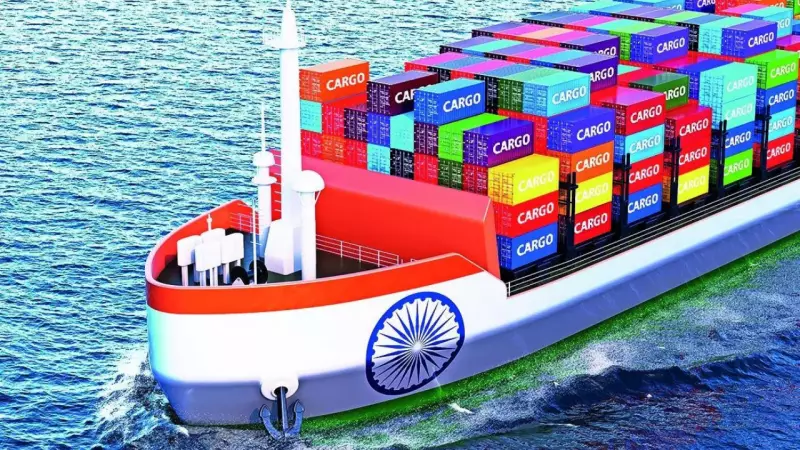
In a significant move to bolster India's export sector, the government on Wednesday launched a substantial financial support initiative. The newly operationalised Market Access Support (MAS) scheme, with a total outlay of ₹4,531 crore, is designed to empower Indian exporters by facilitating their participation in key international business events.
A Strategic Response to Global Trade Challenges
The launch comes at a crucial time when Indian shipments are navigating headwinds, including steep tariffs imposed by major markets like the United States. The MAS scheme is the first component to go live under the larger ₹25,060-crore export promotion mission approved by the Cabinet in November. According to Director General of Foreign Trade, Ajay Badhoo, the remaining components of this comprehensive mission are slated for rollout by the end of January 2025.
The financial allocation spans a six-year period from 2025 to 2031. For the initial partial year of 2025-26, ₹500 crore has been earmarked. A portion of this, ₹330 crore, will be utilised to clear pending dues from the earlier Market Access Initiative (MAI) scheme, which functioned independently until the last financial year.

How the MAS Scheme Will Work for Exporters
The scheme provides structured financial and institutional backing for a range of market-access activities. These include participation in international trade fairs and exhibitions, organising Buyer-Seller Meets (BSMs), and hosting Mega Reverse Buyer-Seller Meets (RBSMs) within India. The government has set clear financial caps for support:
- Assistance for BSMs is capped at ₹5 crore per event.
- Support for RBSMs can go up to ₹10 crore.
- For trade delegations, the limit is ₹5 crore.
For each approved event, the government will shoulder 60% of the cost, with the participating private sector entities covering the remaining 40%. In identified priority sectors, the government's contribution can increase to a substantial 80%. In a major push for small businesses, 35% of participation slots in BSMs and trade delegations have been reserved for micro, small, and medium enterprises (MSMEs).
Focus on Priority Sectors and Future-Proofing
The government has identified several priority sectors that will receive heightened focus under the MAS. These encompass traditional and emerging areas alike:
- Agriculture & allied industries, Handicrafts, Handlooms, Leather, Sports Goods
- Telecom, Defence, Tourism, Medical, Logistics
- Legal, Audio-visual, Communications, Construction, and Environment-related services
Addressing the needs of innovative industries, a new component for proofs-of-concept and product demonstrations to overseas buyers will be notified shortly. This addition, particularly aimed at technology-intensive and sunrise sectors, was introduced following requests from the Ministries of Telecom, IT, and Electronics.
To ensure effectiveness and continuous improvement, the scheme mandates an online feedback mechanism for exporters after each supported event. They will provide inputs on buyer quality, business leads generated, and market relevance. Badhoo stated that the MAS guidelines will be progressively refined based on this feedback and implementation experience.
Further, a forward-looking three-to-five-year calendar of major market access events will be prepared and approved in advance. This will allow exporters and organising agencies to plan their participation well ahead of time, ensuring strategic and sustained market development efforts.

The Bigger Picture: Niryat Protsahan and Niryat Disha
The overarching export promotion mission comprises two broad components: Niryat Protsahan and Niryat Disha. Of the total ₹25,060 crore outlay, ₹10,401 crore is allocated for Niryat Protsahan and ₹14,659 crore for Niryat Disha. While MAS falls under the mission's umbrella, Niryat Protsahan specifically focuses on reducing the cost of credit for exporters. It includes measures like interest subvention for MSME exporters—expected to cost about ₹5,000 crore—along with collateral guarantees, export factoring support, and credit enhancement facilities.
The push for exports is showing positive early signs. India's exports rebounded sharply by 19.37% to $38.13 billion in November 2024, a six-month high, after a contraction in October. This surge, driven by engineering and electronics goods, helped narrow the trade deficit to a five-month low of $24.53 billion. The MAS scheme aims to build on this momentum, providing Indian businesses with the tools and financial support to compete and thrive on the global stage.





