The Apparel Export Promotion Council (AEPC) on Sunday called upon the newly appointed Chief Minister of Tamil Nadu, C Joseph Vijay, to provide strong policy support for the global branding of 'Made in Tirupur' and to establish a state-level apparel and textile development board.
AEPC's Representation to the New Chief Minister
Welcoming Vijay as the new Chief Minister, AEPC submitted a detailed representation seeking robust policy measures to help Tamil Nadu's apparel industry achieve a target of Rs 1 lakh crore by 2030. The industrial body emphasized that the apparel and readymade garment sector is one of the strongest pillars of Tamil Nadu's economy.
Tirupur's Dominance in Knitwear Exports
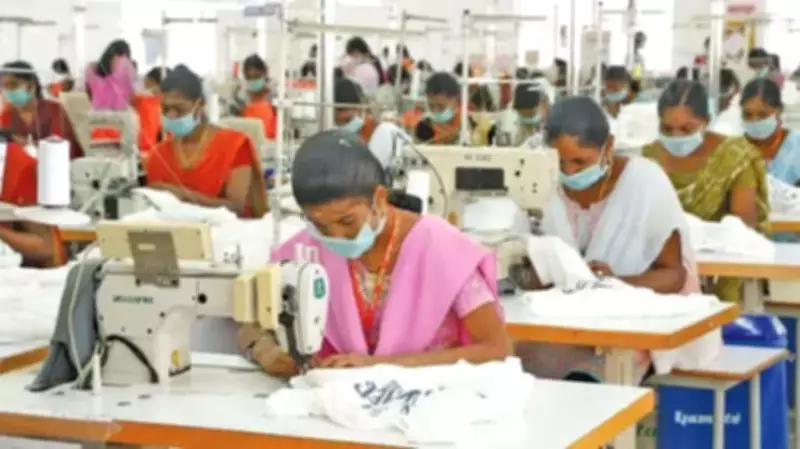
Tirupur alone accounts for nearly 68% of India's knitwear exports, generating business worth over Rs 70,000 crore annually in both domestic and global markets. The industry provides direct employment to more than 10 lakh workers, with nearly 65% being women, making it one of the largest women-centric industries in the state. The sector is predominantly MSME-driven, with around 90% of units falling under the micro, small, and medium enterprise category.

Opportunities from Free Trade Agreements
With India signing free trade agreements with 37 countries, AEPC noted that the coming decade offers significant export opportunities. This positions Tamil Nadu to emerge as a global hub for sustainable textile and apparel manufacturing. To capitalize on this, AEPC urged the TVK-led state government to fast-track affordable rental housing for garment workers, reclassify worker hostels under residential electricity tariffs, and promote working women through safe transport and welfare measures.
Financial and Infrastructure Demands
The council also sought a 50% capital subsidy for worker hostel construction, along with interest subvention for the remaining project cost, especially given the sector's heavy reliance on migrant and women workers. Additionally, AEPC requested dedicated financial support for export-oriented MSMEs, including better access to working capital, interest subvention, and capital subsidies for modernization, automation, and technology adoption.
Infrastructure improvements were also highlighted, including better road and rail connectivity to Thoothukudi and Chennai ports, promotion of multimodal logistics, competitive industrial power tariffs, encouragement of renewable energy use, and support for zero liquid discharge systems, common effluent treatment plants, and sustainable manufacturing initiatives.
Simplified Compliance and Global Branding
AEPC called for simplified regulatory compliance for MSMEs, international buyer-seller meets in Tirupur, stronger global branding for 'Made in Tirupur', and the launch of a Tirupur Knitwear Development Mission through structured government-industry engagement.
The Tirupur Exporters Association also congratulated the new Chief Minister and ministers, seeking infrastructure development to strengthen Tirupur's role as a specialized export city and sustain its global competitiveness.