

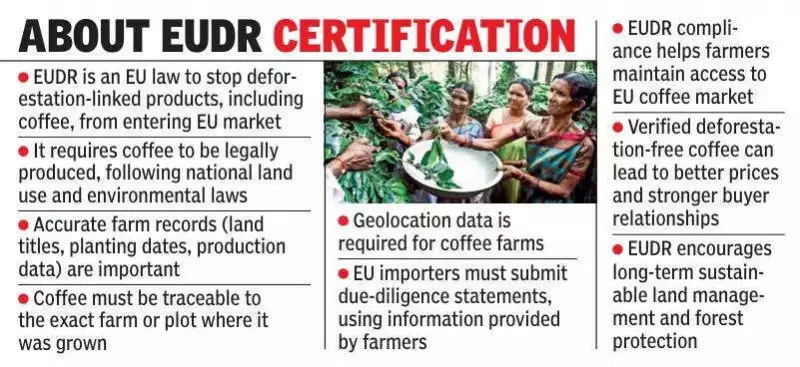
In a significant boost for India's coffee sector, thousands of farmers cultivating the renowned Araku coffee in the Visakhapatnam district are poised to obtain the coveted European Union Deforestation Regulation (EUDR) certification. This strategic move is expected to unlock premium pricing and stronger demand from environmentally conscious European consumers and roasters.
Driving Compliance and Market Access
The initiative is being spearheaded by the Visakhapatnam District Entrepreneurship Mission (VDEM) in partnership with the Ratan Tata Innovation Hub (RTIH) of the Andhra Pradesh government. They are working under the umbrella of the Global Alliance for Mass Entrepreneurship (Game) to facilitate the complex certification process for local farmers.
The ambitious plan targets bringing approximately 15,000 coffee growers on board in the coming months. The drive has already gained momentum, with registrations completed for around 2,600 farmers against this goal. The EUDR is a stringent regulation that mandates commodities like coffee, cocoa, and palm oil imported into or traded within the European Union to be deforestation-free and produced legally.

Ravi Venkatesan, founder and chairman of Game, highlighted the scale of the opportunity. He noted that coffee in the Araku region is cultivated by over one lakh farmers across nearly two lakh acres, yielding an annual production of about 90,000 tonnes of coffee cherry. "A large number of farmers in the Agency area are expected to benefit from EUDR compliance over time," said Venkatesan, who is also the former chairman of Microsoft India.
How Certification Benefits Farmers and Buyers
Under the EUDR, companies must submit due diligence statements confirming their products are traceable to the origin and grown on land that has not been deforested. "By verifying land records to ensure coffee is grown without deforestation, farmers can access premium markets while buyers gain confidence in sourcing certified produce," Venkatesan explained.
The Coffee Board of India is playing a crucial supporting role by facilitating registration and compliance through its dedicated India Coffee mobile application. Ketul Acharya, president of Game, outlined the division of responsibilities: "While Coffee Board manages registration and certification, Game is responsible for awareness creation, training, documentation and mobilisation. We have targeted to register about 15,000 farmers by March."
Beyond Coffee: A Holistic Entrepreneurship Push
The coffee certification project is one of six pilot initiatives currently being implemented by VDEM in collaboration with RTIH. This broader effort aims to ignite a mass entrepreneurship movement, particularly in rural and tribal areas of the district.
Other key pilots include:
- Export Enablement: Focusing on helping Farmer Producer Organisations (FPOs) export coffee, turmeric, and millets.
- Livelihood Support for Fisherwomen: Providing thermal insulated boxes, portable cold chain solutions, and solar driers to reduce post-harvest losses.
- Food Processing Cluster: Establishing dedicated infrastructure for value addition.
- Vegetable Clusters: Developing polyhouse-based cultivation with assured buyback arrangements for farmers, including exotic vegetables.
- Structured MSME Mentorship: A one-year programme to help small enterprises overcome growth stagnation through training and peer learning.
An MSME open platform has also been created, hosting open forums every Wednesday at RTIH-Visakhapatnam where businesses of all sizes can discuss policy, training, and challenges.
Eco-Tourism: Showcasing Tribal Life
Another innovative pilot is a community-based eco-tourism initiative, already launched in Killoguda panchayat and proposed for expansion. Ravi Eswarapu, CEO of RTIH, described the model where entire hamlets participate through homestays, guiding, cooking, and logistics. The initiative offers tourists a complete experiential package from Vizag airport to Araku, encompassing travel, homestays, local food, and deep insights into tribal lifestyles and organic living.

This multi-pronged approach by VDEM and RTIH represents a comprehensive strategy to bolster rural economies, ensure sustainable agricultural practices, and connect local producers directly with lucrative global markets, setting a benchmark for tribal-led entrepreneurship in India.





