

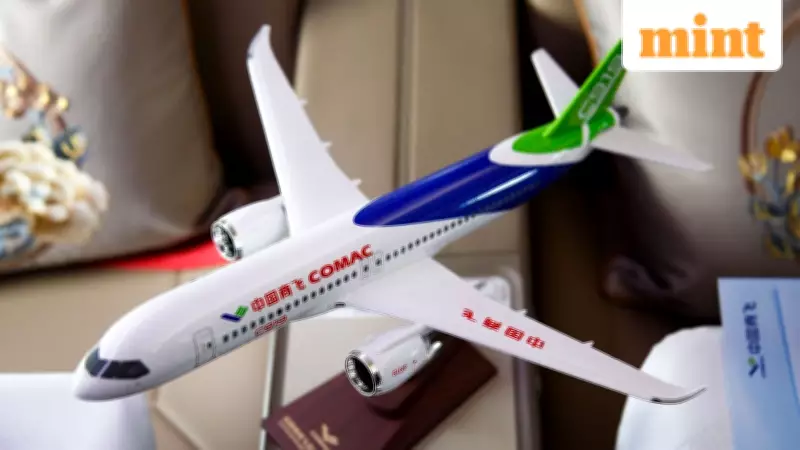
China's Comac Seeks to Challenge Airbus and Boeing in Global Aviation Market
China's ambitious state-owned aerospace manufacturer, Comac, is making strategic moves to position itself as a credible challenger to the long-standing duopoly of Airbus and Boeing in the global commercial aviation industry. While the company has begun exporting smaller aircraft to Southeast Asian markets, significant obstacles including supply-chain bottlenecks, ongoing trade conflicts, and stringent certification requirements raise critical questions about its ability to truly disrupt the established order.
The Incremental Expansion Beyond Chinese Borders
Comac, headquartered in Shanghai, has traditionally served domestic Chinese airlines as its primary customer base. However, the company is now actively burnishing its international reputation through exports of the C909, a single-aisle regional jet with capacity for 97 passengers. This represents a calculated, incremental step in Comac's global strategy, with industry analysts projecting that even by 2030, the Chinese manufacturer will remain substantially smaller than its Western counterparts.
The recent Singapore Airshow provided a platform for Comac to showcase its growing capabilities. The company displayed its flagship C919 model, which can accommodate up to 192 passengers, alongside two C909 regional jets. This demonstration underscores Comac's commitment to establishing itself as a viable alternative in the commercial aircraft market.

International Partnerships and Testing Grounds
Indonesian airline PT TransNusa Aviation Mandiri has emerged as a crucial international partner for Comac, becoming the manufacturer's first foreign customer. TransNusa's vice-chairman, Leo Budiman, expressed satisfaction with the C909's performance and indicated interest in potentially ordering dozens of the larger C919 models to replace some Airbus A320neo aircraft in their fleet.
Although TransNusa currently operates more Airbus planes than Comac aircraft, their three-year experience flying the C909 has provided valuable real-world testing data for the Chinese manufacturer. This partnership, facilitated by China Aircraft Leasing Group Holdings' strategic investment in TransNusa, represents a significant milestone in Comac's international expansion efforts.
Significant Challenges on the Horizon
Comac faces substantial hurdles in its quest to compete with aviation giants Airbus and Boeing. The company's manufacturing capacity remains limited, with only 15 C919 jets delivered last year compared to 793 from Airbus and 600 from Boeing. More than 40% of C919 components are imported, creating vulnerability in the face of ongoing trade tensions between China and Western nations.
Perhaps most significantly, none of Comac's aircraft have received certification from U.S. or European aviation regulators. While this doesn't necessarily impede operations within Asia, lack of Western certifications will substantially limit broader global adoption. The European Union Aviation Safety Agency has begun flight testing the C919, but estimates the certification process could take three to six years to complete.
Domestic Market Strength and Long-Term Ambitions
Despite international certification challenges, Comac maintains a strong position within China's domestic market. Aviation consulting firm IBA projects that Comac's share of China's new narrow-body aircraft deliveries could reach 65% by 2030. However, when considering the total fleet size including existing Airbus and Boeing models, this translates to a more modest 7% market share.
The development of China's commercial aviation industry represents one of the final frontiers in the country's industrial renaissance, alongside semiconductor manufacturing. While progress has been slower than initially anticipated—the C919 entered commercial service in 2023, seven years later than originally planned—the trajectory suggests Comac will eventually emerge as a viable global competitor, though considerable turbulence lies ahead.

President Xi Jinping's leadership has provided renewed momentum for China's aviation ambitions, building upon efforts that began in the 1970s. As Comac continues to navigate supply chain complexities, geopolitical tensions, and regulatory requirements, the global aviation industry watches closely to see if this Chinese challenger can truly disrupt the established Airbus-Boeing duopoly that has dominated commercial aviation for decades.





