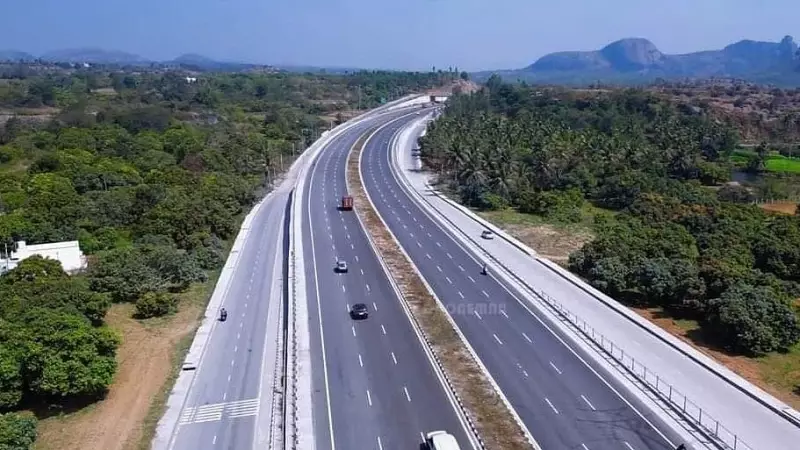
In a significant move to bolster national infrastructure, the central government has granted its approval for the construction of two major highway projects. These developments, with a combined estimated cost of Rs 7,210 crore, are strategically located in the states of Maharashtra and Odisha.
Details of the Approved Highway Projects
The decision was taken during a meeting of the Cabinet Committee on Economic Affairs (CCEA), chaired by Prime Minister Narendra Modi. The projects will be executed by the National Highways Authority of India (NHAI) on a Build-Operate-Transfer (BOT) basis under the Hybrid Annuity Model (HAM).
The first project involves the six-laning of a 67-km section of the Nagpur–Hyderabad corridor in Maharashtra. This stretch, from Kondhali to Butibori, is part of the crucial National Highway 44. The total cost for this development is pegged at approximately Rs 2,249 crore.

The second and larger project is situated in Odisha. It entails the four-laning of a 92-km segment of National Highway 53, connecting the towns of Jharsuguda and Jamnipali near the Chhattisgarh border. This project carries a much higher estimated cost of Rs 4,961 crore.
Strategic Importance and Expected Benefits
These projects are not just about laying asphalt; they are seen as vital arteries for regional economic growth. The Nagpur-Hyderabad corridor enhancement is expected to significantly improve connectivity for key industrial and logistics hubs in Maharashtra's Vidarbha region. This will facilitate smoother movement of goods and people, boosting trade and commerce.
The Odisha project holds immense strategic value for industrial and mineral-rich zones. The improved highway will enhance connectivity to major industrial clusters in Jharsuguda and Sambalpur districts. Furthermore, it will provide better and faster access to the Jagdalpur region in Chhattisgarh, which is known for its mineral resources. This improved infrastructure is anticipated to reduce logistics costs, spur industrial development, and generate employment opportunities in the region.
Implementation and Broader Infrastructure Vision
The approval underscores the government's continued focus on expanding and modernizing the country's road network. The use of the Hybrid Annuity Model is designed to attract private investment while mitigating risks for developers, thereby accelerating project completion.
These two projects are part of a larger, ambitious plan to create a robust national highway grid. Enhanced connectivity is a cornerstone for economic development, and such investments aim to bridge regional disparities, improve supply chain efficiency, and integrate remote areas with mainstream economic activity.
The government's push for infrastructure development, particularly in highways, is seen as a critical driver for post-pandemic economic recovery and long-term sustainable growth. The approval of these projects in Maharashtra and Odisha is a concrete step in that direction, promising to transform regional connectivity landscapes in the coming years.