

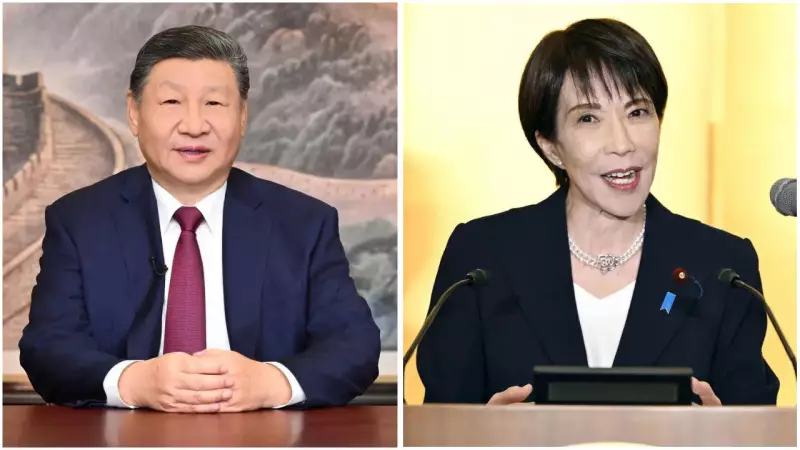
In a significant escalation of bilateral tensions, China on Tuesday imposed an immediate ban on the export of dual-use goods—items that can serve both civilian and military purposes—to Japan. The move is a direct response to recent friction between the two Asian powers, primarily centred around Taiwan.
What Does the Export Ban Entail?
The Chinese Ministry of Commerce issued a formal statement outlining the new restrictions. The ban explicitly prohibits exports of controlled items to Japanese military users and any other end-users that could potentially enhance Japan's military capabilities. The ministry warned that any individual or organisation, regardless of nationality, found transferring or providing these made-in-China products to Japanese entities would face legal consequences.
While the official notice did not provide a detailed list of the specific items covered, analysts suggest that a range of technology-related exports could fall under this category. As per reports from the Associated Press, these could include products like drones and advanced navigation systems, which have clear civilian applications but can be adapted for military use.

Beijing classifies a wide array of products in sensitive sectors—including biotechnology, aerospace, and telecommunications—as dual-use goods subject to strict export controls. The Chinese government stated that the measures, which took effect immediately, are aimed at safeguarding national security and interests.
The Taiwan Flashpoint: Root of the Tensions
The drastic trade measure comes against a backdrop of rapidly deteriorating relations between China and Japan in recent months. The primary catalyst has been a series of comments and actions related to Taiwan, the self-ruled island that Beijing claims as an inseparable part of its territory.
Tensions flared after Japanese Prime Minister Sanae Takaichi stated late last year that Japan's military could potentially get involved if China were to take action against Taiwan. This remark was viewed by Beijing as a serious provocation and a challenge to its core sovereignty claims.
Further straining ties, Japan in December accused Chinese military aircraft of locking their radar onto Japanese fighter jets, despite what Tokyo described as a safe distance between the aircraft. China, for its part, has significantly stepped up military pressure around Taiwan, including launching large-scale military drills near the island just last week.
Diplomatic Fallout and Future Implications
During the recent military exercises, Chinese Foreign Minister Wang Yi publicly criticised Japan's leadership alongside Taiwan's "pro-independence forces." He accused Tokyo of directly challenging China's territorial sovereignty.
Echoing this sentiment, a spokesperson for China's commerce ministry, as reported by AFP, slammed Japan's recent "erroneous remarks concerning Taiwan, implying the possibility of military intervention in the Taiwan Strait." The spokesperson asserted that the tightened export controls were a necessary and justified step to protect China's security interests.
There was no immediate official response from the Japanese government to the announcement of the export ban. The move marks a concrete shift in economic policy as a tool of geopolitical leverage in the ongoing dispute. It signals Beijing's willingness to use its trade muscle to penalise what it perceives as interference in its internal affairs, particularly on the highly sensitive issue of Taiwan. The ban is likely to disrupt supply chains for certain advanced technologies and adds a new, complex layer to the already strained China-Japan relationship.






