

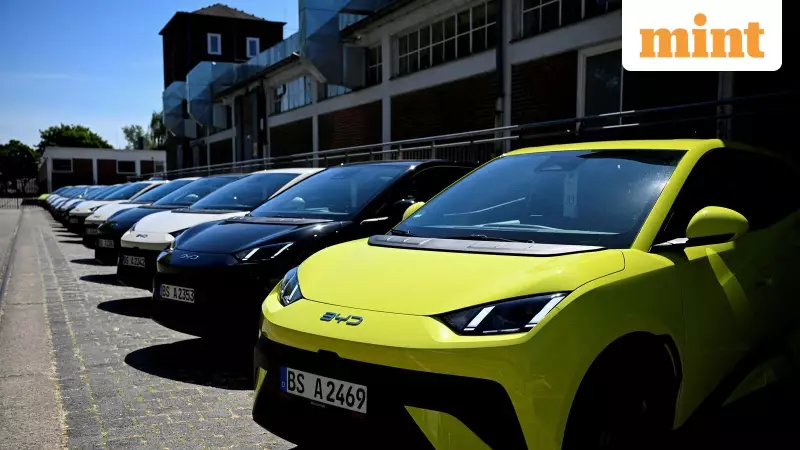
In a strategic masterstroke, Chinese automobile manufacturers have successfully navigated around the European Union's increased tariffs on electric vehicles (EVs), turning the bloc's protective measures on their head. Contrary to expectations that higher duties would stifle imports, data reveals a significant surge in Chinese car exports to Europe, forcing a rethink on trade policy effectiveness.
The Tariff Gambit That Backfired
When the European Union imposed additional tariffs on Chinese battery electric vehicles in 2024, the objective was clear: make imports more expensive to protect domestic industry. The European Commission cited "unfair subsidisation" by the Chinese state as the reason, aiming to restore a "level playing field." The Kiel Institute, a German think-tank, predicted this would cause Chinese car exports to plummet by a staggering 25%.
However, over a year later, the reality is strikingly different. According to China's customs agency, car exports to Europe actually rose to nearly 1.2 million units in the 12 months leading to November, marking a 26% increase compared to the previous year. This growth underscores that the challenge for Europe isn't weak tariffs, but the remarkable agility of Chinese carmakers in finding loopholes.

The Hybrid Pivot: A 155% Surge
Faced with tailored tariffs—17.4% for BYD, 18.8% for Geely, and 35.3% for SAIC on top of the standard 10% duty—Chinese companies executed a swift strategic shift. Instead of retreating, they changed lanes from pure EVs to hybrids, which were spared from the extra levies.
The data is compelling. While monthly Chinese EV sales to Europe grew by a respectable 12% in the past year, exports of hybrid vehicles skyrocketed by an astonishing 155%, albeit from a smaller base. Beatrix Keim of Germany's Centre for Automotive Research noted to Handelsblatt newspaper that this strategic adaptation was inevitable. Hybrids have now become the fastest-growing segment of China's car exports, overtaking fully electric models.
This shift is rapidly transforming European showrooms. By October, Chinese brands captured 13% of the continent's hybrid-vehicle sales, a massive jump from just 3% a year earlier. Their share of the pure EV market also climbed from 8% to 12% in the same period.
Local Production: The Next Frontier
To protect their competitive price advantage, Chinese manufacturers are now investing directly within the EU, effectively sidestepping import duties altogether. This move towards localisation marks a new phase in their European strategy.
Key developments include:
- BYD began setting up its first European production line in Szeged, Hungary, in December 2025.
- Xpeng started manufacturing its G6 and G9 EV models in Graz, Austria, in September.
- Chery is scheduled to begin assembling EVs and hybrids at a former Nissan plant in Barcelona, Spain, in 2026.
This onshoring strategy, while incurring higher local costs, neutralises the tariff barrier and brings production closer to the consumer.
Europe's Dilemma and the Road Ahead
The situation presents European policymakers with a complex puzzle. The broader slowdown in pure EV adoption, evidenced by the EU's recent decision to scrap its 2035 ban on petrol and diesel cars, has inadvertently benefited Chinese hybrids. European lawmakers are now considering extending tariffs to hybrid vehicles to close the loophole.
However, the proven adaptability of Chinese carmakers suggests that any new barrier might simply lead to another strategic pivot. As Chinese brands continue to gain market share through a combination of product diversification and local investment, they have demonstrated that in a vast and open market like Europe's, they are unlikely to run out of road anytime soon. The global auto industry's centre of gravity continues to shift, with trade policy struggling to keep pace.






