

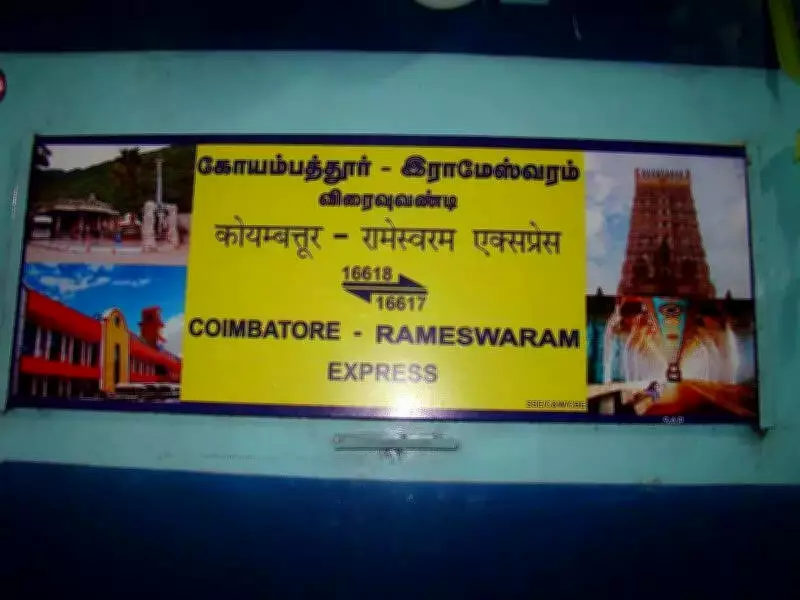
Growing Public Pressure to Revive Historic Coimbatore-Rameswaram Rail Link
Coimbatore: A significant public movement is gaining strength, demanding the complete restoration of the historic Coimbatore–Rameswaram train service. This railway connection, which operated successfully for nearly eight decades, remains partially revived, sparking frustration among passengers and advocacy groups.
A Legacy Interrupted by Gauge Conversion
The Coimbatore-Rameswaram train service was first inaugurated in 1928 during the British colonial era. It served as a vital transportation artery until its discontinuation in 2008. This halt was necessitated to facilitate the conversion of the Coimbatore–Pollachi and Pollachi–Dindigul railway lines from metre gauge to broad gauge.
While the gauge conversion projects were completed—the Pollachi–Dindigul section in 2015 and the Coimbatore–Pollachi stretch in 2017—the full restoration of the Coimbatore–Rameswaram service has not materialized. Currently, only a weekly train operates between the two cities every Tuesday via Karur and Trichy, which falls short of the original service's scope.

Advocates Push for Original Route and Daily Frequency
T Krishna Balaji, secretary of the Pollachi Train Passengers Welfare Association, emphasized the long-standing demand to reinstate the service to its former glory. He advocates for daily operations along the original route: via Podanur, Kinathukadavu, Pollachi, Udumalpet, Palani, Dindigul, Madurai, Manamadurai, and Ramanathapuram to Rameswaram.
Recalling the service's historical significance, Krishna Balaji highlighted its dual role. "The train not only transported large quantities of seafood, including fish and dried fish, but also provided an incredibly convenient option for pilgrims," he stated. "Passengers could depart Coimbatore in the morning, visit the renowned Ramanathaswamy Temple in Rameswaram, and return the same evening, arriving back in Coimbatore the next day. At its peak, there were up to two or three services daily, making spiritual travel highly accessible."
Alleged Delays and Competing Proposals
Krishna Balaji alleged that congestion at Coimbatore Junction has been cited as a primary reason for the delay in restoring the service. Additionally, a proposal from the Salem railway division to operate the train from Erode via Tirupur and Coimbatore to Rameswaram has reportedly been stalled without progress.
He expressed bewilderment at the situation, noting that several new trains, including Vande Bharat services and routes to northern states, are being launched from Rameswaram. "It is difficult to comprehend the delay in restoring a direct service from Coimbatore, especially when other expansions are proceeding," he remarked.
Highlighting the broader connectivity benefits, Krishna Balaji urged railway authorities to at least expedite the Erode-route proposal. This alternative would also advantage passengers from Erode and Tirupur districts, enhancing regional integration.
Economic and Educational Imperatives for Restoration
J Sathish, director of Kongu Global Forum, underscored the service's critical role in supporting Tamil Nadu's economic and educational landscapes. He pointed out that many individuals from southern districts are employed in Coimbatore and Tirupur, which are key hubs for small, micro, and medium enterprises (MSMEs).
With Coimbatore emerging as a major destination for higher education, the train service serves as an essential connectivity link for lakhs of people traveling for work and studies. Sathish lamented the dilution of the service's original purpose, which was to connect significant spiritual centers like Palani, Madurai, Rameswaram, and Dhanushkodi.
"It is unfortunate that the original intent has been completely eroded. In today's context, this service is indispensable not only for passenger mobility but also for efficient goods transport," Sathish asserted.
The collective call from advocates and the public underscores a pressing need for the Indian Railways to address this connectivity gap, restoring a service that once seamlessly linked spiritual, economic, and educational corridors across Tamil Nadu.






