

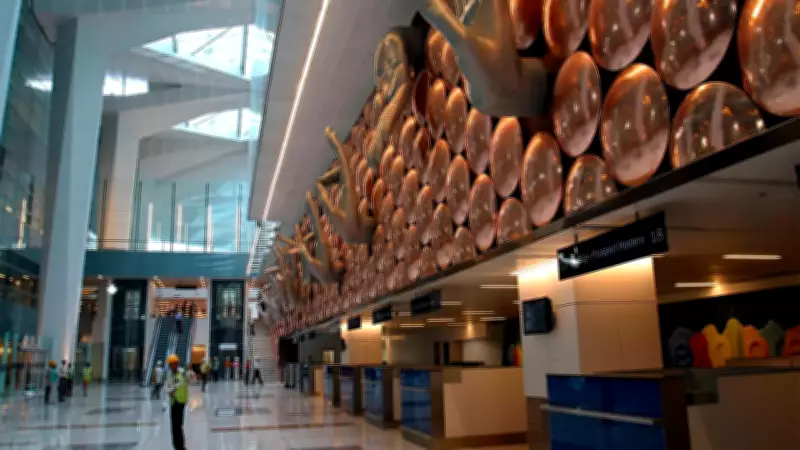
Delhi Airport Set for Significant Transformations in Coming Months
Passengers traveling through Delhi's Indira Gandhi International Airport (IGIA) can anticipate substantial changes over the next two to three months, aimed at enhancing operational efficiency and passenger convenience. Key developments include the introduction of airside transfers between terminals, terminal conversions, and road infrastructure improvements. However, the long-proposed air train project faces continued delays, with little progress expected in the near future.
Airside Transfers Between T1 and T3 to Begin by April
Delhi International Airport Ltd (DIAL) has formally requested approvals from the Bureau of Civil Aviation Security (BCAS) and the Directorate General of Civil Aviation (DGCA) to initiate airside transfers for domestic-to-international and international-to-domestic passengers between Terminal 1 (T1) and Terminal 3 (T3), which are approximately eight kilometers apart. These transfers will involve buses crossing certain taxiways, necessitating thorough security and safety evaluations.
Sources indicate that BCAS clearance is anticipated by March, with airside transfers potentially commencing by April. Meanwhile, domestic-to-domestic transfers will continue to be managed via city-side buses. DIAL is also conducting technical assessments for a similar airside linkage between T2 and T3, with implementation targeted for mid-2024.

Terminal Operations and Future Plans
Currently, T3 exclusively handles international flights, while T1 and T2 are dedicated to domestic operations. T1 will remain a hub for low-cost carriers, whereas the proposed T4, intended to replace the aging T2, may accommodate both domestic and international traffic. The timeline for demolishing T2 and constructing T4 remains uncertain, as DIAL monitors the impact of the upcoming Noida Airport on passenger numbers and awaits potential concession extensions beyond 2036.
Pier C Conversion to International Operations by March
In a strategic move, Pier C at T3 is being converted from domestic to international use, with final clearances from BCAS, Central Industrial Security Force, immigration, and Customs expected in February. This conversion is slated for completion by March, enabling Pier C to handle international flights exclusively. Initially, DIAL considered a 'swing gates' approach for mixed operations, but this was rejected due to concerns about passenger segregation.
By summer 2024, T3 will feature three international piers (A, B, and C) and one domestic pier (D), streamlining flight management and reducing congestion.
Road Infrastructure Upgrades and Flyover Proposal
To alleviate traffic congestion, the Public Works Department (PWD) has appointed RITES as a consultant to study the construction of a Y-shaped flyover between T1 and T3, along with widening the runway tunnel road. A report is due by March-April, after which it will be submitted to the central government for funding under the urban development scheme, with an 80-20 cost-sharing model between central and state authorities.
These road enhancements are crucial to support future developments, including a major mall and commercial complex in Aerocity, which will significantly increase vehicular traffic.
Air Train Project Remains Stalled
Despite being proposed nearly a decade ago, the air train project for seamless inter-terminal transfers among T1, T2/T3, Aerocity, and the cargo terminal is effectively stalled. With only ten years remaining in DIAL's initial 30-year concession period ending in 2036, financial viability concerns hinder progress, as investors seek longer recovery windows. DIAL cannot commit funds beyond 2036 without a concession extension.
As an alternative, the upcoming Golden Line of the Delhi Metro, featuring a 2.3-kilometer underground section linking T1 and Aerocity, is viewed as a viable transfer solution. Passengers will be able to transit between T1 and T3 via Aerocity using platform-to-platform transfers, though this falls short of a dedicated airport air train system like those in New York, Zurich, or Dubai.
These initiatives underscore DIAL's efforts to modernize IGIA, balancing immediate upgrades with long-term planning amidst operational and financial constraints.






