

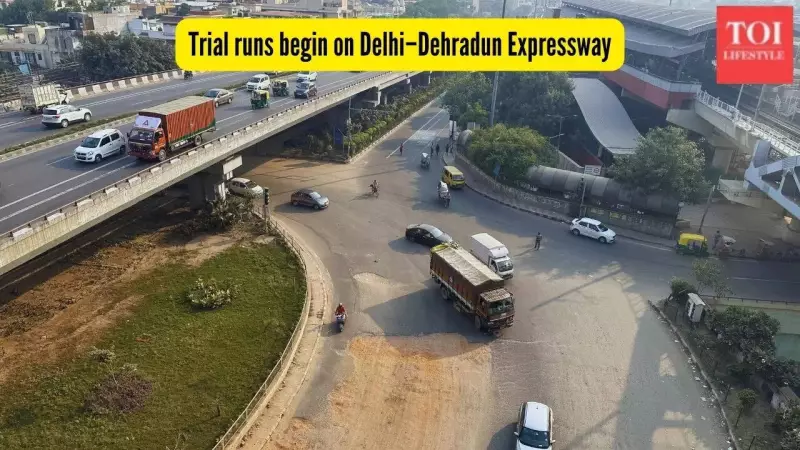
In a significant development for commuters and travellers in North India, a crucial section of the much-anticipated Delhi–Dehradun Expressway has opened for trial runs. This marks a major step towards the completion of the flagship corridor that promises to dramatically reduce travel time between the national capital and the picturesque capital of Uttarakhand.
Trial Run on Key Stretch: What's Open Now?
The trial operations began on 1 December 2025 on a strategically important 32-kilometre segment. This newly opened road connects the Akshardham Temple area in Delhi to the junction with the Eastern Peripheral Expressway (EPE) near Baghpat (Khekra) in Uttar Pradesh. For now, general vehicular traffic is permitted on this stretch strictly on a trial basis.
Officials have stated that this trial phase will last for approximately one month. A major relief for early users is that no toll charges will be levied during this entire trial period. To handle the anticipated increase in traffic flow, authorities are actively planning to install essential amenities along the route. These include rest facilities, designated parking lots, and drinking water and sanitation units. Furthermore, first-aid units will be deployed to ensure passenger safety.

A Game-Changer for Connectivity and The Environment
Once fully operational, the 210-kilometre Delhi–Dehradun Expressway will be a transformative infrastructure project. It is designed to pass through several key districts of Uttar Pradesh, including Baghpat, Baraut, Muzaffarnagar, Shamli, and Saharanpur, before reaching Dehradun.
The most talked-about benefit is the projected reduction in travel time. The journey between Delhi and Dehradun, which currently takes around 6 hours depending on traffic conditions, is expected to be slashed to a mere 2.5 hours. This will be a boon for both tourists and regular commuters.
Beyond speed, the expressway is being constructed with a strong emphasis on modernity, safety, and environmental consciousness. Its standout features include:
- A 12-kilometre elevated wildlife corridor through the eco-sensitive Rajaji National Park and Shivalik reserve forest, featuring a 340-metre tunnel (the Daat Kali tunnel) to prevent disruption to wildlife.
- Several animal underpasses on the Dehradun-side stretch to facilitate safe animal movement.
- Infrastructure for rainwater harvesting at intervals of every 500 metres, with over 400 water-recharge points planned along the route.
- Future plans to install solar panels along a 14.75-km section, including a 6.9-km elevated stretch near Akshardham, promoting sustainable energy.
- Access-controlled lanes with a designated speed limit of 100 km/h for enhanced safety and efficiency.
Project Timeline, Cost, and The Road Ahead
This long-awaited project received approval in 2020, and Prime Minister Narendra Modi laid its foundation stone in December 2021. The entire project is estimated to cost around INR 11,868.6 crore.
While the Delhi to Baghpat section is now on trial, work continues at a brisk pace on the remaining phases of the expressway. These subsequent sections are:
- Baghpat to Saharanpur
- Saharanpur Bypass to Ganeshpur
- The final leg connecting to Dehradun
Even in its partial operational state, this semi-opening is providing significant relief to daily commuters from East Delhi, North-East Delhi, Ghaziabad, and Noida. By offering an alternative to older, congested routes, this corridor is already promising smoother and faster travel, heralding a new era of connectivity in the region.






