

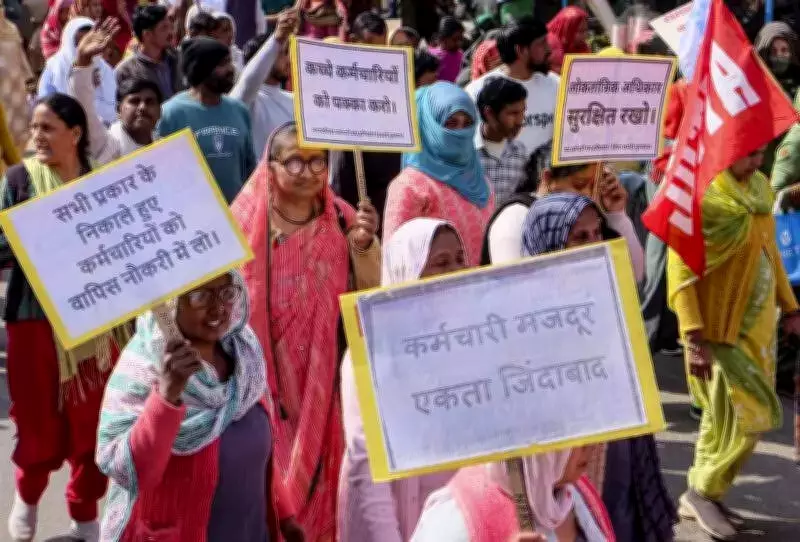
Farmers in Jind Burn India-US Trade Agreement Copies Amid Nationwide Strike
In a dramatic display of dissent, farmers in Jind, Haryana, staged a protest near the old bus stand on Thursday, burning copies of the India–US trade agreement as part of a nationwide strike. The agitation, which spanned across Punjab and Haryana, saw participants demanding the immediate cancellation of the pact and warning of a mass movement if their concerns continue to be ignored by the government.
Strike Declared a "100% Success" by Organisers
Organisers of the strike proudly declared it a "100% success," with participation from a broad coalition including the Bharatiya Kisan Union (BKU), various trade unions, newly formed organisations, and bank employees. This widespread involvement underscored the deep-seated opposition to the trade deal, which protesters argue threatens the livelihoods of farmers and workers across the region.
Joginder Nain, the BKU state president, issued a stern warning, stating that farmers would not accept the Indo–US trade deal under any circumstances. He emphasized their commitment to fighting the agreement on the ground, expressing confidence in achieving ultimate victory. Nain further alleged that Prime Minister Narendra Modi acted out of fear and pressure from the United States, implementing decisions that he claimed would harm the Indian populace. Specifically, he warned that opening India's agricultural markets at zero tariff would lead to the destruction of the farming community.

Political Support Amplifies Protest Voices
The protest gained significant political momentum as several local Congress leaders and workers joined the demonstration, led by district Congress president Rishipal Haibatpur. In his address to the gathering, Haibatpur accused the central government of adopting anti-farmer and anti-worker policies. He alleged that recent amendments to laws have pushed farmers and labourers to the brink of ruin, citing rising inflation, unemployment, and changes in labour laws as factors that "break the backbone of the common man."
Haibatpur asserted that their struggle would extend beyond street protests, vowing to fight strongly for the rights of farmers, workers, and underprivileged sections from the streets to Parliament. This sentiment was echoed by the Congress and Aam Aadmi Party, both of which extended their support to the strike, thereby sharpening the political battle over labour and agrarian reforms. These parties condemned the Union government's policies and economic decisions, aligning with the protesters' demands.
Nationwide Impact and Broader Allegations
Called by a joint platform of central trade unions and federations, with support from the Sanyukt Kisan Morcha and other farm and labour organisations, the all-India general strike had a partial impact on essential services. In Punjab, banking, insurance, postal, electricity, and transport services were affected as protests were held at various locations, highlighting the widespread nature of the discontent.
In Barnala, a protest at labour chowk near the bus stand featured speakers who slammed the central government for policies such as replacing MGNREGA with VB GRAMG and introducing what they termed "anti-people" measures like the Electricity Bill, Seeds Bill, and Labour Codes. On the India–US trade deal, protesters argued that it would further eliminate jobs and push small farmers out of agriculture, exacerbating economic hardships.
The protesters also alleged that the BJP-led government is pursuing privatisation policies to benefit multinational firms and local corporates, a move they claim is snatching livelihoods from crores of people in the country. They criticized these policies as contradictory to promises of providing crores of jobs annually, adding fuel to the ongoing debate over economic reforms.

Power Employees Join the Fray
Adding to the strike's reach, power employees and engineers extended their support. Shailendra Dubey, chairperson of the All India Power Engineers Federation, reported that employees from Punjab, Himachal Pradesh, Jammu and Kashmir, and Haryana boycotted work and held protest rallies in Chandigarh. In Punjab, a pen-down strike was organised by various employees unions and powercom engineers, as confirmed by Ajaypal Singh Atwal, general secretary of the PSEB Engineers Association, demonstrating the cross-sectoral solidarity against the trade agreement and related policies.





