

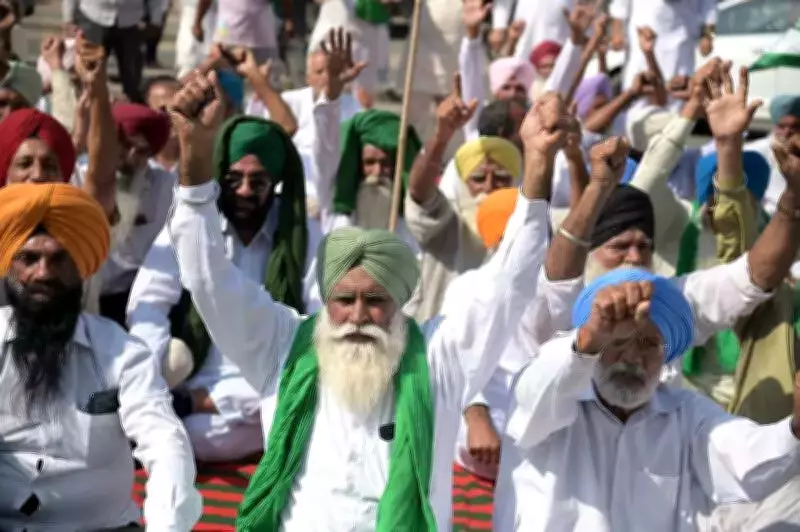
Farmers Across India Voice Fury Over Proposed US Trade Agreement Framework
Anger is escalating throughout the farming community in response to the recently revealed framework for an interim trade agreement between India and the United States. The framework outlines significant tariff reductions or complete elimination of duties on a wide array of US industrial, food, and agricultural products entering the Indian market.
List of Products and Farmer Union Outcry
The extensive list of affected items includes dried distillers' grains (DDGs), red sorghum for animal feed, various tree nuts, fresh and processed fruits, soybean oil, wine, spirits, and several other commodities. Farmer unions are vehemently opposing this move, arguing it will expose India's agricultural sector to aggressive and potentially devastating foreign competition from heavily subsidized American agribusiness giants.
Both the Sanyukt Kisan Morcha (SKM) and the SKM (non-political) faction have issued sharp criticisms of the proposed framework. They have labeled the deal a "total surrender" to American corporate agricultural interests by the ruling NDA government at the Centre.

Contradictions and Demands from Farm Leaders
While the SKM views this agreement as definitive proof that the central government has abandoned its commitment to protect farm livelihoods, the SKM (NP) has gone further, terming it an even bigger blow to farmers than the now-repealed farm laws. The unions have presented a series of demands, including:
- The immediate release of a government white paper detailing all terms of the proposed deal.
- A call for nationwide farmer unity to prepare for what they describe as a struggle larger than the previous farm law agitation.
- The resignation of Commerce Minister Piyush Goyal.
They argue the framework directly contradicts Minister Goyal's repeated public assurances that the agriculture and dairy sectors would remain outside the scope of free trade agreements. Unions point to dairy products already being included in FTAs with the UK, New Zealand, and the EU as evidence, accusing the minister of having "consciously misled" the farming community. They have warned the Prime Minister that signing the India-US agreement would trigger massive, countrywide protests.
Skewed Tariff Structures and Market Fears
Farm groups are highlighting what they see as a heavily imbalanced tariff structure. Reports indicate that while India's duties on several key US agricultural products—which previously ranged from 30% to 150%—have been negotiated down to zero, US tariffs on equivalent Indian goods have reportedly increased from 0% to between 3% and 18% during the 2023–24 period.
The unions warn that such disparities will only tighten the grip of US multinational corporations on Indian agriculture. They further express concern that the reduction of non-tariff barriers could open the floodgates for milk imports from the US, directly contradicting earlier government claims that it would block milk sourced from animals fed on meat-based feed.
Specific Threats to Indian Agriculture
The farmer unions have outlined several specific threats they believe the agreement poses:
- Animal Feed Market Domination: Fear that US companies will dominate India's animal feed market through imports of DDGs, sorghum, and maize.
- Devastation for Specific Growers: Warning that allowing imports of genetically modified (GM) foods, GM seeds, soybean oil, ethanol, and fruits like apples, pineapples, and cashews could devastate growers in key regions like Himachal Pradesh and Jammu & Kashmir.
- Soil Health Erosion: Concern that these changes could erode the country's natural soil health over the long term.
Broader Context of Rural Distress
The protests come at a time of significant challenge for Indian agriculture. With agricultural growth already slowing, input costs rising sharply, and rural distress deepening, the unions argue that opening India's vast farm market—a market described by US officials as crucial for supporting American rural incomes—will directly endanger the livelihoods of approximately 172 million rural households, with small and marginal farmers being the most vulnerable.

The framework, therefore, is not seen as a simple trade negotiation but as an existential threat to the backbone of India's rural economy, setting the stage for a major confrontation between the government and the nation's food producers.





