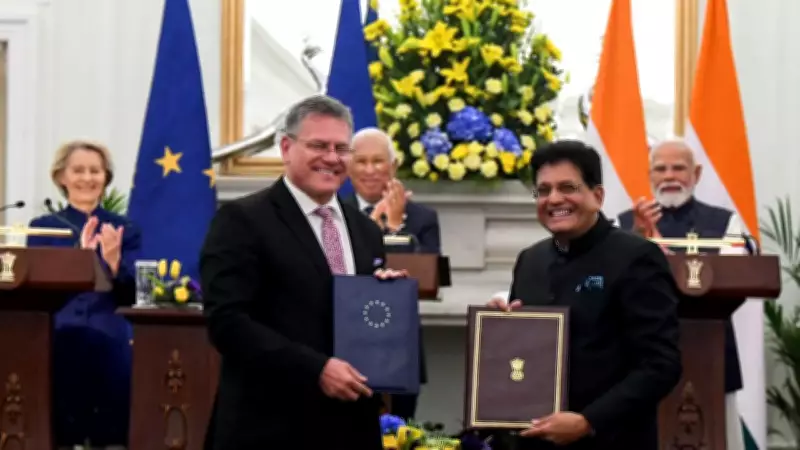
Commerce and Industry Minister Piyush Goyal delivered a robust defense of the newly finalized India-European Union Free Trade Agreement on Wednesday, forcefully countering criticism from Congress leader Jairam Ramesh. In a detailed rebuttal, Goyal questioned the opposition's credibility while championing the pact as a transformative economic arrangement that promises substantial benefits for India's growth trajectory and employment landscape.
Political Motivation vs Economic Reality
Responding to Ramesh's social media post that labeled the FTA as "hugely hyped" and raised multiple concerns, Goyal characterized the criticism as politically driven and disconnected from ground realities. "Is this a story of 'Sour grapes'?" Goyal pointedly asked, suggesting that those who failed to make crucial decisions during their tenure were now attempting to undermine progress.
The minister emphasized that India had incurred significant costs during the nine-year suspension of FTA negotiations between 2013 and 2022, including substantial losses in potential jobs, income generation, and economic expansion. Goyal firmly rejected claims that the agreement had been oversold, asserting that the sheer scale of the pact validated its importance.

The Scale of the Agreement
"When the entire global community recognizes this as the 'mother of all deals,' my friend considers it excessively promoted," Goyal remarked, highlighting the combined economic might represented by the agreement. The pact encompasses economies with a staggering $25 trillion in combined GDP, facilitates $11 trillion in global trade, and creates access to a common market approaching two billion consumers.
Goyal specifically noted that immediate tariff elimination on $33 billion worth of India's labor-intensive exports represented tangible benefits that could not be dismissed as mere exaggeration. This aspect alone, he argued, demonstrated the concrete advantages India would gain from the agreement.
Addressing Specific Concerns
Ramesh had expressed apprehension that the FTA represented "the biggest trade opening India has given to any trade partner," with tariff reductions covering over 96% of EU exports to India. He warned this could potentially double imports from the bloc, thereby widening India's trade deficit.
CBAM and Industrial Sectors
The Congress leader had particularly flagged concerns regarding the Carbon Border Adjustment Mechanism (CBAM), noting the absence of exemptions for India's aluminum and steel exports. Ramesh pointed out that exports in these sectors had already declined from $7 billion to $5 billion and could face further reduction after CBAM implementation begins in January 2026.
Goyal countered these concerns by emphasizing the government's proactive engagement on CBAM and other sensitive issues. "I can state with confidence that our government has actively addressed the CBAM matter and identified viable pathways toward solutions," he asserted, advocating for continued dialogue and cooperative approaches rather than rigid positions.
Regulatory and Intellectual Property Safeguards
Regarding regulatory barriers, Goyal clarified that health and safety regulations remained protected under the agreement while being appropriately disciplined to prevent unjustified trade restrictions. On intellectual property matters, he explained that obligations aligned with the WTO's TRIPS framework while preserving crucial public health flexibilities, technology transfer provisions, recognition of India's traditional knowledge systems, and maintenance of India's data exclusivity policies.
Services and Automotive Sectors
Addressing services sector concerns where Ramesh alleged the EU sought privileged access beyond India's commitments to other partners, Goyal maintained that commitments remained within India's domestic regulatory framework. He suggested these could potentially attract significant EU investment and innovation in sectors including maritime and financial services.

On the inclusion of automobiles—a particular concern for domestic manufacturers and India's emerging electric vehicle industry—Goyal explained that India's approach was quota-based, focused primarily on premium segments, and implemented in phased manner. He noted a five-year transition period specifically for electric vehicles and argued that liberalizing completely knocked down (CKD) imports would encourage European manufacturers to establish local assembly operations, gradually progressing toward full localization and strengthening the Make in India ecosystem.
Refined Fuel Exports
Regarding refined fuel exports—India's largest export category to the EU—Goyal acknowledged the issue's connection to external factors while emphasizing that the trade agreement represented a long-term strategic engagement founded on mutual trust and respect between the partners.
Call for Constructive Engagement
Concluding his remarks, Goyal expressed hope that critics would move beyond negative perspectives. "I sincerely hope my friend will abandon this pessimistic approach... Let us collaborate to create opportunities rather than obstruct the pursuit of prosperity," he urged.
The India-EU FTA negotiations represent an 18-year journey, beginning in 2007 and progressing through 16 rounds before suspension in 2013 over unresolved issues. Talks resumed in June 2022, culminating in Tuesday's announcement of finalization. The agreement now stands as one of India's most significant trade partnerships, promising to reshape economic relations between two of the world's major economic regions.