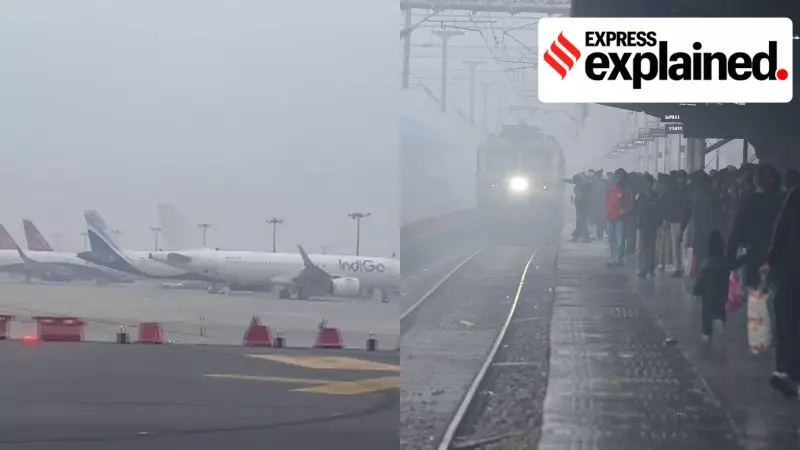
As the winter chill sets in across North India, a familiar adversary returns to haunt millions of travelers: dense, persistent fog. This annual phenomenon brings the bustling transport networks of airlines and the Indian Railways to a near-standstill, causing widespread delays, cancellations, and operational nightmares. While technology has offered some respite, the sheer scale of modern travel means the battle against low visibility is a constant, complex challenge.
The Science Behind North India's Stubborn Fog
The primary culprit behind the travel chaos is radiation fog. This type of fog forms on clear winter nights when the ground loses heat rapidly, causing moisture in the air to condense. Stagnant winds then trap this moisture close to the surface. The situation is severely aggravated by smog, a toxic mix of fog and pollution. Smog not only makes the fog denser but also drags it closer to the ground and prolongs its duration, as it does not dissipate quickly with sunlight. Aviation experts consistently point out that high pollution levels in cities like Delhi have intensified fog-related disruptions over the years.
How Aviation Navigates the Grey-Out
When visibility plummets, airports implement Low Visibility Procedures (LVP). This involves specialized operations like Low Visibility Take-Off (LVTO) and landings using the Instrument Landing System (ILS) CAT IIIB. This advanced system allows aircraft to land with a visibility as low as 50 metres. However, not all airports or aircraft are equipped for this. Major hubs like Delhi's Indira Gandhi International Airport have this capability, but many others do not, forcing delays or cancellations.

Airlines prepare for the official fog window from December 10 to February 10, as declared by the Directorate General of Civil Aviation (DGCA). They station CAT IIIB-certified aircraft at fog-prone airports and ensure a roster of trained pilots is available. Predictive analytics and AI tools are used for better fog forecasting. Despite these measures, disruptions are inevitable. LVP reduces an airport's capacity significantly; for instance, Delhi's capacity drops from 100 movements per hour to about 65. Recovery is slow, with every hour of fog disruption needing two to three hours to normalize operations.
A critical issue arises when visibility is sufficient for CAT IIIB landings (50 metres) but not for take-offs, which require at least 75 metres at Delhi. This imbalance quickly congests parking stands. If visibility falls below 50 metres, even CAT IIIB landings must halt. Airlines prepare by identifying fair-weather alternative airports, like Ahmedabad for flights diverted from Delhi, but decisions are made based on real-time conditions.
The Domino Effect on Airline Networks
Disruptions at a major hub like Delhi create a cascading impact nationwide. Airlines operate on tight schedules where a single aircraft and its crew handle multiple flights daily. A delay in the morning can snowball throughout the day. Strict Flight Duty Time Limitation (FDTL) norms, enforced by the DGCA to combat pilot fatigue, compound the problem. Crews exceeding their duty time—even if spent waiting—must be relieved, leading to acute crew shortages. Airlines keep extra crew on standby and engage in dynamic crew management, but large-scale disruptions can still cause roster chaos.
The Railways' Fight on the Tracks
The Indian Railways faces a monumental challenge, often seeing delays exceeding 12 hours. To combat this, it has deployed several technological solutions. The key tool is the Fog Safety Device (FSD), a GPS-based handheld system for locomotive pilots. It provides audio-visual alerts for signals, stations, and level crossings within a geo-fenced area. In December 2025, the Railway Minister informed the Rajya Sabha that 25,939 fog safety devices had been provisioned, with nearly 23% allocated to the Northern Railway, which operates in the most fog-affected region.

Additional measures include a modified automatic signalling system in Northern and North Central Railways that limits the number of trains between two stations to two during fog. Luminous strips have been added to signalling equipment for better visibility. The most ambitious project is the rollout of the Automatic Train Protection (ATP) system, Kavach. This system allows pilots to maintain speed in dense fog by displaying signal information directly on the locomotive's dashboard and can apply brakes automatically. The advanced Kavach 4.0 has been commissioned on 738 route kilometers, including sections of the Delhi-Mumbai and Delhi-Howrah corridors, with work ongoing on the remaining stretches.
While both sectors are deploying advanced technology and detailed contingency plans, the war against winter fog remains a tough logistical battle. For the traveling public, understanding these challenges underscores why patience remains a necessary virtue during India's foggy season.