

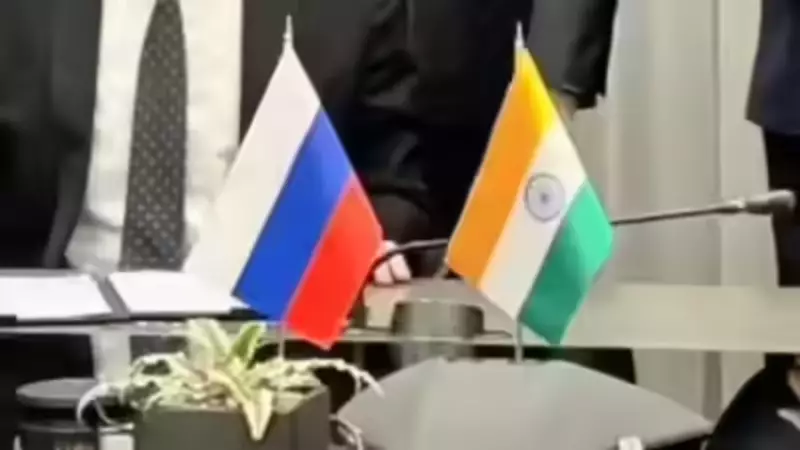
A new analysis reveals a massive untapped opportunity for Indian exporters in the Russian market. According to Ajay Srivastava, founder of the Global Trade and Research Initiative (GTRI), India has the potential to increase its merchandise exports to Russia seven-fold, from the current $5 billion to $35 billion by the year 2030. This ambitious growth hinges on securing better market access in key sectors like food, pharmaceuticals, textiles, and machinery.
The Stark Trade Imbalance: Oil Dominates, Exports Lag
This report gains significance as Russia reiterates its target of lifting bilateral trade with India to $100 billion by 2030. While total trade is nearing $70 billion, the relationship is heavily skewed. In the financial year 2025, India exported goods worth $4.9 billion to Russia but imported a staggering $63.8 billion, resulting in a massive trade deficit of $58.9 billion.
Crude oil alone accounted for $50.3 billion of these imports, highlighting what Srivastava describes as an "oil-heavy relationship rather than a balanced partnership." This dependence on a single commodity underscores the urgent need to diversify India's export basket to Russia.

Mapping the Missed Opportunities: Where India Lags
GTRI's study pinpointed sectors where Russia is a major global importer and India is a major global exporter, yet India's market share in Russia remains below 5%. In 2024, Russia's total goods imports stood at $202.6 billion, but India's share was a mere $4.84 billion, or just 2.4%.
The gaps are particularly glaring in agriculture and food. Russia imported billions in fruits, nuts, oilseeds, edible oils, meat, and dairy, while India's exports in these combined categories were under $250 million. This is despite India being a top global exporter of meat, oilseeds, and fruits.
The story repeats in fast-moving consumer goods and chemicals. Russia's large imports of perfumery, soaps, detergents, and inorganic chemicals see minimal Indian participation. Even in pharmaceuticals, where India is a global powerhouse with over $23 billion in exports, its share in Russia's $11.8 billion medicine import market is only 3.5%, worth $413.5 million.
Textiles and apparel show even sharper deficits. Russia imports significant volumes of man-made filaments, fibres, knitted fabrics, and garments, but Indian supplies are negligible or zero in some sub-categories. In engineering, while Russia imports tens of billions in industrial machinery, electrical equipment, and vehicles, India's exports are a fraction of that demand.
The Core Hurdle: Solving the Payments Problem
GTRI identifies the absence of a predictable and efficient payment system as the single biggest barrier for Indian exporters. With many Russian banks disconnected from the SWIFT network, transactions have become slow, costly, and uncertain, discouraging exporters from entering the market.
"Without a modern rupee–rouble settlement system, Russia may remain India’s largest oil supplier—but not a serious export market," Srivastava emphasized. The report advocates for a modern equivalent of the fixed rupee-rouble mechanism used during the Soviet era. Such a system would reduce currency risks, restore payment predictability, encourage long-term contracts, and allow small and medium enterprises to participate.
The Roadmap to $35 Billion in Exports
To achieve the $35 billion export target and reduce the trade deficit, GTRI recommends a multi-pronged strategy for India. The cornerstone is establishing a reliable local-currency settlement mechanism. This must be supported by stronger logistics and certification frameworks.
Additionally, targeted trade promotion for high-potential sectors like food, pharma, and textiles is crucial. The report also calls for institutional support through buyer-seller meets, dedicated trade missions, and help for exporters navigating compliance, payments, and distribution challenges in Russia.
If these structural reforms are implemented, India can dramatically expand its economic footprint in Eurasia, transforming its trade relationship with Russia from one dominated by oil imports to a balanced and diversified partnership.






