

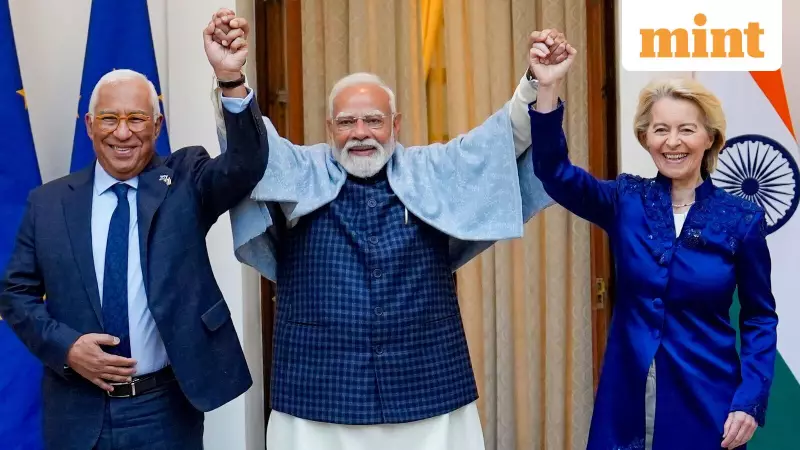
India and European Union Forge Historic Free Trade Agreement
In a landmark development for global trade, India and the European Union (EU) announced on Tuesday the successful conclusion of negotiations for a comprehensive free trade pact. This historic agreement, described as the 'mother of all trade deals' due to its unprecedented scale and strategic importance, establishes a free trade zone encompassing nearly two billion people and close to a quarter of global GDP.
Strategic Partnership Amid Global Uncertainty
The announcement came during the 16th India-EU Summit in New Delhi, where Prime Minister Narendra Modi and European Commission President Ursula von der Leyen jointly revealed the breakthrough. This agreement positions India at the center of one of the world's largest integrated economic partnerships, coming at a time of significant uncertainty in the global trade landscape.
Prime Minister Modi characterized the deal as a symbol of "unprecedented alignment" between the world's largest democracies. "This deal will drive trade, investment and innovation while strengthening India-EU strategic relationship," Modi stated in a social media post. "It reflects our shared resolve to shape a stable, prosperous and future-ready economic relationship."

Protected Sectors and Market Access
Both negotiating partners have maintained protections for sensitive agricultural sectors. India has shielded dairy products, cereals, poultry, soymeal, and certain fruits and vegetables from tariff reductions. Similarly, the EU has protected beef, sugar, rice, chicken meat, milk powder, honey, bananas, and soft wheat, maintaining current tariffs on these products.
Despite these exclusions, the agreement delivers substantial market access improvements. India will gain better EU market access for tea, coffee, spices, and processed food products. In return, India will open its domestic market for EU spirits, wine, and olive oil, with significant tariff reductions across these categories.
Comprehensive Tariff Liberalization
The agreement represents one of the most ambitious trade liberalization efforts in recent history. Once implemented, India will bring nearly 96% of EU goods to zero tariff, while the EU will eliminate duties on approximately 98% of Indian goods. This represents a dramatic shift from current weighted average tariffs of 9.6% levied by India on EU products and 3.6% by the EU on Indian goods.
Union Commerce Minister Piyush Goyal expressed optimism about the agreement's implementation timeline. "This is a wonderful agreement. It will be taken up for legal scrubbing on a fast-track basis, as we discussed today. We hope to be able to celebrate the entry into force of this agreement within the calendar year 2026," Goyal told reporters.
Sector-Specific Benefits
The agreement delivers particularly strong benefits for India's labor-intensive export sectors. Textiles and apparel, which previously faced EU tariffs of up to 12%, will see complete tariff elimination, significantly improving competitiveness for Indian garment and home textile exporters. Similarly, leather goods and footwear will move to zero duty from earlier tariffs of up to 17%, providing substantial relief to this cost-pressured sector.
Marine products, including shrimp and seafood, will gain zero-duty access on most tariff lines, replacing earlier EU duties of 20–26%. In pharmaceuticals, duties will be reduced to near zero for almost all products, strengthening India's position as a key supplier of affordable generic medicines to European markets.
Services and Mobility Framework
Beyond goods trade, the agreement secures major gains in services and mobility. The FTA provides predictable and non-discriminatory access across 144 EU services subsectors, including IT and IT-enabled services, professional services, education, financial services, tourism, construction, research and development, and other business services.

A forward-looking mobility framework facilitates the movement of skilled professionals, intra-corporate transferees, and business visitors. The agreement includes provisions for dependents, student mobility, and post-study work opportunities, alongside commitments to engage on social security arrangements over a five-year horizon. Notably, India has secured access for practitioners of Indian traditional medicine to work under home title in EU member states where such practices are not regulated.
EU Market Access Gains
From the European perspective, the agreement delivers sweeping tariff cuts across nearly all major export sectors. India will eliminate or sharply reduce tariffs on over 90% of EU goods exports, covering 96.6% of trade value. This move is expected to double EU exports to India over time and save European exporters up to €4 billion annually in duties.
Significant tariff reductions will occur in several key sectors. Passenger vehicle tariffs will be cut from 110% to 10% under a quota of 250,000 units annually, while duties on car parts will be eliminated over five to ten years. Machinery and electrical equipment tariffs of up to 44% will fall to zero for almost all products, largely within five to seven years.
Addressing Carbon Border Adjustments
The agreement includes forward-looking provisions addressing the EU's Carbon Border Adjustment Mechanism (CBAM). While the carbon border tax system remains outside the direct scope of the trade deal, both parties have agreed to establish a technical dialogue to address pathways for Indian industries to access the EU market despite the regulation being in place.
Commerce Secretary Rajesh Agarwal explained that the technical group will ensure that any Indian carbon trading system that emerges in the future is integrated into the CBAM framework. "Importantly, the EU has committed that any flexibility extended under CBAM to any partner country in the future would automatically apply to India as well, providing forward-looking comfort," Agarwal stated.
Economic Impact and Next Steps
According to official data, India-EU bilateral trade in goods in 2024–25 stood at $136.5 billion, with Indian exports of $75.8 billion and imports of $60.7 billion. Services trade reached $83.1 billion during the same period. With this agreement, the EU becomes India's 22nd FTA partner, effectively opening up the entire European market for Indian businesses when combined with existing agreements with the UK and EFTA countries.
The agreement will now undergo legal vetting and ratification processes on both sides. On the EU side, the draft text will undergo legal checks and translation into all official EU languages before seeking approval from the EU Council and European Parliament. On the Indian side, the draft text will be placed before the Union Cabinet for approval before completing the ratification process.
EU Trade Commissioner Maroš Šefčovič described the deal as the biggest FTA ever negotiated. "High tariffs down, opportunity unleashed. It proves that hard work pays off, that win-win trade is real, and that genuine partnership is always worth the effort," Šefčovič stated. "Now, our focus is clear: ensuring businesses reap tangible benefits from this FTA as quickly as possible."
This agreement marks the culmination of negotiations that first began in 2007, were put on hold in 2013, and resumed in 2022. The successful conclusion represents a significant milestone in India-EU relations and is expected to reshape India's trade engagement with Europe while reinforcing its position as a trusted, forward-looking global partner in an increasingly complex international trade environment.





