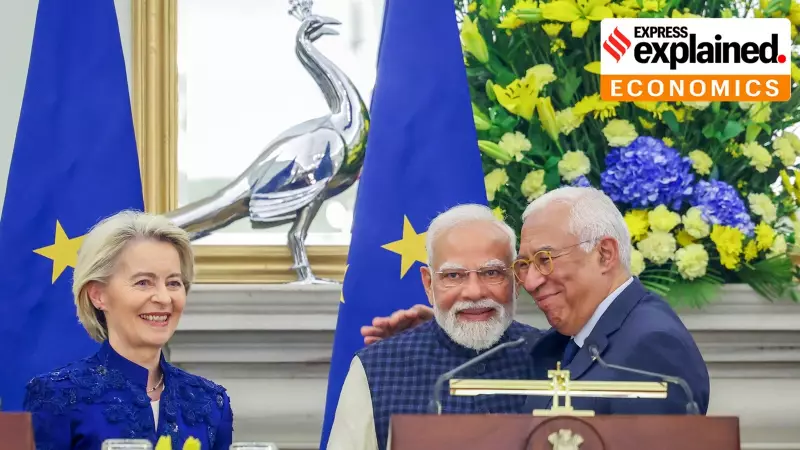
India-EU Trade Deal: Unpacking the Carbon Tax Conundrum and Steel Scrap Access
In a significant development for international trade, Indian negotiators have successfully secured a forward-Most Favoured Nation (MFN) clause concerning the Carbon Border Adjustment Mechanism (CBAM) under the newly concluded India-EU trade agreement. This strategic move, finalized on Tuesday, January 27, 2026, ensures that Indian industries will benefit from the same concessions that the European Union previously extended to the United States in their trade pact signed last year.
The Trump Connection: Leveraging US-EU Precedents
The inclusion of the forward-MFN clause is directly influenced by the EU-US trade deal joint statement released in August of the previous year. In that agreement, the European Union acknowledged US concerns regarding the treatment of small and medium-sized businesses under CBAM and committed to providing additional flexibilities in its implementation. Indian trade officials, recognizing this precedent, strategically pushed for similar relief during negotiations in Brussels, as reported by The Indian Express in August 2025.
Prior to the US-EU agreement, EU representatives, including Ambassador Hervé Delphin, had maintained that CBAM was not a trade measure but rather a compliance tool aligned with the EU's climate agenda to accelerate decarbonisation. However, the concessions granted to the US set a critical precedent that India has now effectively leveraged to protect its economic interests.

Addressing Global Concerns Over Carbon Taxation
The Carbon Border Adjustment Mechanism, which imposes costs on imported carbon-intensive goods into the EU starting January 2026, has been a point of contention for several developing nations. Countries like Brazil, China, India, and South Africa have raised serious objections at World Trade Organisation forums, arguing that CBAM is discriminatory and conflicts with international environmental law. Russia even initiated a formal dispute in May of the previous year, highlighting the global friction surrounding this policy.
In response, India has not only secured the forward-MFN clause but has also negotiated an understanding on steel scrap access, a critical component for low-carbon steel production. Government officials confirmed that India has applied to receive scrap under the EU's recycling policy, reaching a mutual agreement. Additionally, a rebalancing mechanism has been established, allowing India to impose equivalent costs on the EU if its interests are adversely affected.
The Steel Scrap Angle: A Key to Green Steel Production
Indian trade negotiators specifically sought easier access to steel scrap from the European Union as a strategic workaround to mitigate the impact of CBAM. This move addresses concerns raised by Indian manufacturers who view CBAM, combined with the EU's recycling policy, as a non-tariff barrier that restricts metal exports to the bloc and limits scrap exports to other countries to bolster domestic industries.
The EU, as the world's largest producer of steel scrap, holds a pivotal position in the global scrap market. The Engineering Export Promotion Council highlighted during a Board of Trade meeting that sourcing scrap from the EU is challenging due to its recycling policies, creating a significant barrier for Indian industries reliant on scrap-based production methods.
India's Green Steel Initiative and Decarbonisation Efforts
Steel production emissions vary significantly based on the technology used. Traditional blast furnace methods produce the highest emissions, while scrap-based electric arc furnace (EAF) routes offer the lowest carbon footprint. Currently, Indian manufacturers predominantly use blast furnaces, making them vulnerable to CBAM's costs.
To address this, the Indian government has launched a green steel initiative aimed at increasing the share of scrap in steelmaking to 50% by 2047. According to the World Steel Association, using scrap in EAF and induction furnace routes can reduce carbon emissions by 1.5 metric tons per ton of scrap and cut energy consumption by 75% compared to traditional methods.

However, challenges remain. A report by the Indian Council for Research on International Economic Relations (ICRIER) notes that scrap currently constitutes only 20% of India's steelmaking feedstock, constrained by limited domestic availability of approximately 25 million metric tons annually. This scarcity underscores the importance of securing international scrap access to meet decarbonisation goals.
Economic Implications and Future Outlook
The Global Trade Research Initiative (GTRI) estimates that CBAM could impose a 20-35% tax on select Indian exports like iron, steel, and aluminium products to the EU, posing a significant economic threat. In this context, the forward-MFN clause and scrap access agreements are crucial for safeguarding India's trade interests.
Negotiations over CBAM have been particularly complex, as the EU carbon tax applies universally. Yet, India and the EU have reached an understanding to collaborate on decarbonisation, with the EU agreeing to share expertise. This partnership reflects a broader trend of integrating climate goals with trade policies, balancing environmental commitments with economic realities.
As India navigates the evolving landscape of climate-linked trade instruments, securing favorable terms in the EU deal marks a pivotal step toward sustainable industrial growth and enhanced global trade relations.