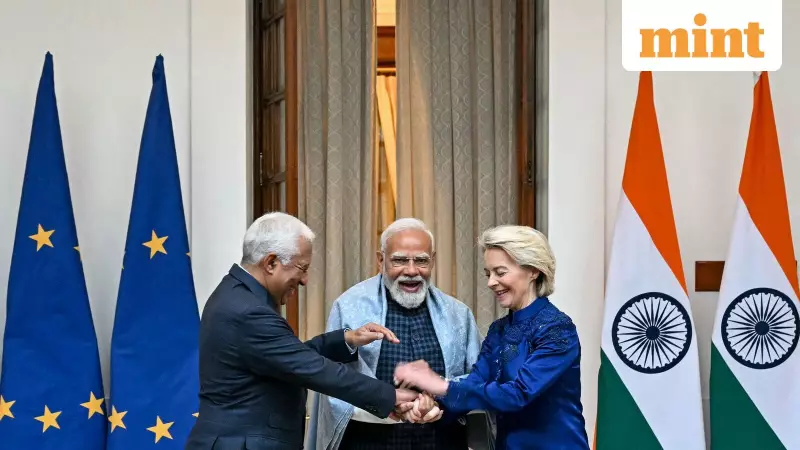
India and European Union Finalize Historic Free Trade Agreement
In a landmark development for global trade, India and the European Union (EU) have successfully finalized their comprehensive free trade agreement (FTA) on Tuesday, 27 January. This monumental pact, often referred to as the "mother of all deals," stands as the largest trade agreement ever concluded by both economic powerhouses, marking a significant milestone in their bilateral relations.
Strategic Timing Amid Global Economic Challenges
The finalization of this agreement comes at a critical juncture, as both regions navigate rising geopolitical tensions and persistent global economic headwinds. According to an official statement released by the EU, the FTA is poised to substantially strengthen economic and political ties between the world's second and fourth-largest economies. This strategic move is particularly noteworthy against the backdrop of recent trade policies from the United States.
Notably, the deal's conclusion follows a period of trade friction initiated by former US President Donald Trump, who imposed significant tariffs on various trading partners. Last year, the Trump administration levied 50% tariffs on India amidst ongoing trade negotiations. Concurrently, Trump had threatened to escalate trade disputes with European allies over their opposition to a US proposal regarding Greenland, though he later reversed this stance.

Current Status and Implementation Timeline
Has the India-EU free trade agreement been officially signed yet?
While the negotiations have been successfully concluded and the agreement finalized, it has not yet been formally signed. Both parties announced the completion of negotiations on 27 January, with reports from PTI indicating that the official signing ceremony is anticipated later this year.
When will the India-EU FTA come into force?
The proposed agreement is expected to take effect early next year. This culmination follows an extensive negotiation process that began in 2007, spanning approximately 18 years of detailed discussions and deliberations.
Next Steps Toward Implementation
For the agreement to become fully operational, several procedural steps must be completed, as outlined in the EU's official statement:
- Publication of the negotiated draft texts for public review
- Comprehensive legal revision and translation into all official EU languages
- Formal proposal of the agreement to the EU Council for signature and conclusion
- Adoption by the EU Council
- Official signing ceremony between the EU and India
- Approval by the European Parliament
- Final decision by the EU Council to conclude the deal, enabling it to come into force
Following these steps, the agreement will require ratification by India before it can formally take effect, paving the way for its implementation.
Why the 'Mother of All Deals' Moniker?
The agreement has earned the dramatic title of "the mother of all deals" from both sides. On Tuesday, Prime Minister Narendra Modi echoed European Commission President Ursula von der Leyen's characterization, reinforcing the pact's historic significance.
A senior Commerce Ministry official explained to PTI that this India-EU trade deal ranks among the largest bilateral trade agreements ever negotiated worldwide. While acknowledging that the China-ASEAN trade agreement is also substantial, the official highlighted a key distinction: ASEAN comprises ten distinct Southeast Asian nations that do not function as a unified customs union like the EU.
The ASEAN member countries include:
- Brunei
- Cambodia
- Indonesia
- Laos
- Malaysia
- Myanmar
- The Philippines
- Singapore
- Thailand
- Vietnam
"So it's a huge deal in that sense," the official emphasized, underscoring the unique scale and integration level of the India-EU pact.
Unprecedented Scale and Economic Impact
The sheer magnitude of this free trade agreement is staggering in its demographic and economic reach:

- It directly impacts approximately 1.9 billion people – about 1.4 billion in India and roughly 500 million across the EU member states.
- Together, India and the EU represent a formidable 25% of the global economy and constitute nearly 30% of the world's total population.
- In terms of trade volume, the combined economic might is equally impressive. In 2024, the EU's total goods imports reached $6.9 trillion, with services imports adding another $2.9 trillion.
- India's goods imports during the same period were approximately $750 billion.
- Collectively, India and the EU account for roughly 11 to 12% of global trade. Out of the estimated $33 trillion in worldwide trade, their combined contribution stands at approximately $11 trillion.
This finalized agreement represents not just a trade pact but a strategic realignment with far-reaching implications for global commerce, economic stability, and geopolitical dynamics in an increasingly multipolar world.