

Historic India-EU Free Trade Agreement Concluded After Decades of Negotiations
In a landmark development for global economic relations, India and the European Union have successfully concluded their long-awaited Free Trade Agreement (FTA) on Tuesday. This historic milestone represents a significant strengthening of bilateral economic ties between two of the world's largest democratic economies, coming at a crucial time of rising global uncertainty and trade turbulence.
Decades of Negotiations Culminate in Strategic Partnership
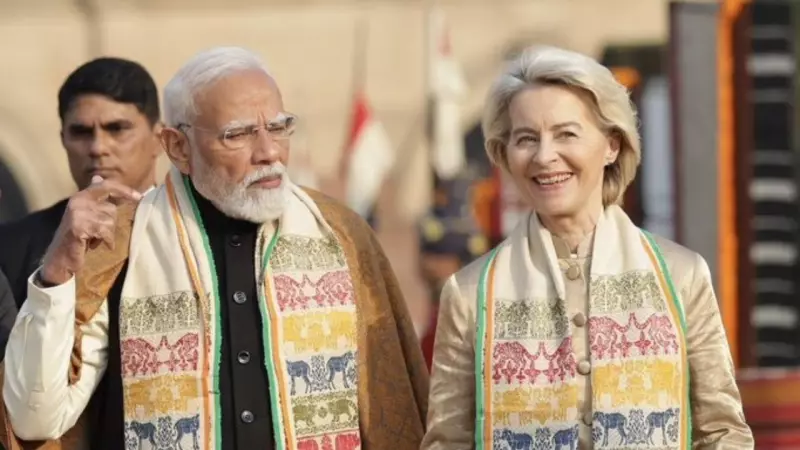
The agreement was officially announced at the 16th India-EU Summit by Prime Minister Narendra Modi and European Commission President Ursula von der Leyen. This culmination follows more than two decades of negotiations, with talks being relaunched in 2022 to accelerate the process. The timing of this agreement is particularly significant, arriving amidst renewed turbulence in global trade characterized by aggressive tariff policies, fragile supply chains, and the prolonged Russia-Ukraine conflict.
Commerce Minister Piyush Goyal described the agreement as a defining achievement, stating: "The conclusion of the India-European Union Free Trade Agreement represents a defining achievement in India's economic engagement and global outlook. This supports India's approach to secure trusted, mutually beneficial and balanced partnerships."

Massive Economic Impact and State-Level Benefits
The economic scale of this partnership is substantial, with India and the EU representing the 4th and 2nd largest economies globally. Together, they account for 25% of global GDP and nearly one-third of global trade. The agreement is expected to benefit Indian exports worth Rs 6.4 lakh crore, providing access to 27 EU markets under a single, unified trade framework.
Multiple Indian states are poised to become major beneficiaries of this agreement, including:
- Gujarat
- Maharashtra
- Tamil Nadu
- Karnataka
- Uttar Pradesh
- Rajasthan
- Punjab
- Telangana
- Andhra Pradesh
- West Bengal
- Assam
- Kerala
These states are expected to see significant gains due to their established strengths in manufacturing, agriculture, and various export-oriented sectors.
Labor-Intensive Sectors Receive Major Boost
The FTA promises to enhance market access for Indian products across numerous sectors, with particular emphasis on labor-intensive industries that form the backbone of India's export economy. Key sectors set to benefit include:
- Textiles and Apparel: Immediate zero duty on 100% of tariff lines, opening direct access to the $263 billion EU textile market. This development will help Indian exporters compete globally while empowering millions of weavers across the country.
- Leather and Footwear: Tariffs reduced from 17% to zero, enabling India to tap into the $100 billion EU leather and footwear market. This will revitalize traditional clusters in Agra, Kanpur, Kolhapur, and Ranipet.
- Gems and Jewellery: 100% duty-free access to a $79 billion premium market, benefiting established hubs in Gujarat, Rajasthan, Maharashtra, and West Bengal.
- Engineering and Manufacturing: Preferential access to a $2 trillion EU industrial market, supporting India's ambition to reach $300 billion in engineering exports by 2030. MSMEs in states like Maharashtra, Karnataka, Gujarat, Andhra Pradesh, and Tamil Nadu are particularly well-positioned to gain from this access.
Overall, tariffs of up to 10% on nearly $33 billion of labor-intensive exports will drop to zero once the agreement comes into force, creating substantial competitive advantages for Indian manufacturers.
Comprehensive Partnership Beyond Traditional Trade
Minister Goyal emphasized that this agreement extends beyond conventional trade deals, stating: "Beyond a conventional trade deal, it represents a comprehensive partnership with strategic dimensions and is one of the most consequential FTAs. India has secured unprecedented market access for more than 99% of Indian exports by trade value to the EU that also bolsters the 'Make in India' initiative."

The agreement is expected to significantly support micro, small, and medium enterprises (MSMEs) by expanding their access to EU markets and integrating Indian firms into global value chains. This integration is projected to create substantial employment opportunities for women, artisans, youth, and professionals across various sectors.
Services, Mobility, and Technology Cooperation
Beyond goods, the FTA delivers commercially meaningful market access in services, including:
- IT and IT-enabled services
- Professional services
- Education
- Financial services
- Tourism
- Construction
India has secured predictable access to 144 EU service subsectors while offering access to 102 subsectors to the EU. The pact also establishes a future-ready mobility framework that eases movement for skilled and semi-skilled professionals, including Intra-Corporate Transferees, business visitors, contractual service suppliers, and independent professionals. Additional provisions support student mobility and post-study work opportunities.
In emerging technological areas, the agreement facilitates cooperation in artificial intelligence, clean technologies, and semiconductors while addressing non-tariff barriers through improved regulatory cooperation, streamlined customs procedures, and SPS measures.
Trade Numbers and Strategic Implications
The EU stands among India's largest trading partners, with bilateral trade in goods reaching Rs 11.5 lakh crore ($136.54 billion) in 2024-25. Indian exports accounted for Rs 6.4 lakh crore ($75.85 billion), while imports stood at Rs 5.1 lakh crore ($60.68 billion). Trade in services reached an additional Rs 7.2 lakh crore ($83.10 billion).
This India-EU FTA becomes India's 22nd trade agreement and, together with FTAs with the UK and EFTA, effectively opens up the entire European market for Indian businesses. Aligned with India's vision of 'Viksit Bharat 2047', the agreement lays a strong foundation for inclusive, resilient, and future-ready growth while strengthening India's role as a trusted global trade partner in an increasingly complex international economic landscape.





