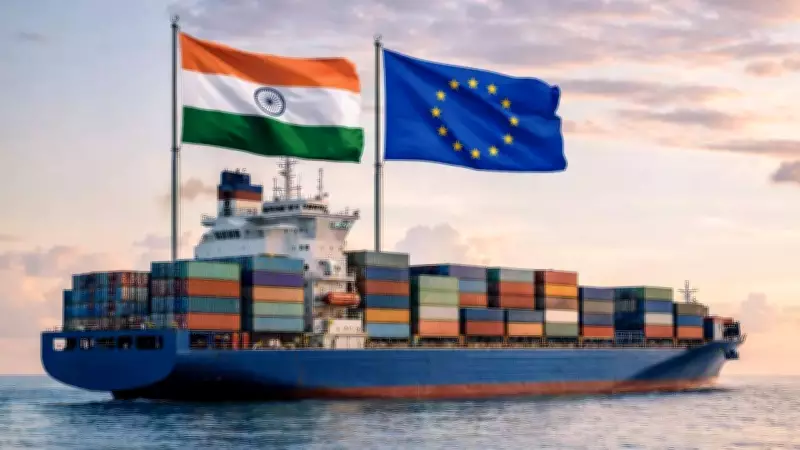
India-EU Free Trade Agreement: A Defining Moment in Economic Diplomacy
The conclusion of the India–European Union Free Trade Agreement represents a watershed moment in India's contemporary trade strategy. This landmark agreement transcends mere tariff reductions and market access provisions, symbolizing a conscious and deliberate shift in India's approach to global economic integration. For much of the past decade, India's trade policy has been characterized by instinctive caution and protective measures. However, this FTA demonstrates a move toward a more confident, rules-based, and pragmatic engagement with major global economic partners.
Navigating Complex Negotiations
Negotiating a comprehensive free trade agreement with the European Union—one of the world's most demanding and highly regulated markets—has always presented significant challenges for India. The EU's stringent standards on sustainability, labor practices, environmental protection, data governance, and regulatory compliance have traditionally clashed with India's preference for policy flexibility and domestic safeguards. The successful conclusion of this agreement reflects a strategic realization that in today's fragmenting global economy, neither insulation nor relying solely on existing strengths represents a viable long-term strategy.
Key Provisions and Sectoral Benefits
The FTA showcases India's willingness to step beyond its comfort zone by committing to:

- Deep market access provisions
- Predictable trade rules
- Modern trade disciplines
while simultaneously protecting sensitive sectors such as dairy and select agricultural products. The agreement provides preferential access for over 99 percent of Indian exports into the EU market, highlighting the ambitious scope of this partnership.
Labor-intensive sectors stand to gain substantially from this arrangement:
- Textiles and apparel
- Leather goods
- Gems and jewellery
- Marine products
These benefits extend beyond simple tariff elimination to include greater integration into sophisticated European value chains.
Strategic Openness in Complex Sectors
India's calibrated approach to complex sectors deserves particular attention. In the automobile industry, a carefully structured, quota-based system balances domestic manufacturing priorities with exposure to advanced technologies and healthy competition. For services, the agreement secures commercially meaningful commitments across multiple domains:
- Information technology services
- Professional services
- Financial services
- Business services
These are further strengthened by enhanced mobility provisions for skilled professionals. This reflects growing confidence in India's services competitiveness and its pool of skilled human capital.
Mutual Commitments and Strategic Alignment
The European Union's acceptance of a social security framework within a five-year timeframe underscores the mutual commitment to expansive economic integration. For the EU, this agreement arrives at a crucial juncture marked by rising geopolitical uncertainty and economic coercion. The bloc is actively seeking trusted partners who share its commitment to democracy, transparency, and a rules-based international order. As the world's largest democracy and a rapidly growing major economy, India aligns perfectly with this strategic vision.
Values-Based Pragmatism in Action
What distinguishes this agreement is not merely its economic content but the values-based pragmatism that underpins it. Both negotiating parties approached the table with clear-eyed understanding of each other's constraints and priorities. India has successfully safeguarded sensitive sectors and preserved essential policy space, while the EU has demonstrated flexibility through:

- Phased liberalization schedules
- Cooperation on carbon regulation
- Recognition of India's developmental context
Institutionalizing Cooperation Mechanisms
The inclusion of structured cooperation mechanisms represents a significant evolution in trade agreements. Rather than allowing regulatory differences to become insurmountable trade barriers, the agreement institutionalizes:
- Cooperation on sustainability measures
- Digital trade frameworks
- Support for small and medium enterprises
- Engagement on carbon-related measures including CBAM
This shift from adversarial trade conditionalities to structured dialogue reflects remarkable maturity on both sides.
Broader Implications for Global Trade
In a global environment where unilateralism and transactionalism are gaining ground, the India-EU FTA stands out as a reaffirmation of democratic norms in economic governance. It reinforces the principle that open trade, when anchored in mutual respect and established rules, can coexist harmoniously with domestic priorities and social objectives. For India specifically, this agreement represents a powerful statement of intent that integration with high-standard markets is not a threat but rather a pathway to:
- Upgrading industrial competitiveness
- Attracting quality foreign investment
- Embedding itself more deeply in global value chains
Beyond Immediate Trade Gains
Ultimately, this agreement transcends immediate trade benefits to focus on long-term strategic alignment. By moving beyond traditional caution and engaging the European Union as an equal partner, India signals its readiness to actively shape—rather than shy away from—the evolving rules of global commerce. For both democratic partners, the FTA serves as a timely reminder that democracies can still deliver ambitious, balanced, and pragmatic economic outcomes through collaborative effort.