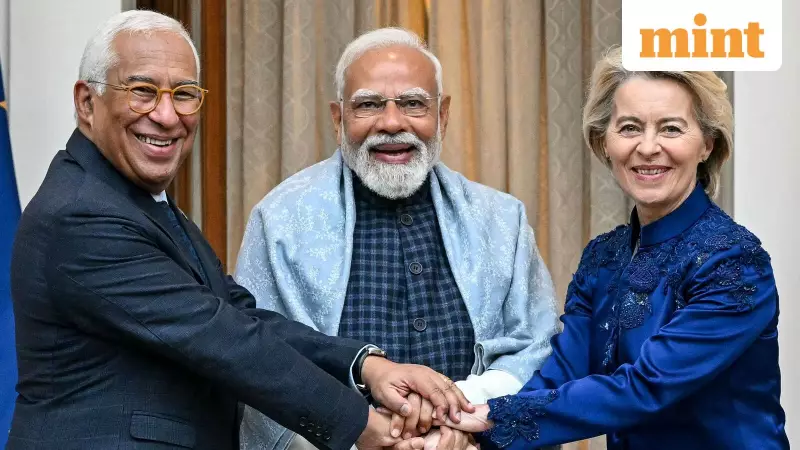
India-EU Free Trade Agreement: A Comprehensive Breakdown of Opportunities and Challenges
The long-awaited free trade agreement between India and the European Union was officially announced on Tuesday, marking a significant milestone in bilateral trade relations. Spanning 20 comprehensive chapters, this pact is often described as the "mother of all trade deals" due to its extensive scope and potential impact. While the EU has already released a detailed chapter-by-chapter summary, India's official text remains pending, adding an element of anticipation to the implementation phase.
Trade in Goods: Enhanced Market Access and Competitive Edge
India stands to gain substantially from improved market access for goods under this agreement. The European Union has committed to eliminating tariffs on over 90% of tariff lines, covering approximately 91% of the total trade value. With partial liberalization measures, this percentage is expected to rise to an impressive 99.3%. This development significantly enhances competitiveness for India's labour-intensive export sectors, including textiles, apparel, footwear, marine products, chemicals, and pharmaceuticals, which previously faced EU duties ranging from 6% to 12% or higher.
The tariff reductions effectively level the playing field for Indian manufacturers seeking to penetrate this crucial developed market. The EU represents one of India's largest trading partners, with bilateral trade in goods reaching ₹11.5 trillion ($136.54 billion) during the 2024-25 fiscal year. India maintained a trade surplus with exports valued at ₹6.4 trillion ($75.85 billion) against imports of ₹5.1 trillion ($60.68 billion). Additionally, services trade between the two economies amounted to ₹7.2 trillion ($83.10 billion) in 2024, highlighting the comprehensive nature of their economic relationship.

Rules of Origin: Modernization with Stringent Requirements
The agreement adopts EU-style rules of origin that align with recent European Union free trade agreements, emphasizing self-certification and digital verification processes. While these modernized procedures reduce paperwork burdens and benefit micro, small, and medium enterprises (MSMEs), the value-addition thresholds remain relatively strict. This could pose challenges for Indian exporters operating within complex global supply chains.
Anant S. Iyer, Director General of the Confederation of Indian Alcoholic Beverage Companies (CIABC), emphasized the importance of robust rules of origin. "Robust and enforceable rules of origin would help stop third-country products from entering India through indirect routes, which often leads to unfair competition and loss of revenue for the country," he stated. Regarding geographical indication (GI)-tagged products such as Scotch whisky, Irish whiskey, Cognac, Champagne, and Tequila, Iyer added that "the GI-linked country should be recognised as the true country of origin for tariff purposes, regardless of where the shipment originates, which is vital to preserve the authenticity of such products and uphold the integrity of trade commitments."
Customs and Trade Facilitation: Streamlining Export Processes
The agreement includes significant commitments to customs and trade facilitation, featuring:
- Advance rulings on tariff classification, valuation, and origin requirements
- Simplified procedures and expedited release of goods
- Faster clearance mechanisms with reduced documentation
- Enhanced customs cooperation including supply-chain security coordination
These measures will reduce uncertainty at borders, lower logistics costs, and ease compliance burdens, particularly benefiting small and mid-sized exporters. Trusted Indian exporters can expect risk-based inspections and faster green-channel clearances, allowing their consignments to move more predictably into EU markets.

Sanitary and Phytosanitary Measures: Persistent Agricultural Challenges
This area represents one of India's least advantageous aspects of the agreement. The European Union has maintained its strict food safety, animal health, and plant health regulations without dilution, applying them uniformly to all Indian agricultural and food exports. Unlike the India-UK Free Trade Agreement, there is no joint SPS committee with a consultative approach, raising concerns that these norms will continue to function as non-tariff barriers.
Indian exporters of rice, spices, and tea must comply with pesticide residue limits that often exceed international benchmarks, increasing costs and shipment rejection risks. Marine exports including shrimp and fish remain vulnerable to enhanced inspections or bans over antibiotic traces, while fresh fruits could face sudden plant health restrictions. Dairy exports continue to struggle as the EU does not recognize milk from animals treated with certain hormones or antibiotics.
Key Regulatory Chapters and Their Implications
Technical Barriers to Trade: This chapter reinforces World Trade Organization principles while introducing mandatory consultation timelines for new regulations. A dedicated working group on conformity assessment provides a formal platform to address regulatory frictions, though it stops short of mutual recognition agreements.
Trade Remedies: Both parties preserve rights to implement anti-dumping, anti-subsidy, and safeguard measures. A bilateral safeguard mechanism allows temporary action if import surges cause serious injury to domestic industries.
Services: India has secured commitments exceeding its WTO obligations, including clearer rules on domestic regulation, senior management, and local presence. Professional mobility provisions represent some of India's most ambitious negotiations, though they remain calibrated rather than fully liberalized.
Digital Trade: This chapter incorporates most WTO e-commerce joint initiative rules while preserving regulatory space for privacy and public policy, aligning with India's digital priorities.
Intellectual Property Rights: Robust protection and enforcement across copyrights, trademarks, designs, trade secrets, and plant varieties are provided, largely consistent with India's existing legal framework. Crucially, India has avoided commitments that could weaken access to affordable medicines.
Competition and Subsidies: The EU gains enhanced ability to seek information on subsidies and deepen cooperation between competition authorities, reflecting European concerns about state support without creating automatic penalties.
SMEs, Transparency, and Regulatory Practices: Dedicated provisions for small and medium enterprises, single digital information portals, and stronger transparency rules should help smaller Indian firms navigate EU markets. Good regulatory practices increase predictability while adding procedural discipline.
Sustainable Development, Labour, Environment: Legally binding commitments on labour rights, climate action, and environmental protection are included, supported by consultation and dispute mechanisms. While supporting India's green transition goals, these raise compliance expectations for exporters.
Carbon Border Adjustment Mechanism: Unaddressed Challenge
Notably, the agreement does not mitigate the immediate impact of the EU's Carbon Border Adjustment Mechanism (CBAM). Indian exports in steel and aluminium will continue facing Europe's carbon tax, with potential expansion to other industrial products that could erode tariff gains over time. There is no transition relief or special consideration for developing countries, requiring Indian exporters to comply with detailed emissions reporting and verification requirements that add to operational costs.
As the EU phases out free carbon allowances for its domestic producers, the effective tax burden on Indian steel and aluminium exports is expected to increase further. This development raises concerns that CBAM could offset a significant portion of the tariff benefits anticipated under the free trade agreement.
Economic Impact and Sectoral Analysis
From India's perspective, the India-EU Free Trade Agreement delivers substantial gains in labour-intensive exports, services, and deeper supply-chain integration while improving access to a large developed market. Once implemented, European products including wines and spirits, premium automobiles and auto components, machinery, electrical equipment, medical devices, and specialty chemicals are expected to become more affordable for Indian consumers and businesses as duties are reduced.
The textiles sector emerges as one of the biggest beneficiaries, with sharp tariff cuts potentially expanding India's European footprint significantly. Commerce Minister Piyush Goyal has highlighted that exports could rise rapidly from approximately $7 billion to $30-40 billion, potentially generating 6-7 million jobs. Simultaneously, cheaper textile machinery imports from Germany should facilitate technology upgrades and reduce dependence on Chinese suppliers.
This comprehensive agreement represents a balanced approach to international trade, offering clear economic advantages while navigating complex regulatory landscapes. The successful implementation will depend on effective coordination between stakeholders and continuous dialogue to address emerging challenges in this dynamic partnership.