India-EU Trade Deal Creates Strategic Import Pathway for European Automakers
The recently finalized free trade agreement (FTA) between India and the European Union establishes a new framework for automotive trade, granting European car manufacturers enhanced flexibility in their Indian market approach. While the deal facilitates strategic imports of fully built vehicles, industry experts indicate that immediate price reductions for consumers remain unlikely in the near term.
Tariff Reduction and Import Quota Provisions
Under the comprehensive trade agreement, India has committed to progressively reducing import duties on completely built units (CBUs) from the current 110% to 10% over a specified implementation period. The FTA includes an annual import quota of 250,000 vehicles, providing European automakers with substantial capacity to introduce newer models and assess market demand without immediate commitments to local manufacturing.
It is important to note that the India-EU FTA does not take immediate effect, with both parties initiating ratification processes that are expected to culminate in full implementation by 2027. This timeline allows manufacturers to prepare strategic responses to the changing trade landscape.

Strategic Flexibility for European Manufacturers
The tariff reduction creates significant optionality for European automotive companies, enabling them to import select high-end models to gauge consumer response before making substantial investments in localization. This approach allows manufacturers to test market appetite for specific vehicle segments while maintaining their existing production strategies.
"The FTA opens up new avenues for customers with improved vehicle allocations, better availability of top-end global models for the Indian market, and faster access to latest technology," stated Santosh Iyer, Managing Director and CEO of Mercedes-Benz India. "Mercedes-Benz will however continue to value add to customers with local production of world-class models from our manufacturing plant."
Limited Near-Term Pricing Impact
Despite the substantial tariff reductions outlined in the agreement, industry analysts anticipate minimal immediate impact on vehicle pricing. This expectation stems from the existing localization strategies of major European manufacturers, who already operate assembly facilities in India for the majority of their models.
Luxury automakers including Mercedes India and BMW maintain local assembly operations in Chakan and Chennai respectively, where they import completely knocked down (CKD) kits for over 90% of vehicles sold domestically. These operations already benefit from lower tariffs of 16.5%, reducing the pricing advantage that imported CBUs might otherwise offer.
"While we do not foresee any immediate price changes in the near term, the FTA could create opportunities to introduce new and niche products," explained Hardeep Singh Brar, President and CEO of BMW India. "If demand scales, it could support deeper localization over time."
Market Structure and Competitive Dynamics
Analysts emphasize that the structure of the Indian automotive market provides inherent protection for domestic mass-market manufacturers. With European carmakers primarily focused on luxury segments or already localized mass-market models, companies like Maruti Suzuki, Mahindra and Mahindra, Hyundai Motor India, and Tata Motors face limited competitive threats.
Luxury vehicles constitute approximately 1% of the total Indian automotive market, creating minimal overlap with mainstream manufacturers. According to Aditya Jakhotia of PL Capital, "The tariff reduction should not impact the mass market players like Maruti Suzuki and entry/mid-level vehicles from TMPV and M&M, but it will impact to a small extent premium plus cars from these players."
Export Opportunities and Manufacturing Reinforcement
Beyond import provisions, the trade agreement potentially strengthens India's position as a manufacturing hub for exports to European markets. The predictable tariff structure could encourage additional investment in local production facilities, particularly for automakers seeking cost-competitive manufacturing bases with export capabilities.

"India offers a strong cost-competitive manufacturing base," noted Vinay Piparsania, founder of MillenStrat Advisory & Research. "For global automakers, local production becomes more compelling when it also supports export opportunities at internationally competitive prices."
Major European manufacturers already maintain substantial production capacity in India, with Volkswagen Group operating facilities in Chakan and Chhatrapati Sambhaji Nagar capable of producing 200,000 units annually, and Renault maintaining a 480,000-unit plant near Chennai.
Market Reaction and Future Outlook
Financial markets responded to the FTA announcement with shares of major Indian automakers declining between 1.5% and 4% on Tuesday, reflecting investor concerns about potential increased competition from European imports. However, industry experts suggest these concerns may be overstated given the structural protections for domestic manufacturers.
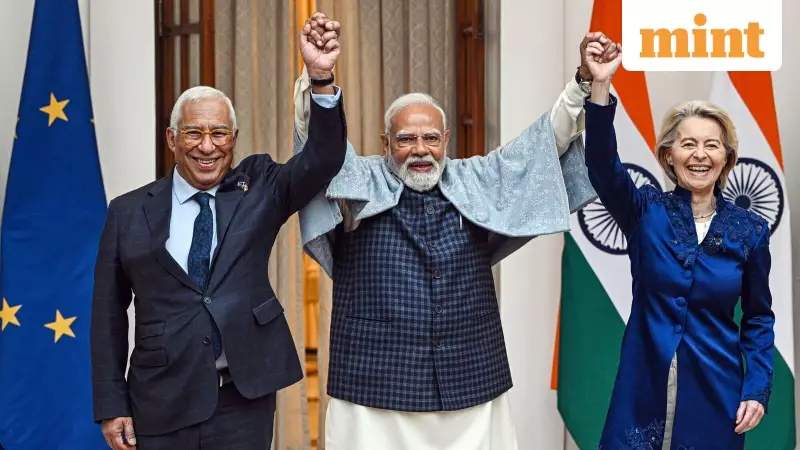
The India-EU trade agreement represents a strategic alignment between two major economic regions, with Prime Minister Narendra Modi highlighting its potential to strengthen India's manufacturing and services sectors while boosting investor confidence. As implementation processes proceed toward the 2027 target, automotive manufacturers will continue refining their strategies to leverage both import flexibility and manufacturing advantages within the new trade framework.