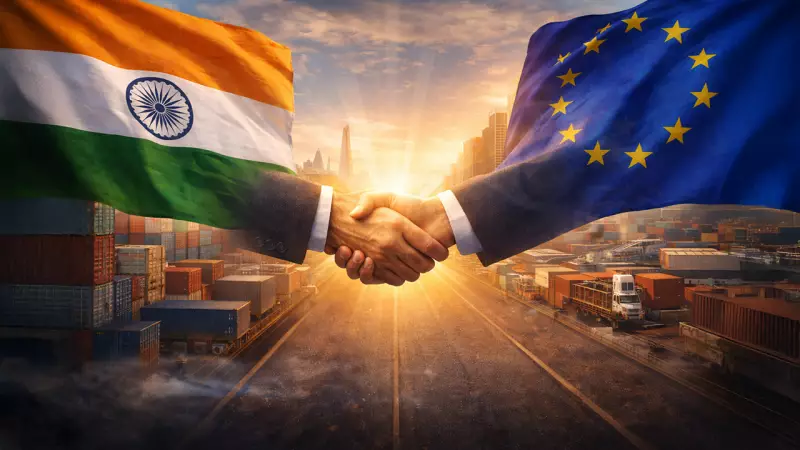
In a historic development for global commerce, India and the European Union have successfully finalized their long-awaited Free Trade Agreement (FTA) on Tuesday. This monumental pact, often referred to as the 'mother of all trade deals', marks the culmination of negotiations that spanned nearly eighteen years.
A New Era in India-EU Economic Relations
The agreement now awaits the completion of legal formalities and approval from the European Parliament before it can be officially signed into effect. This FTA arrives at a crucial juncture characterized by heightened global trade uncertainty, largely driven by tariff threats from US President Donald Trump.
The European Union stands as India's largest trading partner when considered as a bloc, while the United States remains India's biggest single-country trading partner. The prolonged negotiations faced significant hurdles due to the EU's firm positions on various non-trade concerns, but momentum accelerated recently in response to the shifting international trade landscape.

Strategic Importance and Leadership Perspectives
Prime Minister Narendra Modi welcomed the conclusion of the pact with profound significance, stating, "This is not just a trade agreement. It is a new blueprint for shared prosperity." His words underscore the transformative potential this agreement holds for both economies.
European Commission President Ursula von der Leyen emphasized the broader implications, declaring, "We have created a free trade zone of two billion people, with both sides set to benefit...We are not only making our economies stronger — we are also delivering security for our people in an increasingly insecure world."
Key Provisions and Tariff Reductions
The comprehensive agreement spans twenty-one chapters and covers extensive ground beyond mere tariff reductions:
- Tariffs will be progressively eliminated on approximately 96% of exports measured by value, though sensitive sectors including cereals and dairy products have been excluded from the pact
- The European Union will gradually open 99.5% of its market over seven years, with 90.7% of goods moving to zero tariffs immediately upon implementation
- India will liberalize 30% of its market when the agreement takes effect, followed by phased openings at three, five, seven, and ten-year intervals, eventually removing duties on 96% of goods by trade value
Benefits for Indian Export Sectors
Several key Indian industries stand to gain significantly from this agreement:
- Textiles and garments will receive duty-free access to EU markets, helping India compete more effectively against Bangladesh, which currently enjoys a 12% duty advantage
- Marine products, leather, and footwear sectors will benefit from reduced trade barriers
- Gems and jewellery, toys, and sports goods manufacturers will gain enhanced market access
Consumer Benefits and European Access
For Indian consumers, the FTA promises lower prices on various imported goods:
- Premium cars priced above ₹25 lakh will see tariffs reduced from over 100% to as low as 10%
- Chocolates, olives, wine, vodka, and beer will become more affordable
- These concessions will apply to capped quantities annually and be implemented gradually
An official noted that "small cars, the bulk of the market, have been protected" in the negotiations, ensuring domestic manufacturers retain competitive advantages in this crucial segment.
Broader Economic Implications
The agreement arrives as both India and the EU pursue diversified trade strategies. India has recently concluded trade pacts with the United Kingdom, New Zealand, and Oman, while the European Union has established agreements with partners including the Mercosur bloc in South America, Indonesia, Mexico, and Switzerland.
This reflects a global trend toward reducing reliance on the United States, which many nations now view as an increasingly unpredictable trade partner. The India-EU FTA is expected to provide substantial boosts to exporters on both sides as they seek to diversify markets and minimize exposure to global trade volatility.

Services, Investment, and Additional Provisions
Beyond goods, the agreement encompasses significant services components:
- The European Union has committed to opening 144 of its 155 service sub-sectors
- India will grant access in 104 service sub-sectors
- The pact includes visa relaxations for students, including opportunities for post-study employment
European companies will gain enhanced ability to establish manufacturing operations in India and export their products while benefiting from zero-duty access across numerous product categories. This development is expected to provide fresh momentum to India's Make in India initiative.
Comprehensive Coverage and Safeguards
The agreement addresses multiple critical areas beyond traditional trade matters:
- Intellectual property rights protections
- Labor standards and sustainable development provisions
- Rules of origin specifications
- Special considerations for small and medium enterprises
- Safeguards linking certain liberalization elements to social security agreements with individual EU member states
Currently, the European Union accounts for approximately 17% of India's total exports, a percentage expected to grow significantly following implementation of this landmark agreement. The FTA represents not merely a commercial arrangement but a strategic partnership that could potentially double bilateral trade volumes while creating new economic opportunities for nearly two billion people across two of the world's most significant economic regions.