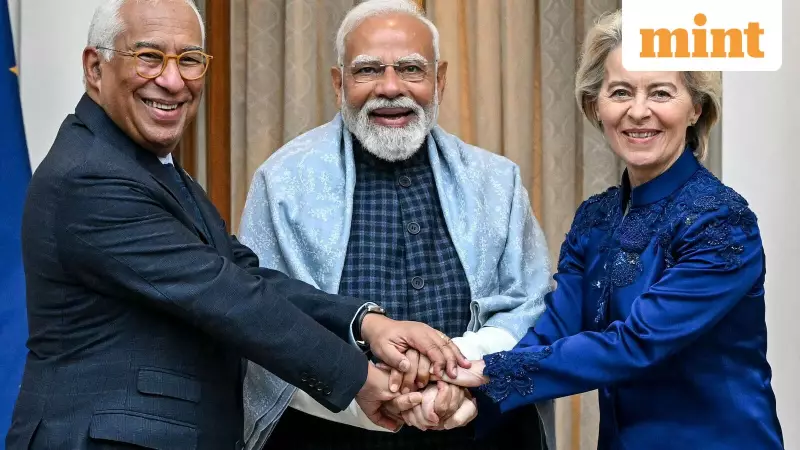
India-EU Free Trade Agreement Finalized: A Strategic Milestone for Indian Economy
India's landmark Free Trade Agreement with the European Union, officially finalized on January 26, 2026, represents one of the most significant trade alliances in contemporary global commerce. This comprehensive pact connects economies that collectively account for nearly 25% of the world's GDP and approximately 33% of global trade flows, creating a formidable economic partnership with far-reaching implications.
Economic Significance and Market Implications
The India-EU agreement is poised to accelerate India's integration into global supply chains while substantially strengthening the nation's long-term export competitiveness. For Indian stock markets, this development carries undeniably positive implications, enhancing India's strategic positioning within an increasingly fragmented global trade landscape. The agreement provides tariff-friendly access to the world's largest trading bloc, opening new avenues for economic growth and market expansion.
However, financial experts emphasize a crucial distinction: the India-EU pact should not be viewed as a substitute for a potential India-United States trade agreement. This differentiation carries material implications for sectoral earnings, capital flows, and overall market valuations that investors must carefully consider.

Expert Perspectives on Trade Dynamics
V K Vijayakumar, Chief Investment Strategist at Geojit Investments Limited, highlighted the asymmetric nature of India's trade relationships, noting that India's trade surplus with the United States stands at approximately $45 billion, compared to roughly $25 billion with the European Union. "India's FTA with the EU represents a major breakthrough in international trade relations," he stated, "but it should not be perceived as a replacement for an India-US trade deal."
Vijayakumar further pointed out that the EU agreement is expected to become fully operational only in early 2027, suggesting a staggered implementation timeline rather than immediate market impact. This phased approach means benefits will accumulate gradually rather than creating sudden market disruptions or immediate valuation changes.
Sectoral Benefits and Market Diversification
From a market perspective, the India-EU agreement strengthens economic diversification rather than creating dominance in any single direction. Bilateral trade between India and the European Union already exceeds $135 billion annually, and the new pact aims to liberalize tariffs across 90-95% of traded goods over time.
Several key sectors are positioned to gain incremental access to European markets, including:
- Textiles and apparel
- Leather and footwear
- Marine products
- Gems and jewellery
- Engineering goods
- Automobiles and components
This expanded market access is expected to improve export volumes while enhancing supply-chain resilience for Indian manufacturers.
Economic Analysis and Competitive Considerations
Rajani Sinha, Chief Economist at CareEdge Ratings, believes the agreement will materially benefit India's labour-intensive sectors and services exports. "The pact facilitates improved professional mobility, enhanced digital services access, and deeper participation in global value chains," she explained. However, Sinha also cautioned that increased market access will expose domestic players to more intense international competition, making execution excellence and cost efficiency critical factors for listed companies seeking to capitalize on these opportunities.
Despite the European Union's economic significance, American markets remain structurally more important for Indian equity markets. The United States offers deeper consumption demand, faster scaling opportunities, and superior pricing power for Indian exporters. This distinction proves particularly relevant for sectors carrying substantial weight in benchmark indices, including:
- Information technology services
- Pharmaceuticals and healthcare
- Speciality chemicals
- Automotive components
These industries are closely monitored by global investors and significantly influence market performance.

Strategic Design and Long-term Implications
Vikas Gupta, CEO and Chief Investment Strategist at OmniScience Capital, highlighted the agreement's dual nature. "While the EU deal expands market opportunities," he noted, "it also serves a distinct strategic purpose by providing alternative markets for products traditionally exported to the United States." The agreement helps hedge against US tariff uncertainty but doesn't replicate the earnings intensity or market depth that American exposure provides to Indian corporations.
Adding further perspective, Munjal Almoula, Managing Partner – Tax & Regulatory Advisory at BDO India, emphasized the pact's sophisticated architecture. "The India-EU FTA is structured as a 'living agreement,' incorporating provisions for digital trade, advanced manufacturing collaboration, and sustainability mechanisms," he explained. This forward-looking design enhances long-term competitiveness but also explains why benefits will accumulate over multiple years rather than triggering immediate market rerating.
Investment Implications and Portfolio Strategy
For investors, the key takeaway requires nuanced understanding. The India-EU trade deal strengthens India's long-term structural growth narrative, supports export-oriented manufacturing initiatives, and reinforces the China-plus-one diversification theme. Over time, these factors can translate into steadier earnings growth and improved global positioning for select sectors.
However, markets should avoid conflating strategic diversification with economic substitution. The United States remains India's most critical trade partner from an equity-market perspective, and any progress on an India-US trade deal would likely generate sharper and more immediate impacts on earnings upgrades, foreign institutional inflows, and overall market sentiment.
In essence, while Brussels matters significantly for India's trade future, Washington continues to move Dalal Street more decisively. The India-EU agreement represents a powerful complement to existing trade relationships, not a replacement, and investors would benefit from positioning their portfolios with this crucial distinction firmly in mind.