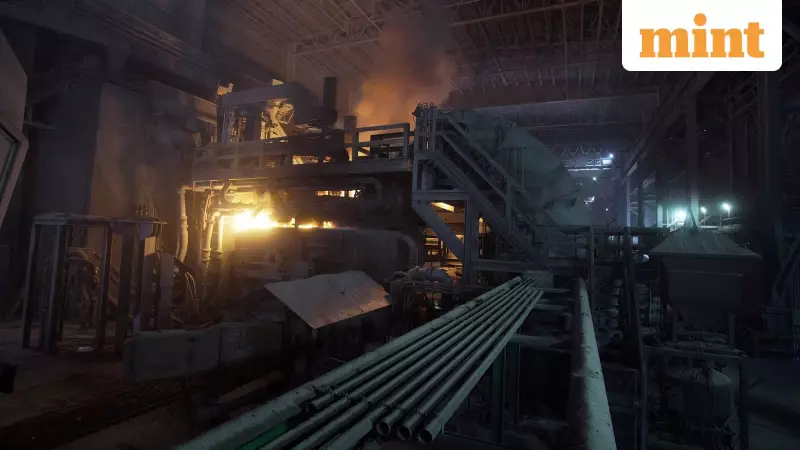
The recently concluded free trade agreement (FTA) between India and the European Union (EU) holds significant promise for Indian steel manufacturers, particularly through preferential treatment under the bloc's carbon tax framework. This development could potentially unlock new export opportunities for domestic steelmakers who have traditionally focused on the vast local market.
Carbon Tax Concessions: A Gateway to European Markets
Europe is implementing the Carbon Border Adjustment Mechanism (CBAM), which will impose surcharges on imports from highly polluting industries including steel, aluminium, cement, and fertilizers. While the scheme became operational in January, actual levies will only commence later in 2026. Steel represents the only sector within CBAM's scope where India maintains substantial exports to Europe.
Indian officials revealed during a Tuesday press briefing that both trading partners have agreed to establish a technical dialogue to explore preferential access for Indian manufacturers under the CBAM framework. They are also examining the possibility of allowing computation of credits accumulated under a future Indian carbon trading system, with outcomes expected within six to eight months.

European Commitments and Indian Advantages
Commerce and Trade Minister Piyush Goyal emphasized the EU's commitment to providing India with "very preferential treatment as an FTA partner" that would surpass arrangements with non-FTA countries. European negotiators have further promised India automatic access to any preferential agreements the EU strikes with other trading partners.
While India's steel exports remain modest compared to domestic production, Europe has consistently been the largest export destination. Data from commodities market intelligence firm BigMint reveals that the trading bloc accounted for 40% of India's 8.6 million tonnes of steel exports in 2025. This contrasts with India's total production of 165 million tonnes during the same year, according to World Steel Association figures.
Export Dynamics and Industry Perspectives
Naveen Jindal, Chair of Jindal Steel Ltd and President of the Indian Steel Association, highlighted the trade imbalance: "The Indian industry exports 3 to 4 million tonnes of steel annually to the EU, while EU exports to India stand at around 0.3 to 0.4 million tonnes. As the quota review takes place, New Delhi can reasonably expect a higher allocation."
Hemant Dewangan, Assistant General Manager for Steel Operations at BigMint, noted that while specific concessions under CBAM remain unclear, Europe already represents a favored destination for Indian steel exports. "If Indian mills get any concessions like higher quotas or lower duties under the framework, it will help in expanding the trade," he observed.
Minimal Import Concerns from European Steel
India has offered to eliminate the 22.5% duty on steel imports from Europe as part of the FTA. However, this concession poses little competitive threat to domestic manufacturers since Europe exports only trace quantities of specialty steel to India—less than 1% of the country's annual consumption of approximately 160 million tonnes.
Dewangan explained the market reality: "Steel made in Europe sells at a high premium to that in India, so even if there is no import duty, it will be difficult for European mills to find buyers in India for normal grades of hot-rolled coil and cold-rolled coils."
Potential Shifts in Specialty Steel Procurement
Suman Kumar, Assistant Vice-President for Metals and Mining at brokerage Philip Capital, suggested that duty reduction might lead to increased procurement of specialty steel from certain EU countries that India currently imports from Japan, South Korea, and China.
The Real Concern: Automotive Imports
Niladri N. Bhattacharjee, Partner and Metals and Mining Industry Leader at Grant Thornton Bharat, identified a more significant concern for Indian steelmakers: "A real concern for Indian steelmakers isn't the import of steel from Europe, but the import of cars."

With India's domestic market for automotive-grade steel exceeding 15 million tonnes annually, Bhattacharjee warned: "As India cuts import duty on vehicular imports from the EU, a small but growing part of this steel production, which goes into the higher-end car market, might get substituted by direct luxury car import from EU nations. The quantum and the period over which this impact will remain need to be seen."
The India-EU FTA thus presents a complex landscape for the steel industry—offering potential export expansion through carbon tax concessions while creating nuanced challenges through automotive import provisions that could indirectly affect domestic steel consumption patterns.