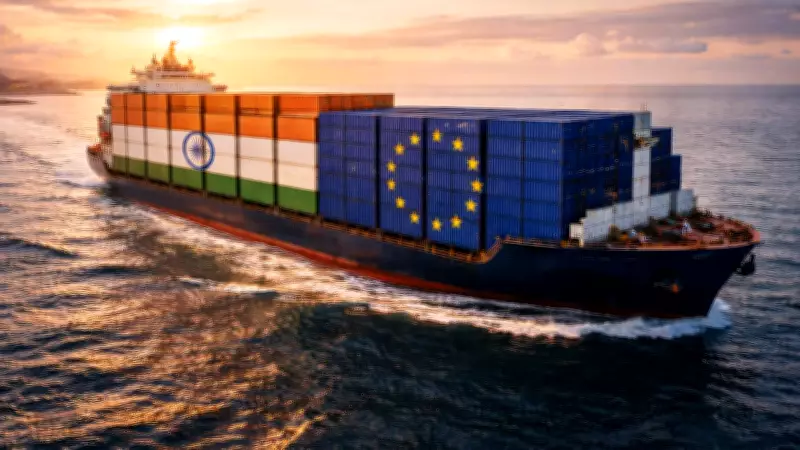
India-EU Free Trade Agreement Finalized: Turkey's Access Question Remains Unanswered
India and the European Union have recently announced the successful conclusion of negotiations for what is being described as a landmark free trade agreement, often referred to as the "mother of all deals." This significant development marks a new chapter in bilateral trade relations, but it has raised a crucial question regarding third-party access: will Turkey be able to reroute its goods to India under this new agreement?
Official Clarification on Turkey's Exclusion
Officials have provided clear clarification on this matter, stating that while Indian products can move into Turkey through European channels, Turkish goods cannot enter India under the FTA terms, even if they are shipped via EU ports. One anonymous official explained, "Our goods go into the EU, and then they can go to any country with which the EU has a customs union, but Turkey will not get the benefit because it is not part of the EU as a territory in the FTA. So, Turkey cannot export to India and benefit from concessions."
The EU-Turkey Customs Union Dynamics
Under the EU-Turkey Customs Union, which has been operational since 1996, Ankara is obligated to align with the EU's common external tariff. This means that when the EU reduces duties for an FTA partner like India, Turkey must extend the same tariff benefit to Indian goods. The arrangement facilitates the free movement of industrial goods and processed agricultural products between the EU and Turkey without tariffs or quotas.

However, this customs union does not extend to several key areas, including primary agriculture, services, investment, government procurement, or digital trade. More importantly, it does not grant Turkey reciprocal access to India under the new FTA, as Turkey is not a signatory to the India-EU agreement.
Rules of Origin: The Critical Barrier
Ajay Srivastava, cofounder of the Global Trade Research Initiative, emphasized the role of rules of origin in this exclusion. He stated, "Turkish goods, however, cannot use the India-EU FTA to enter India duty-free, even if they are shipped via EU ports. They remain Turkish in origin and therefore do not meet the rules of origin under India's FTA, which is signed with the EU and not with Turkey."
The India-EU FTA, expected to be signed and implemented within the year, will provide preferential market access on 96.8% of tariff lines, covering 99.5% of India's exports by volume and 90.7% by value to the EU, which will become duty-free.
Trade Figures and Bilateral Relations Context
This clarification comes amid strained relations between New Delhi and Ankara, following Turkey's backing of Islamabad and its condemnation of India's strikes on terror camps in Pakistan in May under Operation Sindoor. Trade data reflects this tension, with India's exports to Turkey declining by 14.1% to $5.71 billion in 2024–25 from $6.65 billion in the previous financial year.
Imports from Turkey fell 20.8% to around $3 billion during the same period. Turkey accounts for approximately 1.3% of India's total exports, which stood at $437 billion in 2023–24.
Key Trade Commodities Between India and Turkey
India's exports to Turkey include:
- Mineral fuels and oil
- Electrical machinery and equipment
- Automobiles and parts
- Organic chemicals and pharmaceutical products
- Tanning and dyeing items
- Plastics and rubber
- Cotton, man-made fibres, and filaments
- Iron and steel
Imports from Turkey comprise:
- Marble blocks and slabs
- Fresh apples
- Gold
- Vegetables
- Lime and cement
- Mineral oil
- Chemicals
- Natural or cultured pearls
- Iron and steel
The conclusion of the India-EU FTA represents a significant milestone in global trade, but it underscores the complexities of international agreements and the specific limitations faced by non-signatory nations like Turkey in accessing its benefits.