

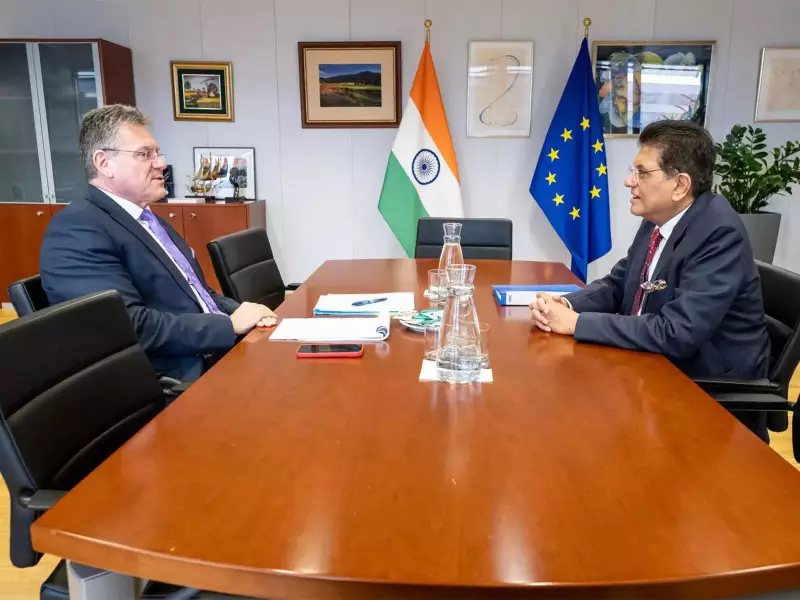
In a significant diplomatic push, India and the European Union have taken concrete steps to reinvigorate negotiations for their long-pending Free Trade Agreement (FTA). The momentum was built during a crucial two-day visit by Union Minister for Commerce and Industry, Piyush Goyal, to Brussels, which concluded on January 9, 2026.
High-Level Talks Chart the Path Forward
During his stay in the Belgian capital on January 8 and 9, Minister Goyal held extensive, high-level discussions with the EU Commissioner for Trade and Economic Security, Maros Sefcovic. The central objective was to break the logjam in the India-EU FTA talks, which have been ongoing for years. Both leaders provided clear directives to their respective negotiating teams to resolve pending issues and accelerate the overall process.
A cornerstone of the dialogue was the shared emphasis on balancing ambitious trade goals with critical domestic priorities. India and the EU jointly underscored that any final agreement must include robust safeguards for farmers and Micro, Small, and Medium Enterprises (MSMEs). Concurrently, the pact is envisioned to facilitate deeper integration of Indian industries into global supply chains, enhancing their competitiveness.

"We reaffirmed our commitment to a rules-based trading framework and a modern economic partnership that safeguards the interests of farmers and MSMEs while integrating Indian industries into global supply chains," Goyal stated in a post on social media platform X, summarizing the outcomes.
Steady Progress Across Key Negotiating Tracks
According to India's Ministry of Commerce, the ministerial dialogue covered several pivotal aspects of the proposed pact. A review of progress across various negotiating tracks—including Market Access for Goods, Rules of Origin, and Services—revealed steady advancement. The discussions reflected a strong political will on both sides to iron out remaining differences through constructive engagement.
The ministry further noted that both parties reiterated the need to finalize a fair, balanced, and ambitious agreement. This final deal must align with shared values, respective economic priorities, and the foundational principle of a rules-based international trading system.
This ministerial engagement was strategically preceded by technical-level talks held on January 6 and 7, 2026. Commerce Secretary Rajesh Agrawal met with European Commission Director-General for Trade, Sabine Weyand, to take stock of progress across all negotiating areas. These official-level meetings aimed to "narrow divergences" and bring clarity to unresolved matters, setting a solid groundwork for the minister's subsequent discussions.
Strengthening Ties with EFTA: A Prelude to Brussels
Before his crucial EU engagement in Brussels, Minister Goyal made a historic visit to Liechtenstein, marking the first-ever trip by an Indian Cabinet Minister to the country. The visit focused on bolstering economic relations under the recently operationalised India-EFTA Trade and Economic Partnership Agreement (TEPA).
Goyal led a business roundtable with senior executives from leading Liechtenstein companies, encouraging them to explore the vast opportunities in India. He highlighted that the India-EFTA TEPA is not merely a trade liberalisation pact but a broader framework encompassing investment, technology collaboration, skill development, and building resilient value chains. He specifically pointed to the $100 billion investment commitment made by EFTA countries (Iceland, Liechtenstein, Norway, and Switzerland) as a transformative opportunity.

As part of the visit, the minister toured the headquarters of the Hilti Group and met its CEO, Jahangir Doongaji. Discussions centered on expanding Hilti's localization efforts in India, increasing value addition, and scaling up global shipments from its Indian operations. Given Hilti's 25-year presence in India's construction sector, talks also veered towards technology collaboration to support safer and smarter infrastructure development, aligning with India's manufacturing and export goals.
Goyal also met Liechtenstein Prime Minister Brigitte Haas to discuss deepening economic and investment cooperation under the TEPA. The leaders explored potential collaboration in skill development, vocational training, and industry-academia partnerships, aiming to synergize India's young workforce with Liechtenstein's advanced industrial expertise.
The back-to-back engagements in Liechtenstein and Brussels underscore India's proactive and multi-pronged trade diplomacy. While the India-EFTA TEPA sets a modern template, the renewed push for the India-EU FTA represents a strategic move to secure one of the most significant trade partnerships for the future, carefully calibrated to protect domestic interests while seeking global economic integration.





