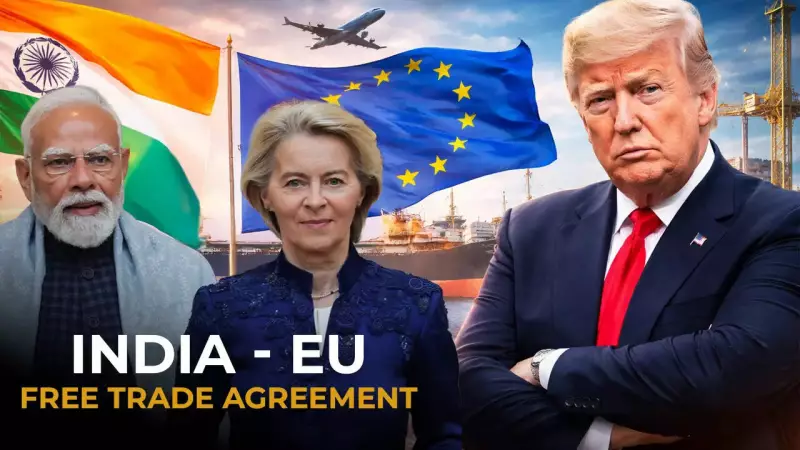
India and European Union Finalize Historic Free Trade Agreement After 18 Years of Negotiations
In a significant diplomatic and economic achievement, India and the European Union have successfully concluded discussions for a comprehensive free trade agreement (FTA), which both sides are describing as the 'mother of all deals'. This landmark pact arrives after nearly two decades of negotiations, marking a crucial breakthrough at a time when the global economy faces turbulence from unpredictable trade policies, particularly those emanating from the United States under President Donald Trump.
A Strategic Response to Global Trade Uncertainties
The push to finalize this agreement gained momentum following the disruption of global trade flows caused by tariffs imposed by the Trump administration on Indian and European goods. Prime Minister Narendra Modi emphasized the broader significance of the pact during a joint press conference with European Council President Antonio Costa and European Commission President Ursula von der Leyen. "This is not just a trade agreement. It is a new blueprint for shared prosperity," Modi stated, highlighting that the partnership would reinforce international stability amidst growing global uncertainty.
He noted that this FTA represents the largest such agreement in India's history, promising to open European markets to Indian farmers and small enterprises, generate fresh opportunities in manufacturing, and deepen collaboration across services sectors.

Economic Impact and Key Figures
The European Union stands as India's largest trading partner in merchandise trade, with two-way goods commerce reaching approximately $136 billion in the year ending March 2025. Services exports from India to the EU have shown remarkable growth, nearly doubling from €19 billion in 2019 to €37 billion in 2024, driven by the expanding footprint of Indian technology firms and outsourcing companies across Europe.
Commerce Minister Piyush Goyal announced that the agreement is expected to come into force in 2026, following expedited legal vetting. "We do hope that we should be able to celebrate the entry into force of this agreement within calendar 2026 itself," he remarked during a special briefing.
US Displeasure and Trade Tensions
Ahead of the FTA announcement, the Trump administration expressed strong displeasure. US Treasury Secretary Scott Bessent criticized the deal, alleging that Europe was indirectly financing the Russia-Ukraine conflict by purchasing refined fuel from India, which is derived from Russian crude oil. Bessent justified the US imposition of 25% tariffs on India for its oil purchases from Russia, directly linking these measures to the timing of the India-EU agreement.
The impact of Trump's 50% tariffs on Indian exports to the US has been severe, with exports declining from $8.4 billion at the start of the financial year to $6.88 billion by December 2025. This represents a nearly 21% drop between May and November 2025, underscoring the challenges faced by Indian exporters in the American market.
Benefits of the India-EU FTA
Once operational, the FTA is set to provide duty-free access for around 93% of India's exports to European markets, while Indian consumers may benefit from lower prices on premium European imports such as luxury automobiles and wines. The agreement covers over 99% of India's exports by value and includes substantial openings in services, supported by a mobility framework for skilled Indian professionals.
Key sectors expected to gain include:
- Textiles and apparel
- Leather and footwear
- Marine products
- Gems and jewellery
- Handicrafts
- Engineering goods and automobiles
The pact will eliminate tariffs of up to ten percent on nearly $33 billion worth of exports, creating a combined market of nearly two billion people and representing about 25% of global GDP.
Expert Insights and Future Outlook
Experts highlight the structural complementarity between the Indian and EU economies. Ajay Srivastava, founder of the Global Trade Research Initiative (GTRI), describes the deal as an example of 'classic FTA economics at work', where tariff elimination acts as a cost-reduction tool rather than causing displacement shocks.

While the FTA is seen as a strategic buffer against US trade frictions, analysts caution that it may not fully offset the impact of Trump's tariffs. Agneshwar Sen of EY India notes that the agreement's value extends beyond tariffs, offering predictable market access and regulatory cooperation. However, he emphasizes that wholesale redirection of trade from the US to the EU is unlikely due to differences in domestic regulations.
Gautam Khattar of Price Waterhouse & Co LLP views the deal as a "strategic expansion of India's global footprint", providing critical diversification for Indian exporters in an era of geopolitical shifts.
Conclusion: Navigating a Challenging Global Trade Landscape
India faces one of the most demanding global trade environments in recent memory, characterized by protectionist policies, softening demand, and climate-related trade restrictions. The India-EU FTA represents a significant step towards preserving market share and fostering export growth. With this agreement, the European Union becomes India's 22nd free trade agreement partner, following recent deals with countries like the UAE, UK, and Australia.
As the world grapples with trade fragmentation, this historic pact underscores India's commitment to strengthening economic ties and enhancing its position in the global value chain.