India and European Union Forge Historic Partnership with Landmark Agreements
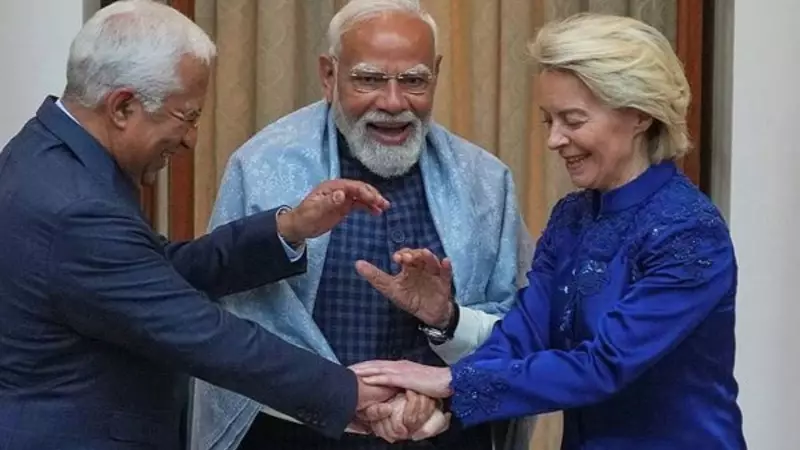
In a momentous development that reshapes global economic and strategic landscapes, India and the European Union have concluded negotiations on a comprehensive Free Trade Agreement (FTA), alongside a security and defence partnership and a mobility framework. Prime Minister Narendra Modi, speaking alongside European Council President António Luís Santos da Costa and European Commission President Ursula von der Leyen, described this as a "new blueprint for shared prosperity."
A Historic Occasion for Democratic Powers
Addressing the gathering, PM Modi emphasized the significance of the day, noting that it marks another historic occasion where the world's two largest democratic powers are adding a decisive chapter to their relations. He highlighted that India has concluded the largest Free Trade Agreement in its history so far, coinciding with the 27th day of the month and involving the 27 countries of the European Union.
"This is not just a trade agreement. This is a new blueprint for shared prosperity," Modi asserted, underlining the broader implications beyond mere commerce. He also referenced the participation of EU leaders as chief guests in India's Republic Day celebrations, calling it a historic moment that underscores deepening ties.

Modi further stressed the shared priority of respect for multilateralism and international norms, stating, "We are in agreement that, to address today's challenges, the reform of global institutions is essential." This remark is seen as an oblique reference to recent geopolitical shifts, including assertive actions by global powers.
EU Leaders Hail the 'Mother of All Deals'
European Commission President Ursula von der Leyen celebrated the achievement, declaring, "We did it. We delivered the mother of all deals." She described the FTA as creating a market of 2 billion people, bringing together the world's second and fourth largest economies in a true win-win fashion. Von der Leyen emphasized that this partnership sends a strong message that cooperation is the best answer to global challenges.
On the economic front, she detailed the benefits:
- Cutting up to 4 billion Euros in annual tariffs for exporters of all sizes.
- Creating good jobs for millions of workers in India and Europe.
- Integrating supply chains and strengthening joint manufacturing power.
- Combining Indian skills, services, and scale with Europe's technology, capital, and innovation to achieve growth levels neither side could attain alone.
Von der Leyen noted that this collaboration reduces strategic dependencies at a time when trade is increasingly weaponized, highlighting the natural complementarity of the two economies.
Enhancing Security and Defence Cooperation
The security and defence partnership marks a landmark departure, establishing a trust-based platform for cooperation on strategic issues. Von der Leyen, drawing on her experience as Germany's former defence minister, outlined key areas of collaboration:
- Maritime security, including joint naval exercises to tackle piracy.
- Countering cyber and hybrid threats, which are growing more sophisticated.
- Space security dialogue, covering situational awareness and secure connectivity.
- Strengthened cooperation on counterterrorism.
She announced the launch of negotiations on a Security of Information Agreement, reinforcing the reliability and trust between Europe and India as partners.
Boosting Mobility and Innovation
On the mobility front, von der Leyen expressed enthusiasm for the agreement facilitating the movement of students, researchers, seasonal and highly skilled workers. She revealed the launch of the first EU legal gateway office in India, serving as a one-stop hub to support Indian talent moving to Europe in alignment with EU member states' needs and policies.
In the realm of innovation, von der Leyen highlighted shared values, such as the freedom of research and science. She announced:

- Work on India's association with Horizon Europe, backed by 100 billion Euros in funding, the world's largest public research programme.
- Establishment of EU-India innovation hubs to foster collaboration among researchers and startups on next-generation technologies.
- Launch of the EU-India startup partnership to boost co-creation and high-potential ventures.
She emphasized cooperation on human-centric, trustworthy artificial intelligence as a prime example of their commitment to progress and technology serving people.
A New Chapter in Bilateral Relations
European Council President António da Costa echoed the historic significance, stating, "Today is a historic moment. We are opening a new chapter in our relations, on trade, on security, on people-to-people ties." He underscored that the summit sends a clear message to the world: as the global order is reshaped, the EU and India stand together as strategic and reliable partners.
Costa, an Indian-origin leader and former prime minister of Portugal, added that this partnership aims to deliver concrete benefits for citizens and shape a resilient global order underpinning peace, stability, economic growth, and sustainable development.
The day's events included leaders paying tribute at Rajghat and proceeding to Hyderabad House for the India-EU leaders' summit, with an evening hosted by President Droupadi Murmu, symbolizing the deepening diplomatic engagement.