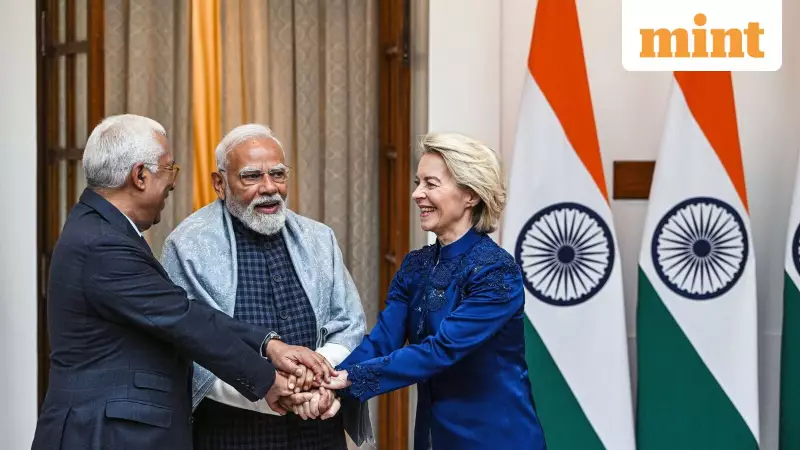
In a significant development for India's economic diplomacy, Prime Minister Narendra Modi on Tuesday, January 27, unveiled a historic trade agreement with the European Union. This landmark free trade agreement (FTA), which the Prime Minister described as the "mother of all deals," culminates nearly two decades of intermittent negotiations between the two economic powers.
A Strategic Agreement Amid Global Trade Tensions
The timing of this agreement is particularly noteworthy as it comes when the global economy is navigating the challenging waters of US President Donald Trump's tariff policies. The India-EU trade deal represents a strategic move to strengthen economic resilience and create new pathways for international commerce.
This comprehensive agreement will enable New Delhi to gradually open its substantial and traditionally regulated market to free trade with the 27-member European Union, which stands as India's largest trading partner. The implications of this development extend far beyond simple tariff reductions, potentially reshaping India's position in global trade networks.

Economic Impact and Export Potential
According to Madhavi Arora, Lead Economist for Emkay Global, the India-EU deal could serve as an effective counter-cyclical buffer by enhancing India's participation in global value chains and expanding market access significantly. "With EU accounting for nearly 17% of India's goods exports, we estimate that a bilateral alignment could lift India's exports to the EU by nearly $50 billion by 2031, led by medium-tech manufacturing," Arora explained.
The economist further elaborated on the broader benefits: "Improved import efficiency and higher FDIs would further support productivity gains and tech transfers, while greater regulatory certainty could aid IT services exports, where the EU already accounts for nearly one-third of demand. We see pharma, textiles, and chemicals as the key beneficiaries to play this theme."
Mitigating US Tariff Pressures
Experts believe this agreement could substantially alleviate the impact of US tariffs and improve overall market sentiment, despite differences in India's export composition to the EU and the United States. Sujan Hajra, Chief Economist and Executive Director at Anand Rathi Group, emphasized the significance of this development: "India-EU trade deal is very significant. The EU is India's single largest trading bloc. Given the current situation—where India is facing elevated tariffs from the US—this deal could have a meaningful positive impact on India's trade outlook."
Hajra pointed to specific sectors that could benefit: "There is considerable overlap in key sectors affected by US tariffs, such as gems and jewellery, marine products, textiles, and garments. To a large extent, this agreement can help mitigate the pain from US tariffs. Moreover, after nearly two decades of negotiations, this deal may also put some pressure on the US to move forward with its own trade discussions with India."
Market Implications and Realistic Expectations
While the agreement represents a long-term positive for the Indian economy and stock market, experts caution that it may not provide immediate momentum to market sentiment, which currently faces pressures from substantial foreign capital outflows, increased geopolitical risks, and mixed third-quarter corporate results.
Market participants observed that to a considerable extent, the India-EU deal had already been anticipated and discounted by financial markets. Consequently, the formal announcement did not trigger a dramatic rally in stock indices. Equity benchmark Sensex reflected this measured response, trading approximately 60 points lower at 81,476 around 2 pm on Tuesday.
The agreement includes provisions that will see approximately 90% of European goods receiving tariff reductions, creating new opportunities for trade expansion and economic cooperation between India and the European Union.