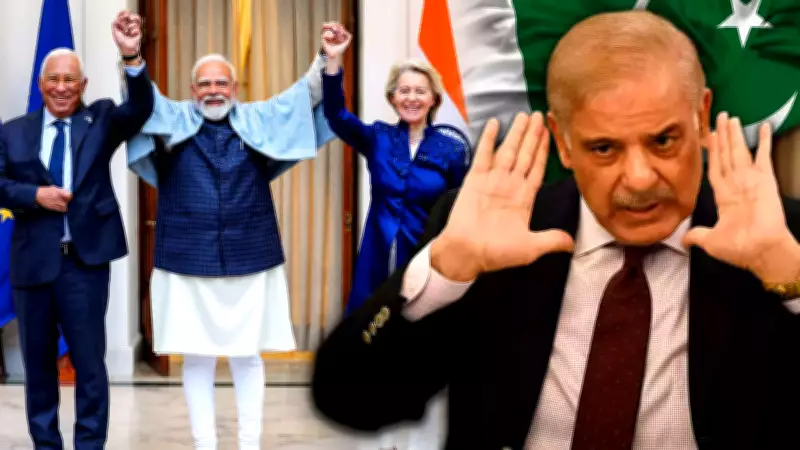
India's Landmark EU Trade Deal Reshapes Regional Dynamics, Puts Pakistan's Export Model Under Pressure
The recently solidified free trade agreement between India and the European Union is rapidly emerging as a pivotal moment in South Asian economic relations, with profound implications for regional trade patterns. This groundbreaking pact, which provides Indian manufacturers with direct, duty-free access to the vast European market, is sending shockwaves through neighboring Pakistan, where the long-standing preferential GSP Plus status is now facing unprecedented challenges.
Pakistan's Textile Sector Confronts Diminishing Competitive Edge
For years, Pakistan's GSP Plus arrangement with the European Union offered a significant tariff advantage, particularly in the crucial textiles and apparel sectors. This preferential treatment created a substantial competitive cushion that helped Pakistani exporters maintain their foothold in European markets. However, with India now securing similar duty-free access through its comprehensive trade agreement, that once-clear advantage is beginning to crumble.
Pakistani officials have been quick to publicly affirm that diplomatic and economic ties with the European Union remain robust and constructive. Behind this official optimism, however, lies growing concern among exporters and industry leaders who recognize that the protective tariff barrier that sustained their competitiveness is rapidly eroding.

Mounting Economic Consequences and Employment Concerns
The timing of this development is particularly troubling for Pakistan's economy, which has already witnessed a noticeable decline in export figures during the current fiscal year. Industry analysts and economic observers are issuing increasingly urgent warnings about the potential consequences of this shifting trade landscape.
Millions of jobs directly and indirectly linked to EU-bound trade now face uncertainty, with the textile industry—a cornerstone of Pakistan's export economy and a major employment generator—standing particularly vulnerable. The sector's reliance on preferential access to European markets has created deep structural dependencies that may prove difficult to unwind or adapt in the face of intensified competition from Indian manufacturers.
Strategic Implications for Regional Economic Power Dynamics
For India, the successful negotiation and implementation of this free trade agreement represents a significant strategic achievement that extends beyond immediate economic benefits. The deal strengthens India's position within global supply chains while enhancing its economic influence on the international stage. By securing preferential access to one of the world's largest consumer markets, Indian manufacturers gain a powerful platform for expansion and diversification.
Conversely, for Pakistan, this development signals an urgent need for economic adaptation and strategic repositioning. As Europe's doors open wider for Indian goods, Pakistani exporters must confront the reality of competing on more equal terms with their regional counterpart. This transition may necessitate substantial investments in productivity enhancement, quality improvement, and market diversification to maintain relevance in the evolving European trade landscape.
The India-EU trade breakthrough thus represents more than a simple bilateral agreement—it serves as a catalyst for broader regional economic realignment, with consequences that will likely reverberate through South Asian trade patterns for years to come.