

India Secures Major Trade Concessions in Landmark US Agreement
India is poised to achieve zero-duty access for merchandise exports valued at approximately $44 billion to the United States, representing nearly half of its total goods shipments to the American market. This significant development comes under the initial phase of the newly announced India–US bilateral trade agreement, as confirmed by Commerce and Industry Minister Piyush Goyal on Saturday.
Strategic Opening with Domestic Safeguards
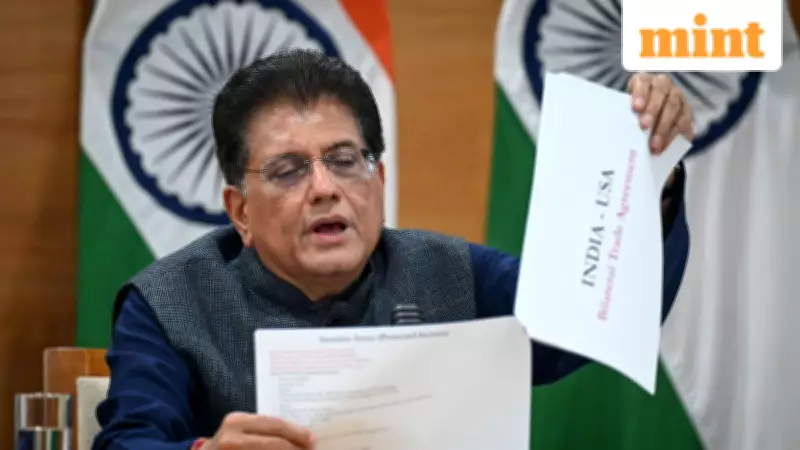
Minister Goyal characterized the pact as a carefully calibrated opening that expands export opportunities while providing comprehensive protection for sensitive domestic sectors, particularly agriculture and dairy. During a press conference to clarify commitments outlined in the White House's joint statement, Goyal emphasized that India has secured carefully crafted exemption lines for numerous products.
Protected agricultural items include:

- Dairy products and soyameal
- Lentils, cereals, and millets (jowar, bajra, kodo)
- Fruits including bananas and strawberries
- Green peas, honey, flowers, and meat products
- Ethanol for fuel blending and genetically modified foods
"Farmers' interests have been fully safeguarded," Goyal asserted, addressing concerns about agricultural imports. Regarding the import of distillers' dried grains with solubles (DDGS), a genetically modified product, the minister clarified that genetic modification characteristics are eliminated during processing.
Tariff Reductions and Immediate Benefits
The United States has immediately removed the additional 25% punitive duty on Indian goods, while under the joint statement, the reciprocal tariff of 25% will be reduced to 18%. Goyal explained that while the 25% duty withdrawal is immediate, the 18% rate is expected to take effect following a fresh order by the US administration, likely next week.
However, sector-specific tariffs imposed under Section 232 will continue at 50% for steel, aluminium, and copper. In auto components, existing 25% tariffs will be eliminated on half the import volume, while the remaining half continues at the same duty level.
Open-Ended Agreement with Future Expansion
The agreement remains open-ended, with discussions set to continue and more products likely to be added or removed through mutual consent as negotiations evolve. "This is the first tranche of the India–US bilateral trade agreement," Goyal stated, indicating further phases will follow.
Once legally concluded, several Indian exports will attract zero duty in the US market, including:
- Aircraft parts and machinery components
- Generic drugs and pharmaceutical products
- Basic auto parts, gems, and diamonds
Smartphones will continue to enjoy zero-duty access, while electronic goods remain exempt under the most-favoured-nation regime at a weighted average tariff of approximately 0.41%.
Labor-Intensive Sector Advantages
Labor-intensive sectors such as textiles, leather, toys, sports goods, and Indian silk products are expected to benefit significantly from reduced or zero duties, enhancing India's competitiveness in the US market. The applicable tariff—either zero or 18%—will become clear after the US issues the executive order implementing the revised tariff regime.
Goyal noted that the marine sector is already "celebrating," citing a 20% increase in seafood exports following improved access to the EU market.
Agricultural Market Access and Regional Benefits
Regarding US agricultural product imports, Goyal stated these items were already imported since the UPA regime, and under the trade agreement framework, certain quotas have been allocated for items like tree nuts and apples. "There is no cause for concern for Indian apple growers. We have protected their interests," he assured.
Gems and diamonds from clusters in West Bengal, Maharashtra, Kerala, and Tamil Nadu are expected to see tariff reductions, supporting regional export economies.

Technology Access and Strategic Alignment
The framework will facilitate access to advanced technologies including AI chips, data centers, aircraft, semiconductors, high-end machinery, and quantum technologies, strengthening India's industrial capacity and national security preparedness.
Addressing domestic industry concerns, Goyal emphasized that "MSMEs, handicrafts, and handloom sectors will not be hurt." He stressed that India's opening in areas like ICT goods represents a strategic necessity, pointing to the income gap between the two nations and the need for affordable access to advanced technologies to maintain global competitiveness.
"Zero duty on smartphones would continue, giving India's smartphone manufacturing ecosystem a sustained edge," he added, noting the agreement would help India gradually move away from restrictive authorization regimes in critical technology imports.
Expert Perspectives on the Agreement
Ajay Srivastava of the Global Trade Research Initiative commented: "This interim deal offers India some tariff relief, but a closer reading shows an uneven exchange, with most permanent concessions flowing from India to the US. Washington has merely rolled back its unsustainable reciprocal tariffs—cutting them from 50% to 18% on about 55% of Indian exports—without reducing MFN tariffs at all."
Bipin Sapra, Partner and Indirect Tax Policy Leader at EY India, observed: "India has given selective concessions on the agricultural side, agreed for purchase of energy products and agreed to lower non-tariff barriers, a US demand for a long time and has in turn secured market access and preferential treatment for the majority of its products including textiles and pharmaceuticals."
The proposed 18% tariff on India would be lower than or comparable to several South and Southeast Asian countries, including Bangladesh (20%), Sri Lanka (20%), and Vietnam (20%), though slightly higher than tariffs faced by Japan (15%) and South Korea (15%).
Trade Data and Future Commitments
India's merchandise exports to the US increased from $77.52 billion in FY24 to $86.51 billion in FY25, while imports rose from $42.20 billion to $45.63 billion, expanding total bilateral trade to $132.14 billion according to official data. Exports remained strong even under high tariffs, reaching $7.01 billion in December 2025 from $6.98 billion in November.
During April-December 2025, exports grew approximately 10% to $65.88 billion, with India recording a trade surplus of $26.45 billion.
India has committed to increasing bilateral trade to $500 billion over the next five years and agreed to procure significant volumes of US energy products, aircraft and aircraft parts, precious metals, technology goods, and coking coal during this period. Both nations plan to substantially expand trade in advanced technology products, including graphics processing units for data centers, and enhance cooperation in critical and emerging technologies.
Industry experts highlighted potential benefits: Suresh Nair, Tax Partner at EY India, noted duty cuts could reduce retail prices for premium nuts, fruits, wines, and soybean oil, making them more accessible to middle-class households. Manoj Mishra of Grant Thornton Bharat pointed to new opportunities for Indian FMCG and food brands in processed food exports.
A. Sakthivel, chairman of the Apparel Export Promotion Council, emphasized that "tariff eliminations and enhanced market access will greatly strengthen the global competitiveness of Indian textiles and apparel sector" while addressing non-tariff barriers and reducing compliance burdens.
Goyal concluded by describing the agreement as "a win-win deal" that benefits India's exporters, manufacturers, and consumers as the trade relationship moves toward greater scale, stability, and mutual trust between the two natural partners in building resilient supply chains.





