

India and Gulf Cooperation Council Launch Historic Free Trade Agreement Negotiations
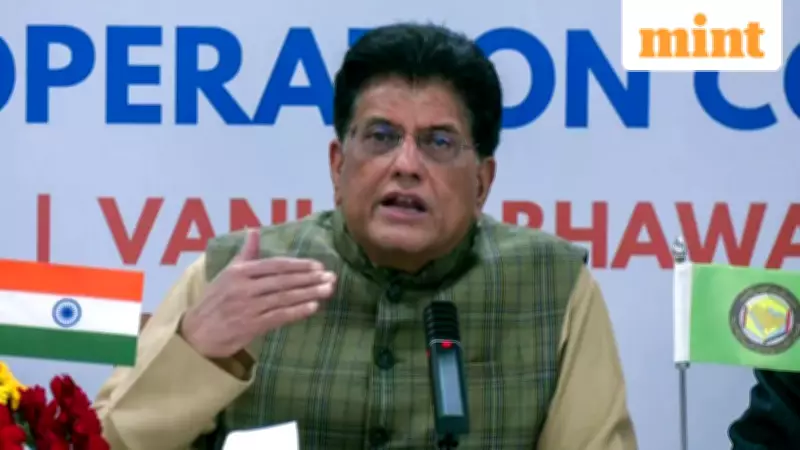
In a landmark development for international trade, India and the six-member Gulf Cooperation Council (GCC) formally launched negotiations for a comprehensive free trade agreement (FTA) on Thursday. The two sides signed the terms of reference (ToR), marking a crucial step toward deepening economic ties at a time of growing global uncertainty and rising trade risks.
Two Decades in the Making: First Round Set for Riyadh
The first round of negotiations for this long-awaited pact, which has been under discussion for nearly two decades, is expected to take place in Riyadh in the coming months. Saudi Arabia has offered to host the talks, signaling the Gulf region's strong commitment to this partnership.
This development comes as India has significantly accelerated its trade diplomacy efforts, signing a series of high-profile agreements with major global economies. Over recent months, New Delhi has successfully concluded FTAs with the United Kingdom, Oman, and the European Union, while also announcing the conclusion of trade deals with New Zealand and the United States.

Strategic Partnership with Expanding Dimensions
Union Commerce and Industry Minister Piyush Goyal emphasized that the agreement would open up new opportunities for Indian goods and services, micro, small and medium enterprises (MSMEs), entrepreneurs, and skilled professionals. Simultaneously, it is expected to attract large-scale investments from the resource-rich Gulf region.
"India's ties with the six GCC countries—Bahrain, Kuwait, Oman, Qatar, Saudi Arabia, and the United Arab Emirates—have evolved into a strategic partnership with expanding economic and geopolitical dimensions," Goyal stated.
The minister explained that together with existing trade arrangements with the UAE and Oman, the proposed GCC FTA would help unlock the full potential of a mutually beneficial economic relationship. Significant gains are anticipated for sectors including:
- Food processing
- Infrastructure development
- Petrochemicals
- Information and communications technology
India's Broader Trade Strategy and Global Signals
Emphasizing India's comprehensive trade strategy, Goyal noted that New Delhi is deepening its engagement with developed economies through a series of trade agreements. These pacts aim to bring predictability, stability, and greater market access for Indian exporters while supporting job creation and economic modernization.
From the Gulf perspective, Raja Al Marzouqui, chief negotiator for the India-GCC FTA, described the launch of talks as a strong signal to the global economy at a time when globalization faces pressure from uncertainty and rising risks.
"It's a message for the whole world. It's a message to be more cooperative. We will contribute to the stability of the global economy," he affirmed.
Substantial Trade Relationship: Numbers Tell the Story
India's trade with GCC nations has remained substantial over recent years:
- 2021-22: Total trade stood at approximately $155 billion, with imports of $110.7 billion and exports of $43.9 billion, reflecting India's significant dependence on the region for energy and raw materials.
- 2022-23: Trade expanded sharply to nearly $185 billion, driven mainly by higher imports from Saudi Arabia and the UAE amid elevated global energy prices. Imports climbed to $133.2 billion, while exports rose more modestly to $51.3 billion.
- 2023-24: Total trade moderated to around $162 billion as commodity prices softened, though India's exports to the region strengthened to $56.3 billion.
- 2024-25: India-GCC trade rebounded to about $179 billion, with imports increasing to $121.7 billion and exports holding steady at nearly $56.9 billion.
The UAE remained India's largest trading partner within the bloc, with bilateral trade crossing $100 billion in 2024-25, followed by Saudi Arabia at approximately $42 billion. Oman, Kuwait, Qatar, and Bahrain together accounted for a smaller but stable share of trade, with Oman showing recovery after a dip in 2023-24.

Expert Analysis: Mutual Gains and Global Integration
Anant Swarup, senior advisor at EY India, highlighted the substantial mutual benefits expected from the agreement: "The signing of the ToR between India and the GCC promises substantial mutual gains; expanded market access for Indian exports, plus Gulf investments in infrastructure and tech, boosting jobs and supply chain resilience."
He further noted that with approximately 9 million Indians already working in the region and contributing to its growth, the proposed FTA will further enhance economic integration between the partners. "Today's development highlights India's proactive global integration, connecting India to nearly all major consuming markets as an open economy," Swarup added.
This strategic move represents India's ninth FTA signed or announced since the National Democratic Alliance government came to power in 2014, demonstrating a consistent push toward broader economic engagement on the world stage.





