

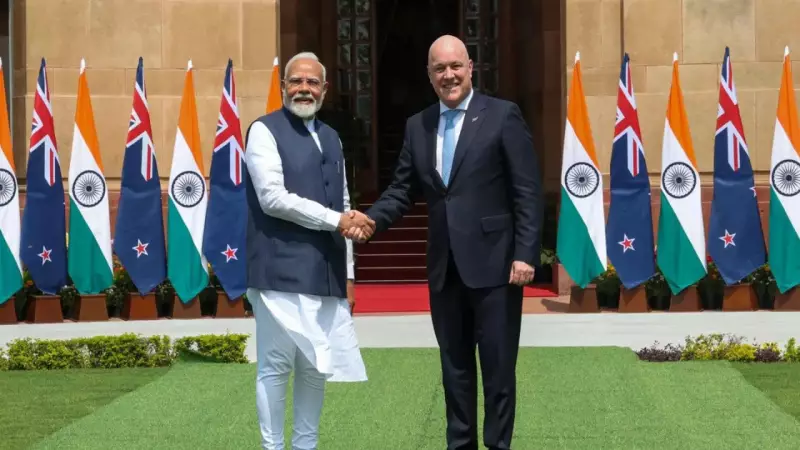
In a significant move to reshape its international trade dynamics, New Zealand is actively looking towards India as a pivotal partner to lessen its heavy economic reliance on China. This strategic pivot was underscored by New Zealand's Trade Minister, Todd McClay, during his recent visit to India, where he engaged in high-level discussions aimed at deepening bilateral economic ties.
New Zealand's Strategic Push for Trade Diversification
The visit, which took place from July 14 to July 17, 2024, was not merely ceremonial. Minister McClay held substantive talks with key Indian figures, including Commerce and Industry Minister Piyush Goyal and External Affairs Minister S. Jaishankar. The central theme was clear: forging a more resilient and diversified trade portfolio for New Zealand. Minister McClay explicitly stated that a stronger economic relationship with India provides his country with "more options" and is a crucial part of their strategy to mitigate the risks associated with over-dependence on a single market, implicitly referring to China.
This approach aligns with a global trend where nations are re-evaluating supply chain concentrations. For New Zealand, China remains its largest trading partner, a relationship that brings prosperity but also strategic vulnerability. The New Zealand government, as articulated by McClay, believes that "the more we can do with India, the better options we have". This isn't about severing ties with Beijing but about building a balanced and secure economic framework for the future.

Building Blocks of a Strengthened Partnership
The discussions between the two ministers covered a broad spectrum of areas ripe for collaboration. A primary focus was on concluding the long-pending India-New Zealand Free Trade Agreement (FTA). While an earlier attempt faced hurdles, both sides have now renewed their commitment. Minister McClay confirmed that officials have been directed to "work quickly" towards this goal, with the hope of presenting a substantial outcome to their respective leaders in the near future.
Beyond the FTA, several sectors were identified as having immense potential for growth. These include:
- Logistics and Supply Chains: Enhancing connectivity and creating robust trade corridors.
- Agriculture and Food Processing: Collaborating on technology and market access for dairy, fruits, and other agri-products.
- Renewable Energy & Green Hydrogen: Partnering on clean energy solutions and technology transfer.
- Space and Digital Economy: Exploring cooperation in satellite technology, cybersecurity, and digital payment systems.
Minister McClay also highlighted the success of Indian companies in New Zealand, such as HCL Tech and Tata Consultancy Services (TCS), as a testament to the existing synergy. He expressed a desire to see this success replicated by New Zealand firms in the vast Indian market.
Implications and the Road Ahead
This strategic outreach holds profound implications for both nations and the broader Indo-Pacific region. For India, it represents a tangible opportunity to expand its economic footprint and position itself as a reliable, large-scale alternative in global supply chains. It strengthens New Delhi's role as a key player in the economic stability of the region.
For New Zealand, diversifying its trade portfolio with India is a pragmatic step towards economic resilience and strategic autonomy. Reducing over-reliance on any single nation, especially one with which geopolitical tensions can arise, is a prudent long-term policy. This move is consistent with the stance of other Western-aligned nations like Australia, the US, and members of the EU, who are also seeking to de-risk their economies.

The path forward, however, requires sustained effort. Concluding the FTA will be a critical milestone that will unlock tariffs and streamline regulations. Both nations must also work on improving physical and digital connectivity and fostering greater business-to-business linkages. If successful, this partnership could evolve into a model of how middle powers can collaborate to build a more balanced and multipolar global trading system, reducing vulnerabilities and creating new avenues for mutual growth.





