India's Pharmaceutical Exports Face Setback, May Miss FY26 Target Amid Geopolitical Turmoil
India's pharmaceutical exports are anticipated to fall short of the ambitious $32 billion target set for the fiscal year 2026, primarily due to the ongoing crisis in West Asia. This assessment was highlighted by Pharmexcil chairman Namit Joshi during the Pharmexcil Chintan Shivir held in Hyderabad. Despite this setback, exports are still expected to surpass the previous fiscal year's performance of $30.47 billion, indicating a resilient yet challenged sector.
Export Growth Slows as Industry Grapples with External Pressures
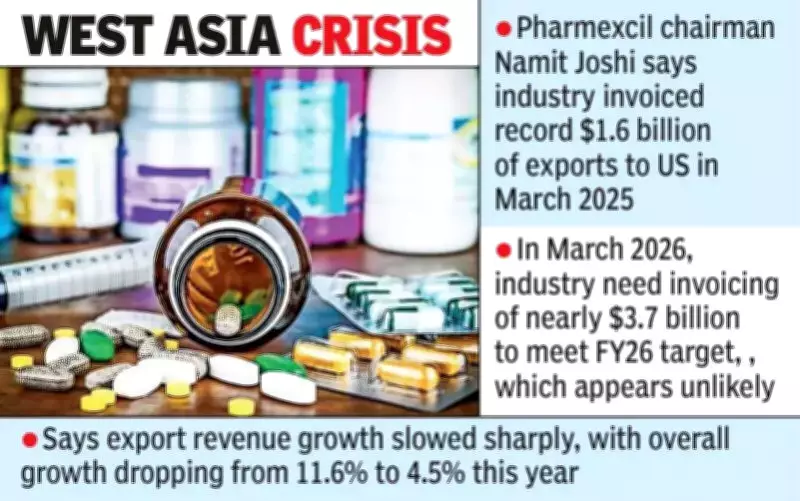
Namit Joshi provided detailed insights into the current export dynamics. He revealed that the industry achieved a record $1.6 billion in exports to the United States in March 2025, a significant spike driven by efforts to beat impending US tariffs that took effect in April 2025. This figure starkly contrasts with the usual monthly average of approximately $800 million, showcasing a temporary boost. However, Joshi cautioned that to meet the FY26 target, the industry would need to invoice nearly $3.7 billion in March 2026 alone, a feat he deemed unlikely given the prevailing conditions.
The overall growth in export revenue has decelerated sharply, dropping from 11.6% to 4.5% this year. This slowdown underscores the impact of geopolitical tensions and market uncertainties. On a positive note, bulk drugs demonstrated stronger performance, with growth increasing from 2.4% to 4.6%, suggesting some segments are weathering the storm better than others.

Resilience Amid Challenges: Sector Shows Moderate Growth
Pharmexcil director general K Raja Bhanu offered a broader perspective on the industry's performance. He reported that despite tariff wars and the persistent West Asia crisis, pharmaceutical exports from April 2025 to February 2026 rose by 5.6%, reaching nearly $28.3 billion. This growth was propelled by key segments including formulations, biologicals, vaccines, and AYUSH products, highlighting the diversity and strength of India's pharmaceutical offerings.
Bhanu also projected an optimistic long-term outlook, noting that the sector, currently valued at around $60 billion, is on track to expand to $130 billion by 2030. This growth trajectory points to significant potential, albeit with current hurdles that need addressing.
Government and Industry Focus on Strategic Shifts for Future Leadership
Commerce secretary Rajesh Agrawal emphasized the need for strategic evolution within the industry. He stated that India's pharmaceutical sector is well-positioned to reinforce its global leadership in a rapidly changing geopolitical landscape. However, he stressed the importance of reducing supply-chain dependencies and advancing toward greater self-reliance to mitigate future disruptions.
Agrawal outlined that India's next phase of growth will depend on moving beyond mere cost competitiveness to establish itself as a global benchmark for quality and reliability. He advocated for a shift from a volume-driven model to a value-driven approach, focusing on higher-value segments such as biologics and biosimilars. This transition is crucial for retaining leadership in the competitive global market.
Opportunities for Innovation and Supply Chain Resilience
Agrawal highlighted India's significant opportunity to lead the next wave of pharmaceutical innovation, building on its legacy in generics. On the government's role, he detailed efforts aimed at easing supply-chain stress, acknowledging that disruptions pose a major challenge. Specific measures include diversifying LPG sourcing and addressing the industry's solvent requirements to ensure stability.
He assured that the government and industry are collaborating closely to implement steps that will ease disruptions, ensuring that supplies of essential drugs remain unaffected. While the supply chain may not return to its previous state entirely, proactive measures are being taken to safeguard critical pharmaceutical outputs.