India's Pharmaceutical Sector Braces for Major Export Losses Amid West Asia Turmoil
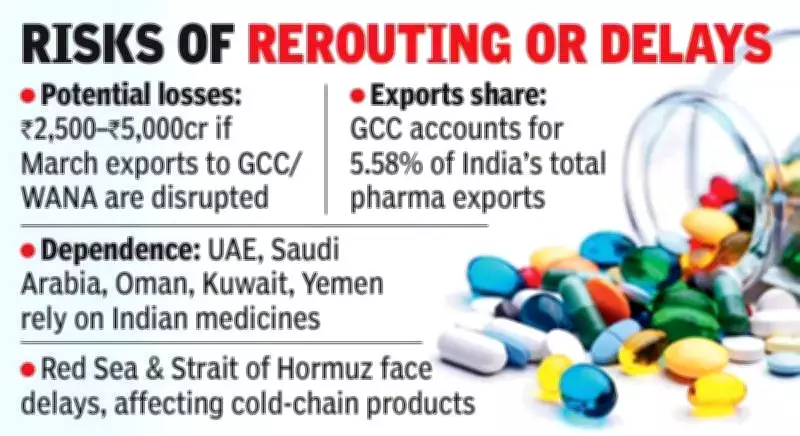
Hyderabad: India's pharmaceutical industry is confronting a severe financial threat, with potential losses estimated between Rs 2,500 crore and Rs 5,000 crore if exports to the Gulf Cooperation Council (GCC) and the broader West Asia and North Africa (WANA) region are fully disrupted in March. This alarming projection comes from the Pharmaceuticals Export Promotion Council of India (Pharmexcil), which cites the intensifying West Asia conflict as a primary driver, exacerbating pressures on freight, shipping routes, and delivery schedules.
Growing Export Dependence and Regional Risks
GCC nations account for 5.58% of India's total exports, with pharmaceuticals emerging as a significant and expanding component of this trade. Recent industry data reveals a notable upward trend: Indian pharmaceutical exports to the WANA region surged from $1,320.44 million in the fiscal year 2020-21 to $1,749.68 million in FY 2024-25. Key markets such as the United Arab Emirates (UAE), Saudi Arabia, Oman, Kuwait, and Yemen heavily rely on India for affordable medicines. Additionally, emerging markets like Jordan, Kuwait, and Libya have shown increasing demand for vaccines, surgical products, and AYUSH formulations, further bolstering India's export growth.
Critical Supply Chain Disruptions and Escalating Costs
However, this positive trajectory is now jeopardized by the ongoing conflict in West Asia, which is severely impacting global logistics. Pharmexcil chairman Namit Joshi highlighted that tensions are disrupting critical maritime and air cargo corridors, including high-risk zones like the Red Sea, Strait of Hormuz, and Gulf corridors. These areas face heightened threats of rerouting or delays, posing a particular concern for temperature-sensitive pharmaceutical products vulnerable to damage from prolonged transit or cold-chain disruptions.

The conflict has already placed considerable strain on the global freight market, with freight charges for both imports and exports doubling in some instances. Joshi emphasized that "the doubling of freight charges for both imports and exports, accompanied by surcharges of $4,000–$8,000 per shipment, is putting immense pressure on Indian pharmaceutical companies." Beyond freight, escalating costs across the pharmaceutical supply chain are a major worry, driven by factors such as crude oil price fluctuations, rising logistics expenses for active pharmaceutical ingredients (APIs) and finished formulations, and shipping delays that could disrupt inventory cycles.
Strategic Responses and Mitigation Efforts
In response to these challenges, Pharmexcil is actively monitoring developments and engaging with logistics and trade stakeholders to implement damage control measures. The council has recommended several strategic actions to mitigate risks:
- Closer coordination with government authorities to explore possible freight relief measures.
- Diversification of shipping routes and adoption of alternative logistics options to ensure continuity.
- Continued dialogue with international regulators to maintain the timely availability of medicines in key markets, safeguarding public health.
As the situation evolves, the Indian pharmaceutical sector remains on high alert, with stakeholders urging proactive steps to navigate the turbulent waters of global trade amidst geopolitical instability.