

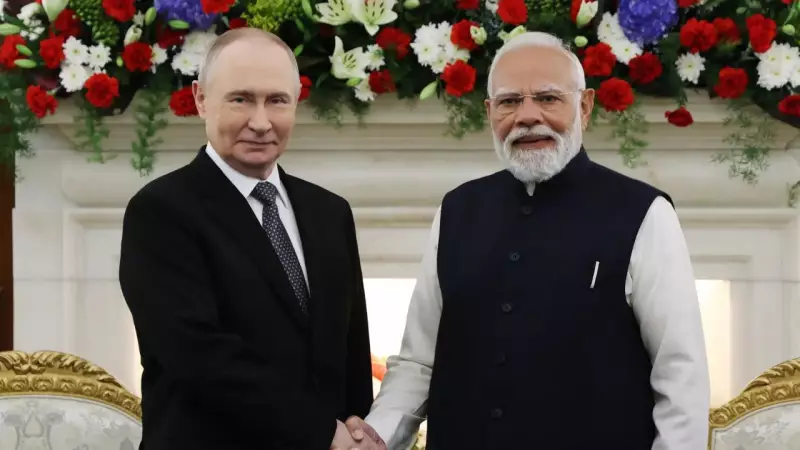
In a significant move underscoring the resilience of their long-standing strategic partnership, India and Russia on Friday charted an ambitious five-year roadmap to substantially enhance economic and trade cooperation. This development comes even as both nations navigate the complex landscape of global geopolitics, marked by Western sanctions and tariffs.
A Shared Vision for Deeper Economic Ties
Prime Minister Narendra Modi and Russian President Vladimir Putin, during the 23rd India-Russia Annual Summit, demonstrated a firm mutual commitment to expanding bilateral engagement across a wide spectrum of sectors. The centerpiece of this commitment is the newly finalized 'Economic Cooperation Programme' extending through 2030. This strategic plan is designed to diversify, balance, and sustain the flow of trade and investment between the two countries.
PM Modi revealed that the two sides are working diligently towards the early conclusion of a Free Trade Agreement (FTA) with the Eurasian Economic Union (EAEU), a move poised to dramatically deepen trade relations. Echoing the ambitious spirit, President Putin announced a shared target to elevate annual bilateral trade to $100 billion, identifying energy collaboration as a foundational pillar of this growth.

A notable shift in financial transactions was also highlighted, with the leaders noting that an overwhelming 96 per cent of bilateral trade is now settled in national currencies—the Indian rupee and the Russian ruble. Efforts are underway to further expand these mechanisms, particularly for using rupees in settlements for Russian exports.
Strategic Agreements Across Critical Sectors
The summit witnessed the signing of an impressive array of intergovernmental and inter-organisational agreements, covering vital areas such as health, food safety, mobility, and critical minerals. PM Modi emphasized the strategic importance of critical minerals for building secure and diversified supply chains, which are essential for clean energy initiatives, high-tech manufacturing, and new-age industries.
President Putin reaffirmed Russia's role as a reliable supplier of key energy resources like oil, gas, and coal. He also expressed Russia's readiness for extensive collaboration in the civil nuclear sector, including on India's largest nuclear power project, the development of small modular reactors, floating nuclear power plants, and non-energy applications of atomic technology in medicine and agriculture.
Boosting 'Make in India' and People-to-People Links
In a major boost for domestic manufacturing, President Putin confirmed Russia's concrete support for the 'Make in India' initiative. This support will translate into the local production of industrial goods and the establishment of joint ventures in manufacturing, machine-building, digital technologies, and other science-intensive fields.
Beyond hard economics, the summit also focused on human capital and employment. PM Modi outlined plans for training Indian seafarers in polar waters, a step that strengthens India's Arctic cooperation while creating novel job opportunities for its youth. The leaders also pinned hopes on the India-Russia Business Forum, scheduled later the same day, to act as a dynamic platform for fostering exports, co-production, and innovation between the business communities of both nations.
Overall, the 23rd Annual Summit provided a comprehensive and forward-looking blueprint to deepen the multifaceted India-Russia partnership, aiming to ensure its growth and relevance despite prevailing global uncertainties and external pressures.






