

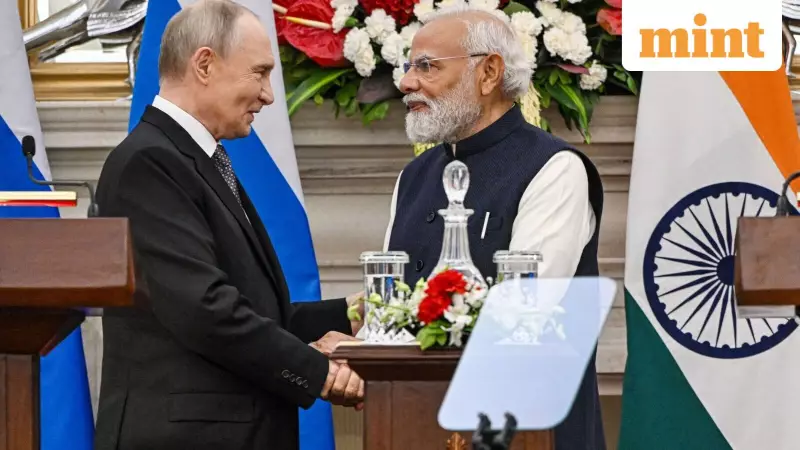
In a significant display of enduring partnership, Russian President Vladimir Putin and Indian Prime Minister Narendra Modi concluded their annual summit on Friday with a sweeping vision to expand and diversify bilateral ties. The leaders agreed to push trade beyond traditional sectors like oil and defence, setting an ambitious target of $100 billion in annual trade by 2030. This strategic pivot comes even as the United States intensifies pressure on New Delhi to reassess its long-standing relationship with Moscow.
Strengthening a 25-Year Strategic Partnership
The 23rd India-Russia summit holds special significance, marking the 25th anniversary of the Declaration on Strategic Partnership signed during Putin's first state visit to India in October 2000. President Putin, on his first trip to a major partner since the Ukraine conflict began, was accorded a ceremonial welcome featuring an honour guard and a 21-gun salute.
The cornerstone of the new roadmap is the finalized economic cooperation programme extending till 2030. This plan aims to drastically diversify mutual business interests. Currently, India accounts for less than 2% of Russian imports, highlighting immense untapped potential. Bilateral trade for 2024-25 stood at a record $68.7 billion, nearly six times pre-pandemic levels. However, a deep trade imbalance persists, with Indian exports amounting to only $4.88 billion. Bridging this deficit through increased Indian exports is a key priority, even as this broadening of ties draws scrutiny from Western nations.

Key Agreements: From Energy to Digital Payments
The summit yielded concrete outcomes across multiple critical sectors:
Energy Security & Nuclear Power: President Putin assured "uninterrupted shipments" of fuel to India, a crucial commitment as New Delhi faces external pressure to curb Russian oil purchases. Russia supplied 36% of India's crude imports in 2024 (approx. 1.8 million barrels per day). In nuclear energy, the nations discussed constructing a second nuclear power plant with Russian reactors, with India committing to allocate a site, reviving talks stalled since 2016.
Trade & Financial Architecture: To ensure smooth commerce, both sides agreed to advance bilateral settlements using national currencies and work on interoperability between payment systems and Central Bank Digital Currency (CBDC) platforms. A major $1.2 billion investment was announced for a joint urea plant with a 2-million-tonne annual capacity, set for completion by mid-2028, securing fertilizer supplies for India.
Defence & Advanced Tech: The partnership is evolving from buyer-seller dynamics to joint development and production of military hardware. Cooperation will also deepen in critical minerals and rare earths exploration and processing. The nations pledged to bolster connectivity via the International North-South Transport Corridor (INSTC), the Chennai-Vladivostok route, and the Northern Sea Route.
A Future-Oriented Roadmap
The newly adopted 2024–2029 India-Russia Cooperation Program provides a framework for collaboration in agriculture, mining, diamonds, pharmaceuticals, and maritime transport, with a special focus on Russia's Far East and Arctic zones.
A suite of agreements was signed, covering:
- Temporary labour mobility and combating irregular migration.
- Cooperation in healthcare, medical education, and food safety.
- Collaboration between postal services and universities.
This comprehensive summit underscores India's strategic autonomy, as it moves to cement a multifaceted, future-ready partnership with Russia while navigating a complex global geopolitical landscape.






