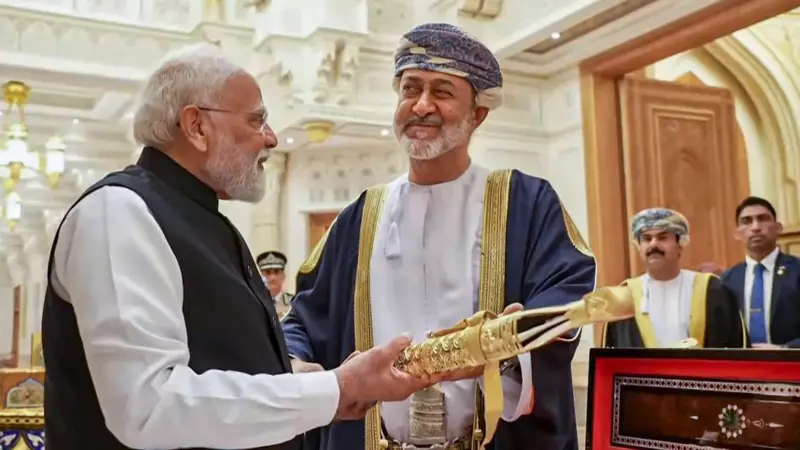
In a significant move to expand its economic footprint in West Asia, India on Thursday signed a comprehensive free trade agreement with the Sultanate of Oman. The Comprehensive Economic Partnership Agreement (CEPA) marks India's second such pact with a Gulf Cooperation Council (GCC) nation, following the deal with the UAE in 2022.
A Historic Blueprint for Shared Future
The agreement was sealed during Prime Minister Narendra Modi's visit to Muscat, where he was also conferred the prestigious Order of Oman by Sultan Haitham bin Tarik for his exceptional contribution to bilateral ties. Addressing the India-Oman Business Forum, PM Modi termed the CEPA a "historic decision" and a "blueprint for our shared future" that would infuse the partnership with new confidence and energy.
"CEPA will create many new opportunities for growth, innovation and employment for our youth," the Prime Minister stated, urging the business community to ensure the agreement moves "from paper to performance." Commerce Minister Piyush Goyal highlighted that this is Oman's first trade agreement in nearly two decades, calling it a defining milestone.

Key Benefits and Market Access
The core of the agreement provides a massive boost to Indian exporters. Oman has offered zero-duty access on 98% of its tariff lines, which official estimates suggest could spur an additional $2 billion in Indian exports in the near term. Sectors set to gain immensely include gems and jewellery, textiles, leather, footwear, sports goods, plastics, furniture, agricultural products, and engineering goods.
In return, India has liberalised tariffs on 77.79% of its own tariff lines, while strategically protecting sensitive sectors. These include various agricultural products like dairy, tea, coffee, rubber, and tobacco, as well as gold and silver bullion and jewellery.
Services Sector and Investment Gains
The CEPA breaks new ground in services trade. Oman has made substantial commitments, notably increasing the quota for Intra-Corporate Transferees from 20% to 50%. It has also extended the permitted stay for Contractual Service Suppliers from 90 days to two years, with a potential two-year extension.
The pact ensures more liberal entry conditions for skilled Indian professionals in sectors like accountancy, architecture, and medical services. Furthermore, it allows for 100% Foreign Direct Investment by Indian companies in major Omani services sectors. Both nations have also agreed to future discussions on social security coordination.
Strategic Implications and Expert Analysis
With Oman's annual imports valued at around $40 billion, and Indian exports to the country having tripled from $2 billion to $6 billion in the last five years, the potential is vast. S C Ralhan, President of the Federation of Indian Export Organisations (FIEO), emphasised that Oman's strategic location makes it a vital gateway to the broader Gulf and African markets, enabling Indian exporters to integrate into regional value chains.
Trade expert Ajay Srivastava of the Global Trade Research Initiative (GTRI) noted that while over 80% of Indian goods already enter Oman at an average 5% duty, the elimination of tariffs on items with duties as high as 100% will improve price competitiveness. Oman's primary gains from the pact lie in energy and industrial inputs, with India importing roughly $6.6 billion worth of goods like crude oil, LNG, and fertilisers from Oman in FY25.
The agreement is bolstered by strong existing economic links, including over 6,000 India-Oman joint ventures and the $969 million Oman India Fertilizer Company (OMIFCO). Alongside the CEPA, the two nations signed five additional pacts covering maritime heritage, agriculture, higher education, food innovation, and maritime cooperation, solidifying a multi-faceted partnership poised for accelerated growth.