

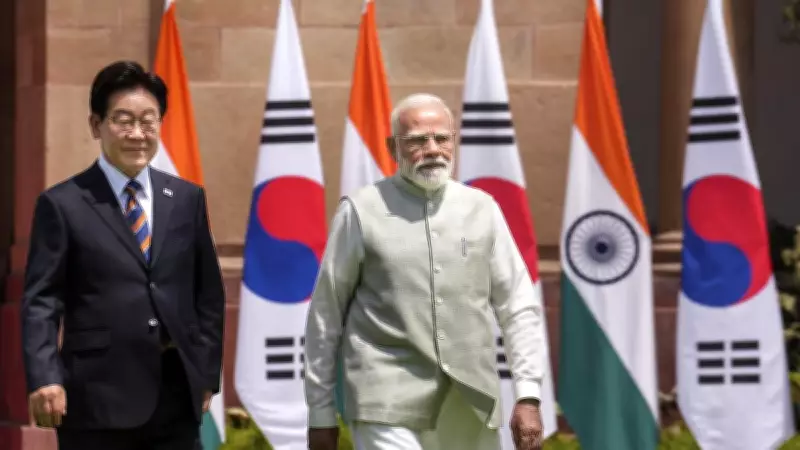
India and South Korea Strengthen Economic Ties with Upgraded Trade Pact
In a significant move to bolster economic cooperation, India and South Korea have agreed to upgrade their existing bilateral trade agreement, with a clear vision to double their trade volume to an impressive $50 billion by the year 2030. This development marks a pivotal moment in the strategic partnership between the two nations, reflecting their shared commitment to fostering robust economic growth and mutual prosperity.
High-Level Talks Between Modi and Lee Jae Myung
Prime Minister Narendra Modi and South Korean President Lee Jae Myung engaged in comprehensive delegation-level talks during President Lee's maiden state visit to India. The discussions, held on April 20, 2026, centered on enhancing bilateral relations across various sectors, with a particular emphasis on trade and investment. Both leaders underscored the importance of deepening economic ties to unlock new opportunities for businesses and consumers in both countries.
The upgraded pact is expected to address key areas such as tariff reductions, market access, and regulatory harmonization, which are crucial for facilitating smoother trade flows. This initiative builds upon the existing Comprehensive Economic Partnership Agreement (CEPA) between India and South Korea, which has been in effect since 2010 and has already contributed to a steady increase in bilateral trade over the years.

Ambitious Trade Targets and Strategic Implications
The goal to double bilateral trade to $50 billion by 2030 represents a bold and ambitious target, signaling a renewed focus on expanding economic engagement. Currently, trade between India and South Korea stands at approximately $25 billion, highlighting the substantial growth potential that both nations aim to tap into. This target aligns with broader economic strategies in both countries, including India's push for increased exports and South Korea's efforts to diversify its trade partnerships in the Asia-Pacific region.
Key sectors identified for enhanced collaboration include electronics, automobiles, pharmaceuticals, and information technology, where both nations possess complementary strengths. By leveraging these synergies, the upgraded pact is poised to drive innovation, create jobs, and boost competitiveness in global markets. Additionally, the agreement is likely to include provisions for cooperation in emerging fields such as renewable energy, digital economy, and startups, further broadening the scope of bilateral engagement.
Broader Context and Future Prospects
This trade pact upgrade comes at a time when both India and South Korea are navigating complex global economic landscapes, marked by shifting trade dynamics and geopolitical uncertainties. By strengthening their economic partnership, the two countries aim to enhance resilience and stability, while also contributing to regional economic integration. The talks between Modi and Lee Jae Myung also touched upon other areas of cooperation, including defense, cultural exchanges, and people-to-people ties, underscoring the multifaceted nature of the bilateral relationship.
Looking ahead, the implementation of the upgraded pact will require concerted efforts from both governments and private sectors to address challenges such as non-tariff barriers and logistical hurdles. However, with strong political will and a clear roadmap, the target of $50 billion in bilateral trade by 2030 appears achievable, promising significant benefits for both nations. This development not only reinforces the strategic partnership between India and South Korea but also sets a positive precedent for other countries seeking to enhance their economic ties in the region.






