

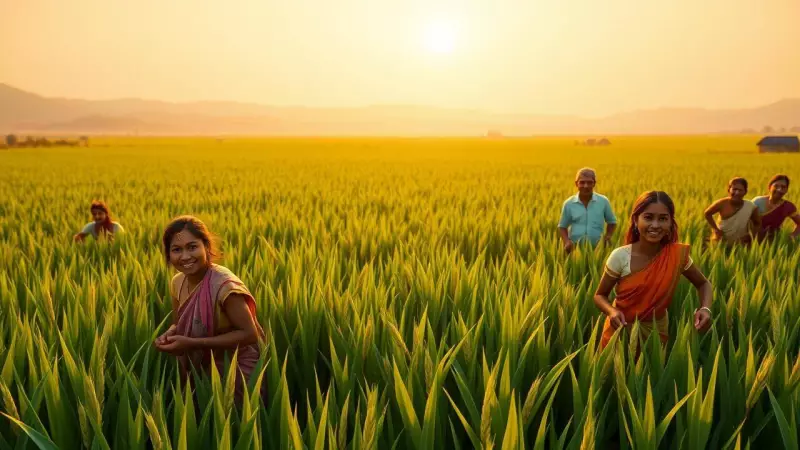
In a landmark achievement for the nation's agricultural sector, India has now claimed the title of the world's largest producer of rice. Union Minister for Agriculture and Farmers Welfare, Shivraj Singh Chouhan, made the significant announcement on Sunday, revealing that the country's output has reached an unprecedented 150.18 million tonnes, thereby surpassing China's production.
A Historic Milestone in Food Production
The announcement came during an event in New Delhi where Minister Chouhan released 184 new varieties of 25 different crops. These have been developed by the Indian Council of Agricultural Research (ICAR). Addressing the gathering, the minister stated that India has achieved "great success" in creating high-yielding seeds, transforming from a nation that once faced food shortages into a key global food supplier. He provided a direct comparison, noting that China's rice output currently stands at 145.28 million tonnes.
Chouhan described this feat as historic and highlighted that India is now actively supplying rice to international markets. He emphasized that the country maintains ample stocks of food grains, which solidifies its national food security. The minister also issued directives to officials to ensure the swift distribution of the newly developed seed varieties to farmers across the country, enabling them to reap the benefits of increased yields and superior quality produce.

New Seeds for a New Agricultural Era
The 184 newly notified crop varieties represent a major push towards modern and sustainable agriculture. The breakdown includes:
- 122 varieties of cereals
- 6 pulses
- 13 oilseeds
- 11 fodder crops
- 6 sugarcane varieties
- 24 cotton varieties, which include 22 Bt cotton types
- 1 variety each of jute and tobacco
These innovations are the result of collaborative work by ICAR institutes, state and central agricultural universities, and private seed companies. A key feature of these new varieties is their climate-resilient nature, coupled with high yield potential and resistance to major pests and diseases.
Building on a Legacy of Seed Development
The release of these varieties adds to a long history of agricultural research in India. Since the official gazette notification process began in 1969, a total of 7,205 crop varieties have been notified. The data reveals an accelerated pace of innovation in recent years: 3,236 high-yielding varieties were approved under the government led by Prime Minister Narendra Modi, compared to 3,969 varieties notified in the period between 1969 and 2014.
Minister Chouhan declared that India has entered a fresh phase of agricultural revolution, driven by these advanced seeds. He urged scientists to concentrate their efforts on enhancing the production of pulses and oilseeds to move the country towards self-sufficiency in these essential commodities.
Supporting this vision, Agriculture Secretary Devesh Chaturvedi informed that seed multiplication rates have been enhanced by 1.5 to 2 times to improve availability. He assured that national and state seed corporations are working to provide quality seeds to farmers at reasonable and affordable prices, ensuring the gains of research reach the fields effectively.






