

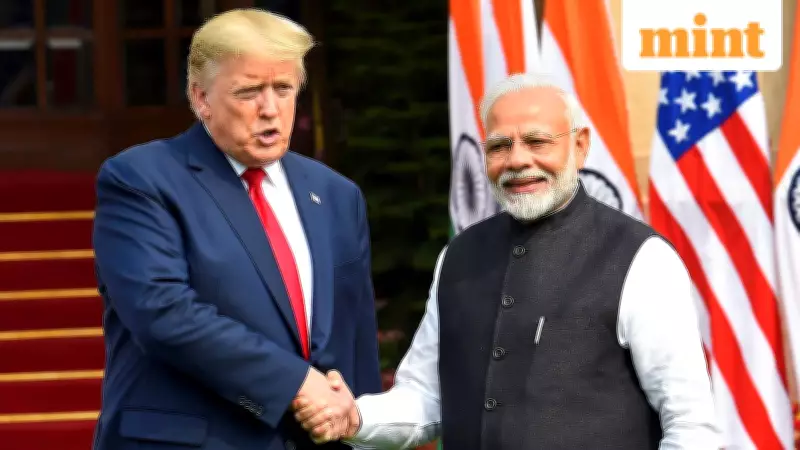
India and US Forge New Trade Pact with Focus on Agricultural Expansion
New Delhi: In a significant development for bilateral relations, India and the United States have formalized a new trade agreement that promises to unlock substantial growth in agricultural trade. This pact emerges despite historical differences over market access and tariff barriers, signaling a mutual commitment to strengthening economic ties.
Tariff Reductions and Reciprocal Concessions
As per the joint statement issued by both nations, Indian exports to the United States will now be subject to an 18% tariff. This marks a steep reduction from the previous 50%, which comprised a 25% reciprocal tariff and an additional 25% punitive duty linked to India’s procurement of Russian crude oil.
In return, India has agreed to cut or eliminate import duties on all US industrial goods and on several key US food and agricultural products. These include:

- Dried distillers’ grains (DDGs)
- Red sorghum used as animal feed
- Tree nuts
- Fresh and processed fruits
- Soybean oil
- Wine and spirits
Dried distillers’ grains (DDGs), often produced as DDGS with solubles, are a nutrient-rich, high-protein co-product of ethanol production derived from fermented corn. The US is one of the world’s largest producers of DDGs, and lower Indian tariffs are expected to make this feed more affordable for India’s livestock and poultry producers. This move could increase competition for domestic feed ingredients such as maize and oilseed meals.
Boost to Indian Agricultural Exports
The tariff reduction is anticipated to significantly enhance the price competitiveness of Indian agricultural exports in the US market. Industry experts believe this will enable Indian farmers to achieve better price realization, particularly for products like rice, seafood, fruits, and processed foods.
In recent years, trade talks had been stalled by market access concerns in the farm and dairy sectors. Key agricultural items from India set to benefit from this deal and be exported to the US include:
- Seafood
- Rice (both basmati and non-basmati varieties)
- Spices
- Dairy products
- Honey
- Processed foods
According to USDA figures, total agricultural trade between India and the US exceeded $6.2 billion in the calendar year 2024, with trade largely favoring India.
Seafood and Rice: Major Export Contributors
India’s key agricultural exports to the US prominently feature seafood, especially frozen shrimp, which constitutes a significant portion of shipments. Exporters note that the US is the largest market for Indian seafood, accounting for 36% of total marine product exports from India. In 2024–25, India exported seafood valued at $2.78 billion.
However, export volumes declined by approximately 6.3% in value terms and nearly 15% in quantity terms during April–November 2025 compared to the same period the previous year. This downturn was attributed to the imposition of the 50% tariff starting August 2025.
In absolute terms, India’s seafood exports fell to 201,501 metric tonnes in April–November 2025 from 236,061 metric tonnes in April–November 2024. Value-wise, exports decreased to $1,720 million from $1,835.46 million a year earlier.
Prior to the tariff reduction announcement on February 2, seafood exports to the US faced a cumulative tariff of 59.7%, including countervailing and anti-dumping duties of 9.7%. This placed India at a disadvantage compared to competitor Ecuador, which encountered a duty of only 19%.
Rice remains a staple export, with basmati being the major variety. During April–November 2025, India exported around 200,000 tonnes of basmati rice, up from 180,000 tonnes in the same period last year. In FY25, India exported 274,000 tonnes of basmati rice to the US, valued at $337 million.
Economic Significance and US Exports to India
This development holds considerable importance as agriculture and allied activities are projected to contribute 15.6% of India’s national income at current prices in FY26. The sector employs 46.1% of the country’s workforce, making it central to India’s overall growth trajectory.

On the other side, total US agricultural exports to India amounted to $2.25 billion in 2024. Major US exports include:
- Tree nuts ($1.12 billion)
- Ethanol ($420.89 million)
- Cotton ($209 million)
- Pulses ($73.4 million)
- Essential oils ($67.2 million)
- Dairy products ($52.65 million)
Farm shipments from the US to India remain smaller than India’s agricultural exports to the US.
Challenges and Government Assurance
Beyond high tariffs, non-tariff measures such as stringent sanitary and phytosanitary standards also limit market access, particularly for sensitive products like dairy and shrimp. This regulatory asymmetry has been a sticking point in negotiations.
With this trade deal, both nations are pursuing mutually beneficial solutions that could further liberalize market access while protecting vulnerable producers. Achieving this balance will require sustained diplomatic engagement and careful trade policy calibration.
Amid opposition allegations, Union Agriculture Minister Shivraj Singh Chouhan emphasized that the deal fully safeguards domestic agricultural interests. He countered claims that increased market access could threaten local farmers, reflecting long-standing concerns in New Delhi about protecting livelihoods for millions dependent on farming. Chouhan reiterated that India’s staple grains, fruits, major crops, millets, and dairy products remain fully protected and face no threat whatsoever.
As India advances toward broader global market integration and the US seeks expanded export opportunities for its commodity producers, agriculture is poised to remain both a potential flashpoint and a key driver of bilateral growth.





