

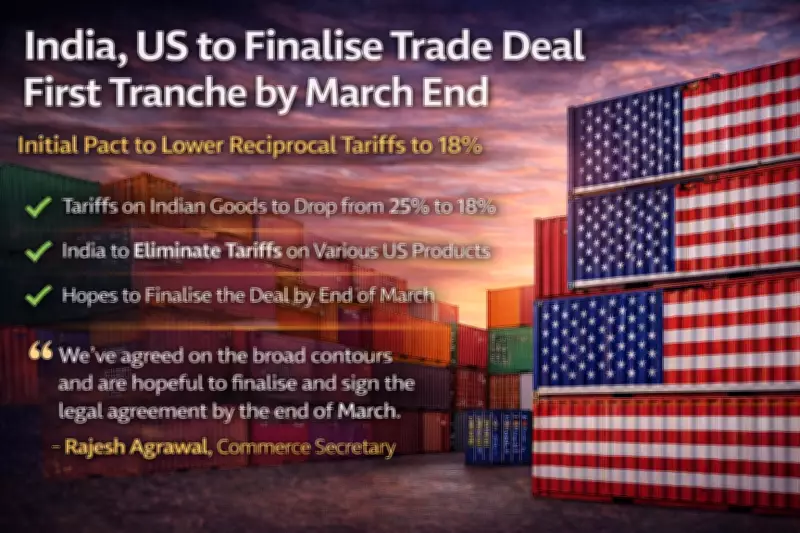
India and US Aim to Finalize Trade Deal Legal Agreement by March-End
Commerce Secretary Rajesh Agrawal announced on Wednesday that India and the United States are on track to sign the first phase of their trade deal's legal agreement by the end of March. This development follows the agreement on broad contours earlier this month, with the signing expected to lower reciprocal tariffs on Indian goods from 25% to 18%.
Key Details of the Interim Agreement
During an interview with ANI at the BIOFACH Germany 2026 trade fair for organic products, Agrawal emphasized the progress in drafting the legal document. He stated, "We expect that by the end of March... we should be able to finalize and sign the legal agreement. However, drafting a legal agreement to the satisfaction of both sides may sometimes take time. But we are hopeful, the teams are working on it, and we should look at March as the timeline in which we should make it operational."
The joint statement released by India and the US outlines the interim agreement's framework, which now needs conversion into a formal legal document. As part of this deal:

- India has agreed to eliminate or reduce tariffs on all US industrial goods and a wide range of American agricultural products, including dried distillers' grains, red sorghum for animal feed, tree nuts, fresh and processed fruit, soybean oil, wine, and spirits.
- The US will apply a reciprocal tariff rate of 18% on Indian goods, covering sectors such as textiles and apparel, leather and footwear, plastic and rubber, organic chemicals, home décor, artisanal products, and certain machinery.
Impact on Tariffs and Trade Dynamics
Washington has already rolled back the additional 25% tariffs imposed on August 27 last year, which were related to India's purchase of Russian oil. The new agreement specifies that, subject to successful conclusion, the US will remove reciprocal tariffs on a wide range of goods identified in the Potential Tariff Adjustments for Aligned Partners. Additionally, the US has agreed to eliminate tariffs on certain aircraft and aircraft parts from India.
International trade expert Ajay Srivastava, Founder of the Global Trade Research Initiative, highlighted potential challenges. He noted that tariff reductions on US fresh fruits like apples and oranges, as well as on soybean oil, could negatively impact Indian farmers and might face opposition from farmer groups. Srivastava also raised concerns about concessions on electronic components, smartphones, and solar panels, which could affect domestic manufacturing in India.
Expert Analysis and Economic Implications
Suresh Nair, a tax partner at EY India, explained that the interim trade deal is likely to make several American farm products more affordable in India. This includes items such as soybean oil, tree nuts, fresh and processed fruits, dried distillers' grains, red sorghum for animal feed, and wines and spirits. By cutting or scrapping tariffs and addressing non-tariff barriers, retail prices for these premium products could decrease, making them more accessible to middle-class households and potentially reducing input costs for food processors and the livestock sector.
On the energy front, Nair mentioned that while the agreement does not directly alter tariffs on oil or energy imports, India's commitment to purchase $500 billion worth of US energy products over the next five years could lead to larger, steadier volumes. This might help stabilize supply and support more competitive pricing in the long term, although retail fuel prices will still be influenced by global markets and domestic policies.
The former trade officer clarified that the US will not reduce regular most favoured nation (MFN) tariffs on any products. Instead, it will only lower reciprocal tariffs currently applied to about 55% of Indian exports to America, bringing them down from 50% to 18%.






