

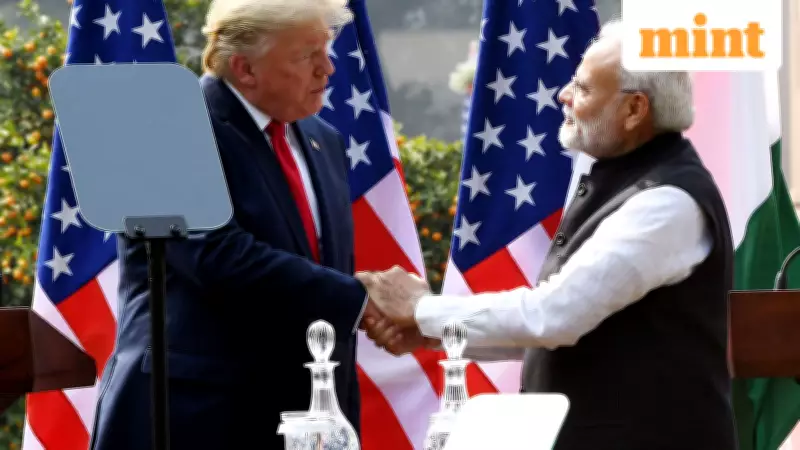
India-US Interim Trade Agreement Fuels Market Optimism and Export Sector Gains
The Indian stock markets are anticipated to commence trading on a higher note this Monday, buoyed by a robust surge in US markets on Friday. This optimistic sentiment follows the release of a joint statement by India and the United States on Friday, February 6, 2026, which detailed a comprehensive framework for the Interim Trade Agreement (ITA). This development comes shortly after the initial announcement of the India-US trade deal earlier in the week.
The ITA represents a pivotal first step toward a more expansive Bilateral Trade Agreement (BTA), providing crucial near-term visibility on tariff structures while laying a solid foundation for deeper and more integrated trade relations between the two nations. For the investment community, this announcement has intensified focus on export-oriented and manufacturing-linked sectors that are poised to benefit significantly from enhanced access to the vast US market.
Key Provisions and Tariff Adjustments
Under the newly established framework, the United States will implement an 18% reciprocal tariff on a select range of Indian goods. This list encompasses textiles and apparel, leather and footwear, plastics and rubber, organic chemicals, home décor items, artisanal products, and certain machinery categories. Concurrently, the agreement outlines the potential for the removal of reciprocal tariffs across a broader spectrum of products, which is expected to substantially improve the competitiveness of Indian exporters on the global stage.

This deal marks a significant shift from the previous era of uncertainty-driven trade headlines to a more structured, rules-based framework. Financial markets typically respond favorably to such clarity, as it enhances earnings visibility and reduces operational risks for businesses engaged in international trade.
From Announcements to Action: Legal Clarity and Commitments
The joint statement provides much-needed legal and policy clarity that was absent from earlier social media pronouncements. According to analysis from JM Financial, Indian exports are set to receive preferential tariff rate quotas for automotive parts and see tariff removals on specific aircraft components. In return, the United States secures tariff reductions across several key sectors, including food and agricultural products. Additionally, India has made long-term commitments involving planned purchases totaling $500 billion over a five-year period.
A crucial development is the legal withdrawal by the United States of the additional 25% ad valorem duty under Executive Order 14329, effective February 7, 2026. The executive order also stipulates that India has committed to ceasing direct and indirect imports of Russian oil while simultaneously expanding its purchases of US energy products. The US retains explicit rights to monitor compliance and re-impose duties if these commitments are not upheld.
India, for its part, has clarified that the agreement involves selective liberalization rather than blanket zero tariffs, thereby tempering expectations of across-the-board duty elimination. Another significant element is the targeting of India’s non-tariff barriers, which include restrictions on medical devices and ICT goods.
While near-term trade visibility has improved meaningfully, experts caution that medium-term risks remain largely policy-driven, dependent on effective execution and ongoing geopolitical developments.
Investment Implications and Sectoral Analysis
The sectoral implications of this agreement are overwhelmingly positive. Electronics exports remain largely unaffected, having already benefited from exemptions under earlier tariff regimes. Incremental beneficiaries from the improved clarity include diamonds and jewellery, textiles, machinery, chemicals, and automobiles, where tariff reductions are expected to materially enhance competitiveness. Pharmaceuticals and aircraft components continue to enjoy near-zero duty access, preserving their strong linkage to the US market.
Axis Securities noted that the agreement enhances earnings visibility and supports valuation re-rating, particularly for export-oriented and capital expenditure-linked sectors. It also reinforces India’s positioning as a relatively safe haven among emerging markets.

"Sustained execution could meaningfully enhance India’s export competitiveness, manufacturing depth, and global integration. Investors should focus on companies with strong US exposure, scalable manufacturing capabilities, regulatory compliance strength, and balance-sheet resilience to fully capture the opportunity," stated Axis Securities in their analysis.
Stocks in Focus: Analyst Recommendations
Axis Securities’ top positive plays within their coverage include Dr Reddy’s Laboratories, Lupin, Aurobindo Pharma, Aarti Industries, Pitti Engineering, Kirloskar Brothers, Welspun Living, Sansera Engineering, Steel Strip Wheels, Infosys, HCL Tech, and LTI Mindtree.
Their non-coverage ideas highlighted as potential beneficiaries are Sun Pharma, Divi’s Laboratories, KPR Mill, Gokaldas Export, Indo Count Industries, SRF, UPL, Bharat Forge, Samvardhana Motherson, Dixon Technologies, Syrma SGS Technology, Sona BLW, LT Foods, and Avanti Feeds.
SAMCO Securities identified a similar opportunity set, naming Goldiam International, Indo Count Industries, Gokaldas Exports, Kitex Garments, Sona BLW Precision, Avalon Technologies, Bharat Forge, KPR Mills, PCBL Chemical, Welspun Living, Apar Industries, and Avanti Feeds as key beneficiaries of the trade agreement.
Disclaimer: The views and recommendations presented above are those of individual analysts or broking companies and not of Bharat Horizon. We advise investors to consult with certified experts before making any investment decisions.





