

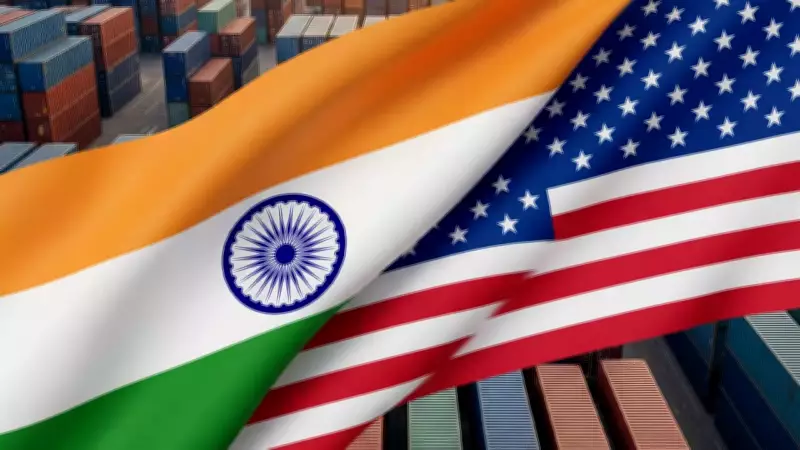
India-US Trade Deal: A Strategic Breakthrough with 18% Tariff Rate
In a surprising diplomatic move, American President Donald Trump and Prime Minister Narendra Modi announced a significant reduction in tariff rates on Indian goods exported to the United States, slashing them to 18%. This development marks a pivotal moment in bilateral trade relations, effectively ending a period of stalemate and setting the stage for normalized economic interactions between two of the world's largest economies.
Ending the Trade Impasse
While a formal trade agreement remains to be signed and final details are being ironed out, this announcement has broken the deadlock that had strained India-US ties. The United States stands as India's single largest trading partner, and the previous imposition of 50% tariffs by the Trump administration had severely impacted Indian exporters. With the new 18% tariff rate, India's exports regain their competitive edge in the American market.
In a post on Truth Social, President Trump highlighted several aspects of the deal, including commitments to halt purchases of Russian crude oil and to procure $500 billion worth of American goods. As specifics of the trade pact continue to emerge, the significance of this agreement for India can be understood through key analytical insights.

Comparative Advantage for Indian Exporters
The 18% tariff rate positions India favorably against its regional competitors and neighboring countries. Key nations that compete with India in labor-intensive global sectors now face higher tariffs: Vietnam at 20%, Malaysia at 19%, Bangladesh at 20%, Cambodia and Thailand at 19%, China at 34%, and Pakistan at 19%. This strategic advantage underscores the deal's value for Indian exporters.
Commerce Minister Piyush Goyal emphasized that India secured a very good deal, surpassing terms offered to competitors. Agneshwar Sen, Trade Policy Leader at EY India, noted that the most significant takeaway is India's transition from a passive, tariff-affected exporter to an active partner with negotiated stakes in the US market.
For India, the deal is less about headline concessions and more about its symbolic and practical implications. With immediate implementation of the new tariff rates, it will first arrest the erosion of exports that India has been experiencing. High tariffs had previously eroded marginal advantages in quality and dependability, but this agreement caps further damage and restores predictability, enabling exporters to plan, price, and retain market share effectively.
Reinforcing India's Supply-Chain Credibility
Sen further explained that the deal strengthens India's reputation as a reliable, lower-risk sourcing alternative at a time when US buyers are seeking to diversify away from China. It also encourages Indian exporters to move up the value chain, fostering scale, compliance, and higher-value manufacturing rather than relying solely on price arbitrage. Ultimately, the agreement not only recovers lost exports but also reanchors India in the US market on a more durable, strategic basis.
Gulzar Didwania, Partner at Deloitte India, highlighted that India has achieved a level playing field in tariff treatment compared to key competitors in South Asia, such as Vietnam, Bangladesh, and Sri Lanka. Unlike earlier scenarios where some countries enjoyed preferential access, India is now broadly aligned within the same tariff bracket, reducing relative disadvantages for its exporters.
Addressing the Russian Oil Question
As part of the trade deal, President Trump claimed that India would cease purchasing Russian oil, redirecting purchases to the United States and potentially Venezuela. However, Russia has stated that it has received no official communication from India on this matter, according to Kremlin spokesman Dmitry Peskov.
Data from Kpler indicates that Russia's share of India's crude imports has already declined, dropping to 33.7% between April and November 2025 from 37.9% in the same period last year. Conversely, the US share increased to 8.1% from 4.6%. In absolute terms, Russian crude imports fell from about 1.8 million barrels per day in November to 1.16 million in January 2026.

Oil Supply Dynamics and Economic Implications
Despite this trend, analysts suggest that the trade deal is unlikely to cause an immediate or sharp reduction in Russian supplies. Sumit Ritolia, Lead Research Analyst at Kpler, noted that Russian volumes remain largely locked in for the next 8-10 weeks and continue to be economically critical for India's refining system, supported by discounts on Urals crude relative to ICE Brent.
Experts predict that Russian imports will remain broadly stable through the first half of 2026–27, with any moderation balanced by higher inflows from West Asia. A recent SBI Research report suggests that India could save nearly $3 billion annually in its crude import bill by shifting some purchases from Russia to Venezuela, provided Venezuelan heavy crude is priced at a discount of about $10–12 per barrel to make the switch commercially viable.
Broad Economic Benefits for India
The India-US trade deal reduces tariffs on approximately 60% of Indian exports to the US, lowering reciprocal duties from 50% to 18%. This is expected to provide a clear boost for exporters while supporting GDP growth and investor sentiment. Sectors such as garments, leather, footwear, carpets, shrimps, and gems and jewelry are poised to benefit as Indian products become more competitive in the US market.
Goldman Sachs estimates an incremental boost of around 0.2 percentage points of GDP if the lower tariffs are enforced, based on India's goods exports exposure to US final demand. Barclays projects that the tariff reduction could add 30 basis points to headline GDP growth, essentially reversing the negative impact of the previous 50% tariffs.
Market and Currency Reactions
The announcement has been met with enthusiasm in financial markets. The Indian stock market and rupee, which had been under pressure due to foreign investor outflows, rallied strongly. The Sensex recorded its fifth biggest single-day gain, increasing investor wealth by approximately Rs 12 lakh crore. Foreign institutional investors led the rally with a net inflow of Rs 5,236 crore in stocks.
The Indian rupee, previously the worst-performing Asian currency, appreciated by 124 paise to 90.27 against the dollar, marking its strongest single-day gain in seven years. Market experts anticipate continued positive momentum as more details of the trade deal emerge.
Protecting Sensitive Sectors
Concerns were raised following Trump's announcement that India agreed to BUY AMERICAN at higher levels, particularly regarding agriculture and dairy sectors. However, Commerce Minister Piyush Goyal clarified that these sectors remain protected, with India successfully ensuring their safeguarding during negotiations. The US trade representative confirmed that while India agreed to cut tariffs on industrial goods to zero from 13.5%, the agriculture segment is still safeguarded.
Agriculture has long been a contentious issue in India-US trade talks, with the US pushing for greater access to India's markets. India's decision to protect this sector is non-negotiable, as it supports the livelihoods of over 700 million people and is crucial for food security. India maintains agricultural tariffs ranging from zero to 150%, while the US imposes steep duties on products like tobacco, up to 350%.
Catalysts for the Deal
The recent conclusion of the India-EU Free Trade Agreement, dubbed the mother of all trade deals, may have spurred the Trump administration into action. According to analyses, this agreement provided a strong impetus for the US to finalize long-lingering negotiations with India. Talks had continued despite the 50% tariffs, with high-level engagements between officials, including the new US Ambassador to India, Sergio Gor, helping to push the deal forward.
Looking Ahead: Details and Caution
While experts and analysts welcome the trade deal as a positive development for the Indian economy, they caution that the fine print needs to be examined to fully understand its implications for various sectors. Commerce Minister Piyush Goyal indicated that a joint statement by the countries will be issued soon.
Historical experiences, such as the US-Korea Free Trade Agreement, show that initial optimism can be tempered by later safeguards and reinterpretations. Additionally, geopolitical tensions can quickly reshape trade outcomes, underscoring the need for careful analysis as details unfold.





